27 February, 2022

Secrets of the Royal Palaces, Episode 8

The eighth and final episode of Secrets of the Royal Palaces was shown on Channel 5 in the UK in the evening of Saturday 26 February, and featured, among much else, Kate Williams talking about Isabella of France and Edward II. Oh dear lord. Where even to start.

The programme begins with a voiceover stating that at Windsor Castle, we will discover "one of England's most ruthless queens", meaning Isabella of France, then we hear Kate Williams claiming "Legend has it that Isabella killed him herself by pushing a red-hot poker up his bottom. What a brutal way to die."

How unutterably, unbearably stupid. Nobody has ever, in the fourteenth century or at any point in the 700 years since, accused Isabella of personally torturing her husband to death by inserting a burning hot metal implement inside him. What 'legend' says she did? That's a flat-out lie; a stupid, easily disproved, sensationalist lie.

It's basically certain that on the night of 21 September 1327 Isabella was in Lincoln, where her and Edward II's son Edward III (not yet fifteen years old) was holding parliament, when her husband was supposedly murdered at Berkeley Castle. Lincoln is 160 miles from Berkeley. There is not one single shred of evidence that puts Isabella anywhere near Berkeley Castle at any point in 1327.

As I've pointed out on numerous occasions, and Ian Mortimer has pointed out on numerous occasions, and other fourteenth-century specialists have pointed out on numerous occasions, it is, again, all but certain that the story of Edward II being murdered by red-hot poker is a myth. 

At thirty-three minutes into the programme, we see an image on screen that says "Isabella, the She-Wolf". Because obviously. Because that stupid hateful name, given to Isabella by the poet Thomas Gray in 1757, 399 years after her death, is never ever going to die, is it. 

"Edward's love for Piers means he snubs his wife." Having stated two seconds earlier that Isabella was *twelve* years old. Because obviously it would have been far better for a man in his twenties to fawn all over a girl who was barely pubescent.

"He gives Piers half her dowry of jewels." Of course, the tedious old tale invented by Agnes Strickland in the nineteenth century, endlessly repeated by lemmings who can't be bothered to look at primary sources and check that this story is nonsense.

"Soon Edward is back on the prowl for other men" after the barons "bump Piers off". Odd way of talking about Edward's relationships with men, as though he was some kind of predator. I'm pretty sure that wasn't the dynamic.

Edward "began showering titles and money on" Hugh Despenser the Younger. This is a frequently-repeated claim, and it's also untrue. Edward didn't give Hugh a single title. Hugh was lord of Glamorgan by right of his wife Eleanor de Clare, who inherited the lordship from her brother. His father was made earl of Winchester in 1322, but Hugh wasn't.

Isabella was "admired by everyone except her husband." So we'll just merrily skip over the decade and a half when they were happily and affectionately married then.

"Isabella starts her own affair with Roger Mortimer." Ah yes, the usual modern narrative of Isabella of France's life, where she's turned into this bored, sexually frustrated housewife who seeks revenge on her philandering husband in the most simplistic tit-for-tat way possible by taking a lover. All the complexities of the situation, the war against France, the Contrariant rebellion and its aftermath, Isabella as the mediator, intercessor and powerful politician that she so undoubtedly was, all of this is entirely ignored in favour of turning her into a character from a soap opera who apparently thinks "Right, I'll bring down a king for the first time in English history because he doesn't give me enough orgasms."

After the invasion of September 1326, we're told that "the queen storms to victory" over images of a battle, which is weird. What battle is that supposed to be?

"It's time for the She-Wolf to get her payback" when Isabella has Hugh Despenser executed. Can. We. Please. Stop. Using. That. Bloody. Word.

Edward abdicates, then we get the bit I mentioned above, "Legend has it that Isabella killed him herself by pushing a red-hot poker up his bottom. And the screams could be heard for miles around. What a brutal way to die." Told with a certain amount of relish, it seems, and Kate Williams was smiling at that point. Yes, a person being agonisingly raped to death really is madly hilarious, isn't it? I wonder if Williams would have smiled if it had been Isabella who had supposedly been murdered in such a vile fashion, or is it only funny when it happens to a gay or bi man? And yet again, the red-hot poker myth is repeated as though it's a certain fact.

"And that's why she was called the She-Wolf." So now we know. Isabella somehow teleported herself 160 miles to Berkeley Castle and murdered the man who was the father of her children, the man she'd been betrothed to since she was three years old, by insertion of a heated metal implement. That wouldn't make her a 'she-wolf' though, would it? It would make her an extremely sadistic, dangerous psychopath. Which I'm pretty sure Isabella actually wasn't. What an utterly bizarre way of portraying her, even in such an overly sensationalist programme.

25 February, 2022

Names, Titles, Styles of Address, Letters in the Fourteenth Century (2)

I wrote a post on this topic all the way back in June 2007 (yowza, that's close to a decade and a half ago now!), and it's had an absolute ton of page views. I've decided it's time to write another one.

In the thirteenth and fourteenth centuries, the children of kings, but nobody else, had the right to be called Lord and Lady from birth. Before his accession to the throne, Edward II was always known as Lord Edward, and after February 1301 was called 'Lord Edward, Prince of Wales' (Dominus Edwardus Princeps Walliae in Latin or (Mon)sire Edward prince de Galles in French), or often just 'the Prince' for short. He was never, however, called 'Prince Edward', an important distinction. Edward's wife Isabella, daughter of Philip IV, king of France and Joan I, queen of Navarre, was 'Lady Isabella' or more correctly 'my lady Isabella' (ma dame Yzabel) before she married Edward, and as his wife, was called 'Lady Isabella, queen of England'. A letter to Edward II from the bishop of Norwich and the earl of Richmond in the spring of 1325 talked of 'the queen of England, your consort, our lady' (la royne Dengleterre, vostre compaigne, nostre dame). It was also common to refer to Edward as 'our liege lord' and to Isabella as 'our liege lady'. 

Edward's accounts from the year 1293/94, when he was nine years old, happen to survive. In them, he always appears as Lord Edward, while his Lancaster cousins, who stayed with him for a while, were referred to as 'Thomas and Henry the sons of Lord Edmund', i.e. Henry III's younger son Edmund, earl of Lancaster and Leicester. The Lancaster boys were grandsons of a king but sons of an earl, and so had no right to the title which their father had held from birth. The accounts of the joint household of Edward II's brother Henry (1268-74) and sister Eleanor (1269-98), and their cousin John of Brittany (1266-1334), son of Edward I's sister Beatrice, also survive for a few months when they were small children. Henry was always called Dominus Henricus, Eleanor was Domina Alianora, but John, grandson of King Henry III and son of Duke John II of Brittany, was simply Johannis or, rather amusingly, Britonis, meaning 'the Breton'. 

The same applies to Edward's brother-in-law Jan of Brabant (1275-1312), who married Edward's sister Margaret in 1290 and was the son and heir of Duke Jan I of Brabant. A roll of expenses of Jan's household survives from an unknown date probably in the early 1290s, and he is simply called Jehan or Jehans in it. He hadn't yet been knighted, and was only the son-in-law of a king, not the son. By contrast, an indenture regarding the household of Edward I and Marguerite of France's first child Thomas of Brotherton, dated 7 January 1301, refers to the 'wardrobe of Lord Thomas the king's son', garderobe domini Thome filii regis. Thomas was then only seven months and six days old, but because he was the son of a king, the document calls him Lord Thomas. I assume it was the sixteenth century when the children of kings began to be known as Prince and Princess, and they certainly weren't in the fourteenth. Contrary to popular modern belief, Isabella of France was not a princess. That title was not yet given to the daughters of kings, and Isabella married Edward II after his accession to the throne and was never Princess of Wales.

It's interesting to note that Edward II has always been very closely associated with his birthplace in North Wales. In January 1330 a little over two years after his funeral, his friend William Melton, archbishop of York, referred to him as 'our liege lord Edward of Caernarfon' (n're seign' liege Edward de Karnarvan) in a letter to the mayor of London. Some of Edward's sisters are also known by their places of birth, Joan of Acre in particular, and also Elizabeth of Rhuddlan. Edward's half-brothers and his children were always known by their places of birth in their own lifetimes - e.g. Edmund of Woodstock, Eleanor of Woodstock, Joan of the Tower - as were his grandchildren, the twelve children of Edward III and Queen Philippa, e.g. Lionel of Antwerp, Margaret of Windsor, Edmund of Langley. With the exception of Richard of Bordeaux, however, and sometimes Henry of Bolingbroke, this custom wasn't carried on to Edward III's grandchildren, who instead were mostly known by their fathers' ducal titles: Philippa, Elizabeth and Katherine/Catalina of Lancaster, Philippa of Clarence, Humphrey and Anne of Gloucester, Constance of York, and so on. Elizabeth of Lancaster, countess of Huntingdon (1363-1425), the second daughter of John of Gaunt and Blanche of Lancaster, almost always called herself 'Elizabeth Lancastre' without a de or 'of', as though it was her family name. I find it interesting that she continued to refer to herself this way throughout her long and apparently very happy third marriage to Sir John Cornwall, and did not use his surname. When attending their grandmother Queen Philippa's funeral in early 1370, Elizabeth and her older sister Philippa (b. 1360, later queen of Portugal) were called 'the two daughters of Lancaster'.

The future Edward III (b. 1312) was created earl of Chester at a few days old but was never made prince of Wales - the next time the title was used was for Edward III's eldest son Edward of Woodstock in 1343 - and it is incorrect to call him 'Prince Edward' or 'Edward the prince'. He and his brother John of Eltham (b. 1316) were called Monsire Edward de Wyndesore ('Lord Edward of Windsor', his birthplace) and Monsire Johan Deltham, or d'Eltham as it would be in modern French, during their father's reign. A letter to Edward II of 1325 refers to his and Isabella's daughters Eleanor of Woodstock (b. 1318) and Joan of the Tower (b. 1321) as mes dames vos deus files, 'my ladies, your two daughters', and in Edward's accounts John of Eltham appears as Monsire Johan Deltham fuiz le Roi, 'son of the king'. Isabella appears in her husband's accounts as ma dame la roigne or 'my lady the queen', and in royal documents from the reigns of Edward I, Edward II and Edward III, the words ma dame used alone always refer to the queen.

Edward II was only very rarely called 'Edward II' in his own lifetime, and was usually 'King Edward son of King Edward'. His father was 'King Edward son of King Henry [III]'. On Edward III's accession in 1327, it appears that clerks decided that they couldn't keep writing 'King Edward son of King Edward son of King Edward' all the time forever and ever, sometimes adding 'son of King Henry' for good measure, because their hands were going to cramp or whatever. Therefore, they decided to start calling the young king 'Edward the third' (the third English king of that name after the Norman Conquest of 1066).

'Your Majesty' was a later title, as indeed were 'Your Highness' and 'Your Grace'. Edward II was addressed fairly simply in speech as 'Sire' or 'my lord king', or even just 'my lord' or 'my king'. In writing, it was polite to refer to him as 'our lord the king' or 'the lord king', and you can tell that the author of the Vita Edwardi Secundi was becoming utterly exasperated with Edward in and after 1322 when he started referring to him merely as 'the king' (rex in Latin) rather than 'the lord king' (dominus rex) as he had always done before. An extant letter sent by Hugh Despenser the Younger in 1319 rather discourteously refers to Edward simply as 'the king' (le Roy in the French original) and not as 'our lord the king' (nostre seignur le Roy) as Hugh always did in his later letters.

When talking to other people, even pretty high-ranking ones, Edward II appears to have addressed them by their first names. The Vita Edwardi Secundi records a conversation he had with Sir Andrew Harclay, sheriff of Cumberland, in early 1322, and Edward just called the sheriff 'Andrew' not 'Sir Andrew'. How he addressed earls when talking to them, or how he referred to them when they weren't present, isn't something I've been able to find evidence for. A few decades later, Edward's great-grandson Richard II addressed Thomas Beauchamp, earl of Warwick, as 'Thomas of Warwick'. I should probably note at this point that there were no dukes in England until 1337, except that either the king or his heir was duke of Aquitaine in south-west France. The first English duke was Edward III's eldest son Edward of Woodstock, made duke of Cornwall in 1337 and prince of Wales in 1343. The second was the royal cousin Henry of Grosmont, made duke of Lancaster in 1351, and until 1397 when Richard II went slightly mad creating lots of new duketti ('little dukes', as contemporaries contemptuously called them), the only other English dukes were Edward III's younger sons Lionel, John, Edmund and Thomas. The first English duchess (excepting that the queen of England was duchess of Aquitaine) was Henry of Grosmont's oddly obscure wife Isabella Beaumont (d. 1359/60) in 1351, because Edward of Woodstock, the first English duke, didn't marry until 1361. The first English duchess in her own right was Edward II's niece Margaret of Norfolk (b. c. 1322) in 1397.

In writing, people tended to be rather more polite and formal than when speaking, which is usually the case, of course. I somehow find it quite funny that in his extant letters of 1323 to 1325, Hugh Despenser the Younger always punctiliously referred to Roger Mortimer of Wigmore by his correct title, 'Sire Roger de Mortimer', even when telling people that Roger was planning an invasion of England and when Hugh certainly knew that Roger wanted him dead. 

Hugh himself was addressed in letters of the 1320s, when he was the king's mighty favourite, in the most fawningly obsequious terms: 'the very noble man, my very honourable lord'; 'the very noble and wise man, his very dear and very honourable lord'; 'my very honoured and very dread lord'; 'to the noble man, very honourable lord, all manner of reverences', and so on. There's only one extant letter I know of sent from Hugh Despenser to Edward II, which dates to c. 1324 - and is more of a note than a proper letter - and it opens 'Honours and reverences, very honourable lord'. Others tended to address Edward in their correspondence as 'Very dear, very dread lord' (trescher tresredotable seignur), and throughout their letters often addressed him in the third person, as in 'Very dear, very dread lord, your humble subject recommends himself to your very high lordship. May it please your very high lordship to know...'. Three of Edward's clerks outdid themselves in a letter of July 1324, which opened 'To the very noble and very honourable lord, our lord, Lord Edward, by the grace of God king of England...'.

Edward II's own letters mostly began 'Edward, by the grace of God king of England, lord of Ireland and duke of Aquitaine, to our dear and faithful [name and title], greetings', sometimes 'greetings and dear affection'. It was conventional in the fourteenth century to end a letter with 'May God keep you' (A Dieu qe vous gard in French), or 'May the Holy Spirit have you in his keeping', or, rather more hair-raisingly but surprisingly common, 'May God grant you vengeance over your enemies'.

Below, part of a letter from the Gascon lord Arnaud Caillau to Hugh Despenser the Younger in 1325, with two closing salutations: 'May our Lord increase your honour, and grant you a good and long life, and give you vengeance over your enemies wherever they may be', and a few lines later, 'May our Lord have you in his keeping and guard you from all evils'.


15 February, 2022

Queen Isabella's Speech at the French Court in the Autumn of 1325

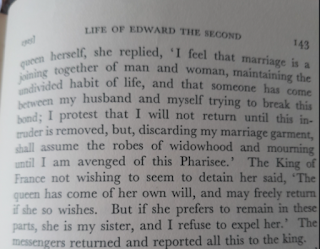
In late October 1325 or thereabouts, Edward II's queen Isabella made a speech at her brother Charles IV's court in Paris that appears in the Vita Edwardi Secundi, though nowhere else. Assuming that the Vita recorded Isabella's words correctly or approximately correctly - and bear in mind that the queen would have spoken in French, which the author of the Vita recorded in Latin, and which has been translated into modern English - this is the speech:

Paraphrasing the queen, what she said was: "There is a third person in my marriage who is trying to come between my husband and myself, and marriage is a very important institution to me but now I feel like a widow and am going to dress like one. I want my husband to send this Pharisee away so that I can return to him, and get my own back on this horrible person." 

Her brother Charles IV, who evidently was present, responded: "My sister is always welcome to stay here with me if she wants, but if she wants to go back to England, that's fine too." 

Modern writers often interpret this speech as Isabella openly admitting treason and saying "I hate my husband and am defying him and want to bring him down, because I'm in love with Roger Mortimer," and Charles IV saying he'll aid her rebellion because he also wants to bring down Edward II. And I go, wait, what? Oh, and for the avoidance of any doubt, because there are people who accuse me of being unfair to novelists when I discuss this on my social media, I'm not talking about fiction here. I'm talking about the way historians have interpreted Isabella's speech, in works of non-fiction, not novelists writing fiction. How novelists depict Isabella often makes me roll my eyes right out of my head but isn't a massive priority of mine, to be honest, but I do care a great deal about a distorted view of her and Edward II being presented in serious works of non-fiction as though it's certain fact.

On the face of it, this speech is Isabella offering Edward II an ultimatum: he must send the unnamed 'Pharisee' away from him so she can return to him and resume their marriage. Some months later in early February 1326, Isabella sent a letter to Walter Reynolds, archbishop of Canterbury, in which she reiterated her strong wish to return to Edward, but stated that she did not dare to do so because she was so frightened of Hugh Despenser, who was in complete control of her husband and his realm. She referred to Edward as "our very dear and very sweet lord and friend", nostre treschier et tresdouche seignur et amy, highly unconventional terms which reveal her great affection for her husband (conventional would have been simply "our very dear lord"). But somehow, modern writers often seem to feel that they know exactly what Isabella was really thinking all the time, as though they're connected to her telepathically, so they go "Aha! She was just pretending to want to go back to Edward and didn't really mean it, so she made up her fear of Hugh Despenser as a useful excuse to stay away from Edward and to remain in Roger Mortimer's arms!" As Michèle Schindler has so correctly pointed out to me, it's really odd that historians have invented all kinds of ways in which Isabella of France was supposedly a victim - the nonsense about her children being stolen from her in 1324, being abandoned by Edward in 1312 when she was pregnant, endlessly neglected by her cruel gay husband who gave her wedding gifts to his lover, and so on - but on the one occasion where Isabella outright stated that she was indeed a potential victim, because she was so frightened of Hugh Despenser and what he might do to her, it's dismissed as a self-serving lie. 

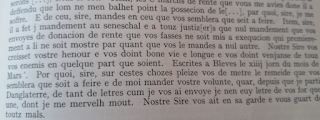
Another important point that I've been thinking about for a while is, who was this 'Pharisee'? According to the Vita Edwardi Secundi, Queen Isabella swore to destroy Hugh Despenser around the same time that she made this speech (see paragraph below). As she used the word 'avenged' in her speech at the French court to describe what she wanted to do to the 'Pharisee' who had come between her and Edward, it does seem natural that she was referring to the same person. But was she? It's almost always been assumed, including by me, that it must have been Hugh, but the queen didn't name him, and furthermore, the meaning of Pharisee is 'a self-righteous or hypocritical person'. That really doesn't seem to fit Hugh at all. He was a ruthless, clever, scary, ambitious and manipulative person, but for all his faults I can't think of a time when he demonstrated hypocrisy or self-righteousness. He was always cheerfully open about his ambitions to be supremely rich and to own most of South Wales, and about the less than entirely legal and ethical methods he employed to achieve this.

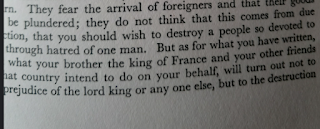
Below, the Vita cites a letter which all the English bishops, on Edward II's command, sent to the queen in France sometime in late 1325. It makes clear that Isabella, in a speech or letter which does not now survive, had threatened to destroy Hugh Despenser with the aid of her brother Charles IV and other powerful Frenchmen. It might not be a coincidence that in November 1325, rumours spread that Hugh had been killed in Wales.


I have wondered, and discussed the possibility in my book Edward II's Nieces, the Clare Sisters: Powerful Pawns of the Crown, whether the person Queen Isabella meant by 'Pharisee' was not Hugh Despenser but his wife Eleanor de Clare, Edward's eldest niece. There's a curiously large amount of evidence that Edward and Eleanor had some kind of intimate, and incestuous, relationship in the last years of his reign. And as Eleanor had regularly attended Queen Isabella going back to at least 1311 and probably earlier, and the two women had spent considerable time together for many years, it perhaps makes sense that Isabella would call Eleanor a hypocritical person if she was being friendly to Isabella's face while having an affair with her husband behind her back. 

One Continental chronicle* says that Edward II and Isabella met at some point after her invasion in September 1326 - the timing isn't clear but appears to be sometime after Hugh Despenser's execution on 24 November 1326 and his wife Eleanor's imprisonment at the Tower of London a few days earlier - and that Isabella fell to her knees and begged Edward to 'cool his anger' with her. The king, however, refused even to look at her, never mind talk to her or accept her apology. It's always taken for granted that it was Isabella who was in charge, who actively defied Edward and whose decision it was to end their marriage, while Edward just reacted passively to events as they unfolded and had no choice about his marriage coming to an end. In this reading, however, and if the chronicle bears any resemblance to reality, it was Edward who rejected Isabella, not the other way around.

[* Extrait d'une Chronique Anonyme intitulée Ancienne Chroniques de Flandre in Recueil des Historiens des Gaules et de France, ed. M.M. de Wailly, vol. 22, p. 425]

Maybe Isabella genuinely did want to go back to Edward without Hugh and Eleanor Despenser's constant and irritating presence, and maybe it really was Edward who rejected her rather than vice versa. After all, it would appear that he refused the ultimatum that she offered him in or around late October 1325, perhaps to her great shock, and several months later in February 1326, Isabella told the archbishop of Canterbury that she still wanted to go back to her husband but that nothing had changed. Again, this letter has often been interpreted as Isabella playing a game, pretending that she wanted to go back to Edward when of course she can't possibly have done, because she was deeply in love/lust with the most heterosexual and virile manly man who has ever existed and who was sooooo superior to the horrid same-sex attracted man she'd been forced to marry. It's odd really. I'm not sure I've ever seen so many people so keen to argue that a person meant something so entirely different from the words she actually spoke, and so keen to claim that this pious daughter of Holy Church glibly told porkies to the most important churchman in England for no better reason than she wanted to continue having hot, doubly adulterous sex. I suppose it's because the constant but erroneous assumption that Edward II and Isabella of France's marriage was nothing but a tragic awful disaster from start to finish makes it hard to imagine that, just maybe, Isabella really did want to go back to Edward. That she wanted to resume a marriage in which she had been happy for many years, without Hugh and Eleanor Despenser always being around.

Perhaps the invasion of September 1326 was aimed at removing Hugh Despenser from Edward II's side and executing him, as the barons had tried to do with Piers Gaveston on several occasions a few years earlier, rather than being intended to remove Edward himself from his throne. Events in the autumn and early winter of 1326, however, snowballed; Edward's support simply collapsed; and it became clear that he could not continue as king. But maybe Edward's downfall was never originally the intention of Isabella and her allies. We don't really know. Whatever anyone else tells you, these people who seem to think they can see into the heart and mind of a woman who lived 700 years ago, we genuinely do not know when Isabella and the others decided that Edward II must be made to abdicate his throne to his and Isabella's son. It might even have been as late as the festive season of 1326, when a big What On Earth Are We Going To Do About The King meeting took place at Wallingford Castle. It's also possible that Edward's downfall/abdication/assassination might have been kind of vaguely contemplated, at least as a concept, years earlier. We just don't know, and don't believe anyone who tells you that we do know, or who tells you with complete certainty that Isabella was repulsed by her husband and in love with Mortimer in 1326, because there is no way that we can know those things. We mustn't lose sight of the fact, either, that in 1326/27 a king of England had never been deposed or forced to abdicate before. How would Isabella and her allies even have conceived of the notion that they might be able to achieve this, years before it happened, and long before they and parliament painstakingly and painfully groped their way towards it? It's not as though they had a precedent to work with, or any way of knowing that deposing unsatisfactory English kings would later become reasonably common.

There often seems to be this idea that everything that happened was always bound to happen and couldn't possibly have happened in any other way, and that any particular event wasn't a result of chance, or of fairly arbitrary decisions and choices, but must always have been carefully planned, step by step. Every single thing that we know Isabella and Roger Mortimer did or said, therefore, has to be fitted into a scheme of their clever and super-secret years-long plan to bring down Isabella's husband. So Isabella can't just stay at the royal residence of the Tower of London for a few nights in early 1323 because that's what the king and queen often did when they were in the city, she has to be conspiring against Edward with Roger Mortimer in prison there and helping him plan his escape as the vital first step in her plan to unking her husband. She can't argue with Edward in late 1322, flounce off in a huff but then go back to him a bit later and try to make up because that's what couples often do, she has to be conspiring against Edward with Roger Mortimer and spying on her husband's movements for him. She can't genuinely mean in late 1325 and early 1326 that she misses her happy marriage and wants to go back to her husband but is too frightened of Hugh Despenser to do so, she has to be conspiring against Edward with Roger Mortimer because she's in love with him, and is obviously lying her socks off so that nobody realises what she's up to. Roger Mortimer can't escape from the Tower and flee to the Continent without any clear idea of what the heck he's going to do once he gets there, he has to spend every waking moment from 1322 to 1326 manoeuvring everyone and everything into position so that the forced abdication of Edward II he's planning can be achieved.

In this way of thinking, obviously it can't be the case that Isabella, Roger, the count of Hainault, the king of France, etc, react to events as they happen, or make decisions on the spur of the moment, or are taken by surprise by the outcome of things they've almost inadvertently set in motion. Somehow all of them have to be part of this massive Europe-wide conspiracy of powerful people who want to see the king of England dethroned, who plot with each other for years on end, and who are all incredibly cunning uber-Machiavellian types who spend years bringing about an English king's downfall for the first time in history without leaving the slightest trace of their machinations on written record. This is a result of looking at history backwards; knowing where people ended up and assuming they were always fated to end up there and had always planned to end up there, and is imposing a coherent narrative on events that at the time they were lived were simply random and chaotic. It forgets that the people themselves were living from day to day, and were making whatever choices and decisions seemed like a good idea at the time, and couldn't actually foretell the future. It's only with hindsight that we can look back at history and see that other English kings after Edward II lost their thrones - Richard II, Henry VI, Edward V, Charles I - and thereby assume that people alive in the 1320s had somehow gone through the same conceptual process that we have, to wit, that failed kings could be unkinged, and that this notion surely occurred to Isabella, Roger Mortimer and others as early as 1322/23.

It's only with hindsight that we can look at Roger Mortimer's escape from the Tower in August 1323 and see that, yes, it was an important step in the events that would bring down Edward II a few years later. Neither Roger nor anyone else knew that in 1323. It's only with hindsight that we can look at Queen Isabella departing for France in March 1325 and see that, yes, this was another important step in the events that would bring down Edward II. Isabella didn't know that in 1325. It's certainly possible that when she left, she had some idea in mind of using her stay in her homeland and the influence of her royal French brother to try to alter her currently unhappy circumstances. Frankly, however, suggesting that she knew she would return to England at the head of an army with the aim of removing her husband from his throne, and that she'd been plotting to do so for years with the mid-ranking baron she was in love with, strikes me as an absurdity. And you know what? Sometimes when a woman says how unhappy she is about a third person in her marriage, what she really means is that she's unhappy about a third person in her marriage.

13 February, 2022

Queen Isabella and Hugh Despenser the Younger


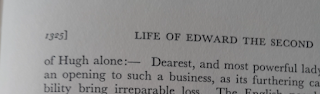
Letter cited in Vita, she'd sworn to destroy Hugh

Letter to Archbishop Reynolds February 1326

Close Rolls, Edward's letters in response to Isabella's letters which don't survive; she feigned friendliness to Hugh to protect herself

Chronicler, great magnates were frightened of Hugh. As he imprisoned people in chains, even his close supporters, threatened to hang them, it's easy to see that he could be frightening.

07 February, 2022

The Annulment of Richard, Earl of Arundel and Isabella Despenser's Marriage, 1344

I'm pretty sure I've written here before somewhere about Richard, earl of Arundel (c. 1313-76) annulling his first marriage to Isabella Despenser (c. 1312-after 1356) in late 1344, thereby making their son Edmund Arundel illegitimate. One thing that interests me is that Pope Clement VI's response to Edmund's sending a petition to him protesting at his treatment at the hands of his father states that Edmund was eighteen in late 1344 and twenty in early 1347. If this is correct, it would place his date of birth in or not too long before late 1326, around the time when both of his grandfathers, Edmund, earl of Arundel, and Hugh Despenser the Younger, lord of Glamorgan, were executed on 17 and on 24 November 1326 respectively. According to Richard, earl of Arundel's correspondence with the pope, he was seven and Isabella Despenser was eight when they married in February 1321, and if their and their son's ages are approximately correct, this would mean Richard and Isabella were only at the start of their teens when they became parents. Yowza. Richard complained to the pope that he and Isabella renounced their wedding vows when they reached puberty, but were 'forced by blows to cohabit' (who hit them to make them sleep together was not clarified).

On 5 February 1345 just a few weeks after Clement VI oblingingly annulled Richard Arundel and Isabella Despenser's marriage in early December 1344, Richard married Isabella's first cousin Eleanor of Lancaster, fifth of the six daughters of the royal and enormously wealthy Henry, earl of Lancaster and Leicester, who died later in 1345. Eleanor's first husband John, Lord Beaumont, with whom she had a son named Henry Beaumont (b. in late 1339 or early 1340), was killed jousting in the spring of 1342. Richard and Eleanor had five children between c. 1345/6 and c. 1352/3, and Richard's heir to his earldoms and vast wealth was Richard the younger, eldest of their three sons. Richard the elder and Isabella Despenser's son Edmund Arundel was made illegitimate and inherited nothing from his father. Almost certainly, Eleanor of Lancaster had been in a relationship with Richard Arundel before they married: she was granted a safe-conduct to go on pilgrimage to Santiago de Compostela in northern Spain in March 1344, two days after her brother Henry of Grosmont, earl of Derby, and Arundel were empowered to travel to Spain and Portugal to negotiate alliances there. This is unlikely to be a coincidence. There is, however, no evidence that I'm aware of that '[w]hile her first husband was still alive, she lived with her future second husband' as claimed on the fmg.ac website. Having an affair with Richard while he was still married to Isabella Despenser, which seems pretty well certain, does not mean that their affair began while John Beaumont was alive.

Richard Arundel and Eleanor of Lancaster deliberately concealed her true identity from the pope until after they were safely married, when it was too late for anyone to do anything much about it. They pretended that Eleanor was called 'Joan Beaumont'. They pretended that she was related to Isabella Despenser via her father, when in fact it was via her mother, Maud Chaworth (1282-1322), who was the older half-sister of Isabella's father Hugh Despenser the Younger (c. 1288-1326). They pretended that they did not know they were third cousins and thus required a papal dispensation for consanguinity, which, given that they were both members of the tiny English comital elite, is all but impossible. They lied to the pope about the date of their wedding, telling him that they married on the last Saturday in Lent when in fact they married eleven days before the start of Lent (as they admitted to him on a later occasion, apparently forgetting their earlier fabrication). They claimed after their wedding that they had 'fear[ed] certain dangers' if they did not marry clandestinely, and referred to Edmund Arundel as Richard's 'illegitimate son' with Isabella Despenser. Only after they were safely married did they openly acknowledge Eleanor's real name and her status as the daughter of Henry, earl of Lancaster, and they correctly stated that Isabella Despenser was related to Eleanor of Lancaster in the second degree of kindred on her father Hugh Despenser the Younger's side and in the third and fourth degrees on her mother Eleanor de Clare's side (the two Eleanors were both descended from King Henry III).

The whole thing leaves a rather nasty taste in my mouth. Poor Edmund Arundel had done nothing wrong, yet was cast off by his father, who in later years nastily referred to him as 'that certain Edmund who claims to be my son'. Horrible man. Isabella's brother Sir Gilbert Despenser, third son of Hugh Despenser the Younger, was arrested and imprisoned in the Tower of London in December 1344. Although the reason was not given, only his 'certain excesses', the timing perhaps reveals that Gilbert had forcefully made his feelings about the annulment known to his brother-in-law. Isabella's life after the annulment is almost entirely obscure and the date of her death is unknown, which is rather sad given that she was a great-granddaughter of Edward I.

Edmund Arundel married Sybil Montacute, who was, as far as I can tell, the second daughter of William Montacute or Montagu, earl of Salisbury (b. 1301) and Katherine Grandisson (the eldest Montacute daughter appears to have been Elizabeth, who married Edmund's maternal uncle Hugh 'Huchon' Despenser; another daughter was Philippa, who married the younger Roger Mortimer, b. 1328, second earl of March). Salisbury was killed jousting in January 1344, and I wonder if it's not a coincidence that the earl of Arundel only started attempting to annul his marriage to Isabella Despenser later that same year. Salisbury, a powerful earl who was a close friend of Edward III, would certainly have done his utmost to ensure that his daughter's husband wasn't made illegitimate and disinherited. Unfortunately for Edmund Arundel and Sybil Montacute, after her father died, her brother (William Montacute the younger, b. June 1328) was only fifteen and was in no position to stop Richard Arundel and his powerful and wealthy soon-to-be Lancaster in-laws from lying to the pope to get his first marriage annulled. 

Edmund Arundel and Sybil Montacute had three daughters, Philippa, Elizabeth and Katherine, though I'm not sure of the birth order. All three women married and had children. I've previously written a post about their daughter Philippa (d. 13 September 1399) and her children from her first marriage to Sir Richard Sergeaux of Cornwall (d. 30 September 1393), and her subsequent rather brief second marriage to the famous warrior Sir John Cornwall (d. 1443). In or around late 1376, a few months after the death of Earl Richard in January 1376, Edmund Arundel and several of his retainers attacked six manors in Essex that his father had given to his mother Isabella in the mid-1340s for her sustenance after the annulment, and which were now in the hands of his much younger half-brother Richard (b. c. 1346/7). Edmund died in 1381 or early 1382; I've never been able to find even an approximate date of death for his wife Sybil Montacute, even though she was the sister of the earl of Salisbury and the countess of March.

Sources

Petitions to the Pope 1342-1419, pp. 75, 81, 99.
Calendar of Papal Letters 1342-1362, pp. 164, 188, 254.
Foedera 1344-61, pp. 8-11, 30-31.
Calendar of Patent Rolls 1343-45, p. 224.
Calendar of Close Rolls 1343-46, p. 483.
CPR 1374-77, pp. 492-3. 
CCR 1374-77, pp. 413, 511, 551.

26 January, 2022

Margaret of Norfolk, Duchess of Norfolk

A post about Edward II's niece Margaret of Norfolk, also often called Margaret Marshal(l) or occasionally Margaret of Brotherton, who was born in the early 1320s, became the first English woman to be made a duchess in her own right in 1397, and lived until 1399.

I've looked before at the peculiar marriage of Margaret's father Thomas of Brotherton, earl of Norfolk and Earl Marshal of England, who was born on 1 June 1300 just under nine months after his father Edward I married his second wife Marguerite of France on 8 September 1299. Thomas was the son and half-brother of kings of England, the grandson and nephew of kings of France (Philip III and Philip IV), yet married the utterly obscure Alice Hales, whose father Sir Roger Hales was the coroner of Norfolk. The date of Thomas and Alice's wedding is not recorded, but it almost certainly took place after Thomas turned twenty-one and thus came of age on 1 June 1321. That it did take place after that date is pretty well confirmed by Edward II's efforts to find a more suitably royal bride for his half-brother. In 1320/21 he negotiated with King Jaume II of Aragon (r. 1291-1327) for Thomas to marry Jaume's youngest daughter, the widowed Violante (b. 1299), but in August 1321 Jaume told Edward that Violante had decided to become a nun.

Thomas is likely, therefore, to have made a love-match or a lust-match with the coroner of Norfolk's daughter sometime in or after August 1321. They had three children: in birth order, they were Margaret, Alice, and Edward, who died young. Given the probable date of her parents' wedding, Margaret is unlikely to have been born before the spring or summer of 1322, and as she gave birth to her daughter Elizabeth Segrave, Lady Mowbray, in October 1338, she is unlikely to have been born after 1323. Margaret's younger sister Alice was of age, i.e. fourteen as she was already married to the earl of Salisbury's brother Edward Montacute, by the time of their father's death in August 1338, and therefore must have been born in or before August 1324. Annoyingly, I've never found any references to the Norfolk sisters' births or baptisms in their uncle Edward II's extant accounts, though their mother Alice does appear occasionally as 'the king's sister, the Countess Marshal'.

I wonder if Margaret was just about old enough to be aware of the deposition and reported death of her uncle Edward II in 1327. On 3 March that year, Queen Isabella granted Thomas of Brotherton - who was both her brother-in-law and her first cousin - the marriage rights of John Segrave, son and heir of Stephen, Lord Segrave. Rather confusingly, Stephen Segrave died not long before 12 December 1325 mere weeks after his father John Segrave the elder died not long before 4 October 1325. Stephen's son John Segrave the younger was said to be either nine or ten years old in his father's inquisition post mortem held in late 1325 and early 1326. He was granted seisin of his inheritance on 20 March 1336 having recently proved his age, so was not born too long before 20 March 1315 and was a good seven years older than Margaret. [1] 

Thomas of Brotherton married John Segrave to his elder daughter at an uncertain date, though the wedding definitely took place before Margaret was twelve or perhaps fourteen; we know this because she later complained to the pope that she was contracted to marry John before she was of marriageable age and never consented to cohabit with him (see below). Given that Margaret was the granddaughter and niece of kings, marrying Lord Segrave wasn't exactly the greatest marriage for her, and the marriage of her younger sister Alice to the earl of Salisbury's youngest brother wasn't that great either. This probably indicates that Thomas arranged the marriages of both his daughters before his young son Edward of Norfolk died, around 1333/34, at which point the girls became his heirs.

Margaret of Norfolk gave birth to her daughter Elizabeth Segrave, later Lady Mowbray, at Croxton Abbey in Leicestershire on 25 October 1338. [2] Her son John Segrave the younger was probably born around 1340 or 1341, and on or a little before 4 May 1347 was betrothed to Blanche of Lancaster (b. 1342), the younger daughter though ultimately the sole heir of Henry of Grosmont, earl of Lancaster, Leicester and Derby (and later the daughter-in-law of Edward III and mother of Henry IV). For some reason this did not work out, and on 25 March 1349 John Segrave was betrothed instead to Blanche Mowbray, future Lady Poynings, who was Henry of Grosmont's niece and Blanche of Lancaster's namesake first cousin; she was the daughter of Joan of Lancaster, one of Henry's six sisters. The young couple actually did marry, as in September 1353 there's a reference on the Close Roll to 'Blanche late the wife of John son of John de Segrave'. [3] Most confusingly, Margaret of Norfolk's nephew and niece Edward and Audrey Montacute, two of her younger sister Alice's five children, had previously been betrothed to Blanche Mowbray and her brother John, on 13 March 1342. [4] 

Margaret's son John Segrave the younger died as a child sometime after his betrothal/marriage in March 1349; when exactly is not known, but when his father died in April 1353, his sister Elizabeth was named as their father's sole heir. [5] Before 4 September 1353, Elizabeth married John, Lord Mowbray (b. June 1340), brother of her brother's wife Blanche Mowbray and nephew of Henry of Grosmont, and formerly betrothed to Audrey Montacute. Elizabeth and John's second son Thomas Mowbray, probably born in March 1367 - his inquisition post mortem of 1399 gives March 1366, but his brother, who died as a teenager in 1383, was born in August 1365 - was made first duke of Norfolk in 1397 and ultimately was his grandmother Margaret of Norfolk's sole heir.

Douglas Richardson's book Plantagenet Ancestry gives Margaret of Norfolk another Segrave daughter called Margaret, and two sons, not one, called John Segrave. Margaret Segrave and the other John Segrave are said to have died young. This may well be the case, but Richardson's habit is to add a long list of sources to the end of each genealogical biography in his books with no indication as to which source belongs to which statement - the Oxford Dictionary of National Biography, annoyingly, does the same thing - so I have no idea which primary sources he used.

Elizabeth Segrave was born a couple of months after her royal maternal grandfather Thomas of Brotherton, earl of Norfolk, died in August 1338, and, as stated in her proof of age, her father Lord Segrave returned to England from the continent 'about the day of St. Matthew [21 September] before the said Elizabeth’s birth...because of his claim to the said earl's lands in right of Margaret his wife'. Thomas of Brotherton's daughters Margaret and Alice were named as his heirs in his IPM ('Margaret the wife of John de Segrave and Alice the wife of Edward de Monte Acuto are his next heirs'). [6]

By 10 June 1350, Margaret of Norfolk was making attempts to have her marriage to John Segrave annulled; on that date, the pope told Ralph Stratford, bishop of London, 'to hear and decide the cause of' John and Margaret, 'who was contracted to him before she was of marrriageable age and has never agreed to cohabit with him'. On 2 March 1351, the pope made references to the 'matrimonial cause between Margaret Marescallis of Lopham [in Norfolk] and John Segrave, knight'. [7]

Margaret's marriage was evidently an unhappy one, but at least it wasn't murderous like her unfortunate younger sister Alice's. Alice was terribly beaten by her husband Edward Montacute and at least two of his retainers, and died at the end of 1351 or beginning of 1352, probably after lapsing into a coma. Of Alice's five children, the youngest, Joan Montacute (b. 1349), was the only one who lived into adulthood and married; she wed William Ufford (b. 1338), earl of Suffolk. Joan and William had several children though none of them lived, and when William died in 1382, having held his mother-in-law Alice's share of the Norfolk inheritance by right of his late wife and the 'courtesy of England', his aunt-in-law Margaret of Norfolk was named as heir to the lands ('Margaret Mareschall, aged 50 years and more, is daughter and sole heir of Thomas, late earl of Norfolk and marshall of England, and aunt and next heir of Joan late the wife of the said earl of Suffolk'). [8] She now held the entire Norfolk inheritance of her long-dead father Thomas of Brotherton.

Margaret's attempts to have her Segrave marriage annulled proved unsuccessful, even though a pardon granted to her by her cousin Edward III in late 1355 makes it apparent that she must have gone to the papal court in Avignon in person: she 'cross[ed] to foreign parts against his prohibition'. On 27 October 1350, Margaret 'crossed the Channel contrary to the king's prohibition...in a barge of William de Denum called le Faucoun...she was met at night by Thomas Barbour, servant of Sir Walter Manny'. [9] John Segrave died fairly soon afterwards anyway, on 1 April 1353, only in his late thirties. Soon afterwards, Margaret married her second husband, the Hainaulter knight Sir Walter Manny or Mauny (b. c. 1310), who had come to England in Queen Philippa's retinue. It seems almost certain that this was a love-match or at least a lust-match, and Margaret had certainly known and perhaps fallen in love with Walter during her unhappy marriage to John Segrave.

Margaret and Walter Manny's daughter Anne was, according to Walter's inquisition post mortem, born on 24 July 1354; she was 'aged seventeen on the eve of St James last' in February/March 1372. [10] Other jurors stated that she was eighteen in 1372. If they were correct, it would appear that Margaret of Norfolk became pregnant around late October or early November 1353, only about seven months after John Segrave's death. Anne Manny was the couple's only surviving child, though genealogist Douglas Richardson states that they had another daughter, Isabel, and a son Thomas as well, who drowned in a well at the age of ten, apparently. Or at the age of five, according to the Medieval Lands project on fmg.ac. Again, I have no idea what the source is.

On 26 July 1354, which would appear to have been just two days after Margaret gave birth to Anne Manny, Edward III ordered his cousin's arrest, and sent two sergeants-at-arms to 'lead her as quietly and honourably as they can' to Somerton Castle in Lincolnshire, which was given to Edward II by the bishop of Durham in 1309 and later passed to his son and heir. Margaret was imprisoned there for a time, though it was not an onerous incarceration; she was accompanied by her entire household, and Walter Manny was also allowed to stay there with her if he wished. Keenly aware of her status as his cousin and as a king's granddaughter, Edward ordered the castle constable to treat Margaret 'in all things in accordance with her estate'. The king pardoned her and Walter in late 1355 for 'all rancours and wraths conceived against them by the king for any causes', and for marrying without his licence. [11]

Sir Walter Manny hadn't, as far as I know, been previously married, though had fathered two illegitimate daughters whom he named in his will of 30 November 1371, and who had the best names ever: Mailosel and Malplesant. He also had a sister called Mary or Marie, and a cousin who bore the curious name of Cishbert (doesn't sound like a traditional Hainault name, does it?) [12] Walter died on 15 January 1372, and ten months later, on or about 11 November 1372, his and Margaret of Norfolk's eighteen-year-old daughter Anne gave birth to her only child, John Hastings the younger, named after her husband John Hastings, earl of Pembroke (b. August 1347). [13] Walter referred to his wife in his will as 'Margaret Mareschall' and left her, among other things, all his beds except a folding bed which he left to their daughter, a gold girdle, a gold garter, and a 'hook for a mantle'.

Margaret of Norfolk was probably not quite fifty years old when she was widowed for the second time, and never remarried. Her joint heirs were her two daughters, Elizabeth Segrave, Lady Mowbray (b. 1338), and Anne Manny, countess of Pembroke (b. 1354). Elizabeth died sometime in 1367 or 1368; the date is not recorded but she appears to have given birth to her son Thomas Mowbray in March 1367, and the IPM of her husband John Mowbray (who died overseas sometime between June and October 1368) makes it apparent that he had held all her lands after her death by the 'courtesy of England'. [14] Anne Manny was widowed in 1375, and died in June 1384, not quite thirty. Margaret was granted sole custody of her grandson John Hastings, heir to the earldom of Pembroke, who as a seven-year-old in June 1380 had been married to John of Gaunt's daughter Elizabeth of Lancaster, then sixteen or seventeen. [15]

Margaret's grandson John Mowbray, the elder son of Elizabeth Segrave and aged not quite twelve, was made the first earl of Nottingham at Richard II's coronation in July 1377, though died, still a teenager, in 1383, leaving his brother Thomas as his heir. Margaret became a great-grandmother in September 1385 when Thomas Mowbray, then eighteen years old, and his wife Elizabeth Fitzalan's son Thomas Mowbray the younger was born. Four years later in December 1389, her seventeen-year-old other grandson John Hastings was killed during the jousts held to celebrate Christmas, in the presence of Richard II and his queen, Anne of Bohemia. Thomas Mowbray, earl of Nottingham, was now her sole heir.

In September 1397, Richard II took his revenge on the three senior Lords Appellant who had executed or exiled many of his friends during the Merciless Parliament of 1388. The king rewarded his supporters with higher titles, and Thomas Mowbray, earl of Nottingham, though also one of the five Lords Appellant of nine years earlier, was made the first duke of Norfolk. His grandmother Margaret was made duchess of Norfolk in her own right, and though she shared the title with her granddaughter-in-law Elizabeth Fitzalan, she was the first English woman to be made a duchess in her own right, now aged seventy-five or thereabouts.

Margaret died on 24 March 1399, aged seventy-six or seventy-seven, apparently intestate, or at least I've never seen any will she left. She was the last surviving grandchild of Edward I; the second last was Margaret de Bohun, countess of Devon, who died at age eighty in December 1391. Margaret's sole heir was her thirty-two-year-old grandson Thomas Mowbray, who had been permanently exiled from England six months earlier by Richard II. Thomas outlived his grandmother by only six months and died of the plague in Venice on 22 September 1399, so Margaret's heir was her fourteen-year-old great-grandson Thomas Mowbray the younger (September 1385 - June 1405). Margaret was buried in the church of the Greyfriars in London, the same church as Edward II's queen Isabella of France (d. 1358), Isabella's daughter Joan of the Tower, queen of Scotland (d. 1362), and Isabella's granddaughter Isabella of Woodstock, countess of Bedford (d. 1382).

Sources

1) Calendar of Patent Rolls 1327-30, p. 23; Calendar of Inquisitions Post Mortem 1317-27, nos. 699, 700, 728; Calendar of Close Rolls 1333-37, p. 555.
2) CIPM 1352-60, no. 121.
3) The National Archives BCM/D/5/101/8; Calendar of Papal Letters 1342-62, p. 305; Petitions to the Pope 1342-1419, p. 151; CPR 1348-50, p. 373; CCR 1349-54, p. 557.
4) TNA BCM/D/1/1/9 and 11.
5) CIPM 1352-60, nos. 116, 121.
6) CIPM 1336-46, nos. 195-6.
7) CPL 1342-62, pp. 381, 391.
8) CIPM 1377-84, nos. 599-623.
9) CPR 1354-58, p. 325; Calendar of Inquisitions Miscellaneous 1348-77, no. 50.
10) CIPM 1370-73, no. 148.
11) CPR 1354-58, pp. 93, 325; CCR 1354-60, p. 27; TNA C 49/7/27.
12) Testamenta Vetusta, vol. 1, pp. 85-6.
13) John was 'aged two on the feast of St Martin last' in the summer of 1375 and 'aged eleven on the feast of St Martin in Winter last' in June 1384: CIPM 1374-77, no. 148; CIPM 1384-92, nos. 12, 13, 20.
14) CIPM 1365-69, no. 397.
15) CPR 1381-85, p. 437; TNA SC 8/125/6209-6211; SC 8/129/6440.

15 January, 2022

Queen Isabella's Letter to Edward II, 31 March 1325

Isabella of France left England on [9] March 1325 and travelled to her homeland, where she spent several months negotiating a peace settlement between her husband Edward II and her brother Charles IV.

On 31 March 1325, the queen sent a long letter to her husband, printed in the original French in Pierre Chaplais's The War of Saint-Sardos (1323-1325): Gascon Correspondence and Diplomatic Documents (1954), pp. 199-200. Here's my translation.

*

Very sweet heart etc. [On the subject of the business we have], may it please it to you know, my very sweet heart,

11 January, 2022

An Attack on Southampton, 30 September and 1 October 1321

According to a petition presented to Edward III sometime in the very early years of his reign by his "liege people of Southampton", Robert Batail of Winchelsea, baron of the Cinque Ports and formerly one of Edward II's admirals, launched an attack on Southampton in the company of "many other" men of the Cinque Ports in the autumn of 1321. This assault was allegedly abetted by Hugh Despenser the Younger, then a pirate in the English Channel after being exiled from England by his baronial enemies in August 1321, and the petition states that Despenser accused the people of Southampton of supporting Thomas, earl of Lancaster, in his ongoing quarrel against his cousin Edward II. The assault was said to have taken place on "the Wednesday and Thursday next after St Michael" (le merkerdy et le joeuedy p'scheins ap's le seint Michel) in the fifteenth year of Edward II's reign. Edward's fifteenth regnal year ran from 8 July 1321 to 7 July 1322, and the feast day of St Michael, also often called Michaelmas, is the 29th of September, which fell on a Tuesday in 1321. This dates Robert Batail's attack on Southampton to Wednesday 30 September and Thursday 1 October 1321. The Annales Paulini, i.e. the annals of St Paul's in London, confirm some of the details of the petition, and give the exact same date: in crastino Sancti Michaelis...et in crastino similiter, i.e. on the morrow of St Michael and then again on the morrow.

Below, part of the petition, which is written in the most gorgeously clear handwriting.

The petition of the people of Southampton states that Robert Batail and his men came to the port and burnt ships with goods, chattels and merchandise inside. Furthermore, they stole other goods, chattels and merchandise which they found, and stole ships as well, to a total value of £8,000. The text of the Annales Paulini confirms that the sailors of Winchelsea, "kindled by the fuel of envy," sailed into the port of Southampton in thirty ships and "maliciously burnt" fifteen ships at anchor there. The petition claims further that soon afterwards, Edward II sent the "community of Southampton" (la comunaute de Suthampton) to Portchester Castle and imprisoned them there, and made them swear not to bring any suit against the people of the Cinque Ports, promising to make good their losses, but failed to do so (des queux rien nest fait). The people of Southampton thus requested "aid and remedy" from the young Edward III, especially as the port was now "in the hand of my lady the queen," Isabella of France.

Robert Batail - his name also appears on record as Bataill or Bataille or Batayle - was appointed "captain and admiral of the ships of the Cinque Ports about to go against the Scots" a few months after the attack on 13 May 1322, and on 18 April 1323 was appointed admiral of the western fleet. On 6 May 1322, Robert and his associate Robert Alard, also of Winchelsea, were pardoned for "all offences committed on land or sea". So it hardly seems that Edward II was angry with him for the destruction and theft he and his associates carried out in Southampton.

Given that Edward II placed Hugh Despenser under the protection of the men of the Cinque Ports during his supposedly perpetual exile from England in August 1321, and given that the king himself arrived at Portchester on 4 or 5 October 1321 just days after the attack on Southampton, the story that he imprisoned some of the victims of Batail's raid at Portchester Castle seems pretty plausible. It's also plausible that Hugh Despenser the Younger, committing piracy in the Channel in the company of some of the men of the Cinque Ports at the time, had something to do with the attack. On the other hand, a lot of the petitions sent to Edward III and/or his mother Queen Isabella near the start of his reign blamed Despenser and his father for everything bad that had happened to the petitioner, and a lot of them claimed loyalty and adherence to Thomas of Lancaster, who was being rehabilitated at the start of the new reign a few years after his execution. I wouldn't be at all surprised if the story was true, though the Annales Paulini don't mention Despenser's involvement, and it's not impossible that including him was a deliberate ploy by the petitioners to elicit a favourable response from the young king and/or his mother.

Sources

 The National Archives SC 8/17/833. 

Annales Paulini 1307-1340, in W. Stubbs, ed., Chronicles of the Reigns of Edward I and Edward II, vol. 1, p. 298.

Calendar of Patent Rolls 1321-24, pp. 107, 119, 276.

05 January, 2022

Edward II got involved with the unlicensed marriage of John of Gravina, one of the Naples brothers, in CCR 1318-23, p. 365

https://en.wikipedia.org/wiki/Matilda_of_Hainaut


19 December, 2021

Book Giveaway: John of Gaunt and Philippa of Hainault

My book John of Gaunt: Son of One King, Father of Another will be released in the UK in mid-January 2022, finally (I submitted it to Amberley in April 2020, but because of Covid, it's been massively delayed). I have three, yes three, free hardback copies to give away!

My biography of John's mother, Philippa of Hainault: Mother of the English Nation, will be released in paperback also in early 2022, and I have two free (paperback) copies of it to give away as well.

You can enter either draw, or both! To do so, either leave a comment here, with your email address so I can contact the winners, or email me at edwardofcaernarfon(at)yahoo(dot)com, or message me/leave a comment on my Edward II Facebook page, or if we're connected on my personal Facebook or Twitter accounts, you can contact me there as well. Make sure I have some means of contacting you if you're one of the lucky winners, and also, let me know which book(s) you'd like to win. It doesn't matter where in the world you are, as long as you have an address I can post a book to!

The closing date is midnight GMT on 31 December 2021, so you have twelve days to enter the draw. Best of luck!