A joint post by my friend Rachel - who gets all the credit for the brilliant idea - and myself. Here's the first meeting of the Support Group For People Unfairly Maligned In Historical Fiction! (And in case you haven't seen it, take a look at our Support Group for Tragic Queens.)
Edward II: Welcome to the group, everyone. I'm your moderator, King Edward II, though do feel free to call me King Edward for short, and I’m glad to see so many of you here. Well actually, I’m not glad at all, as you’re only here because of the nonsense written about you in historical novels. But anyway, I'll get the ball rolling. How haven't I been maligned by writers? I've been accused of physical cowardice...
George Boleyn: Damn right! I've even read that you fled the field after the battle of Bannockburn. As if!
Edward: Well, there's a teeny tiny chance I did actually do that. In a way. You know, just a little bit.
George: Oh.
Edward: But only when I had no other choice once the battle was lost and because the earl of Pembroke forced me to leave the field before Robert Bruce could capture me for, well, a king's ransom. I soooo was not one of the first men to flee the field. That's deeply unfair. Isabella did not despise me for cowardice at Bannockburn as some novelists like to believe. And talking of whom, could someone please, for the love of God, tell the numerous writers who keep mindlessly repeating it that I did NOT abandon her weeping and pregnant to the mercy of our enemies at Tynemouth in 1312? I sent her by land to York and met up with her there a mere nine days later. Do writers honestly think I should have taken a woman in the first trimester of pregnancy on a five-day journey bobbing about in a small boat on the North Sea?
Piers Gaveston: If you had, Ned, no doubt they'd gleefully portray you as callously not caring about the health of your wife and unborn child rather than callously abandoning them. It's a lose-lose situation for you. Talking about myths, here's another one: you did NOT give Isabella's jewels and your wedding gifts to me to keep for myself. You sent them to me to store them safely, but obviously that explanation is too prosaic for some people. Aside from anything else, I might have been ostentatious, but a drag queen? I don’t think so. And by the way? I wasn’t a rent boy either. Where do people get this from? I was a member of the Gascon nobility! Do people seriously imagine that in 1300 - 1300! - the king of England would have selected a boy not of noble birth, who'd been a prostitute for years to boot, to be his son's chief companion? Apparently they do.
Hugh Despenser: On the subject of birth, why do novelists insist on depicting me as a humble knight and basically a nobody? Why can't they do a bit of research and learn that I was in fact a high-ranking nobleman, grandson and nephew of earls of Warwick and step-grandson of the earl of Norfolk? And seriously, I'm going to haunt the next writer who says that Edward II arranged my marriage to his niece Eleanor after I became his lover. Apparently, it's just too much effort to look at the numerous sources which make it clear that I married her in May 1306 and her grandfather Edward I arranged it, and that we'd had half a dozen kids by the time I, erm, you know, kind of accidentally seduced her uncle. *whistles innocently*
Isabella of France: I am somewhat baffled by the way I used to be portrayed as an evil cackling murderous unfeminine she-wolf but am now a) a long-suffering tragic neglected wife dumped on over and over from a great height by her nasty cruel gay husband, who in 1325 is b) miraculously transformed into a strong empowered proto-feminist, but then c) suddenly becomes - ta-da! - a helpless little victim of nasty men again and in no way responsible for anything she does wrong in the late 1320s because it's all Mortimer's fault. Whether I'm a helpless victim of men or a strong empowered feminist icon completely in control of all her actions depends entirely on whether I'm doing something the author approves of or something s/he doesn't like, of course. I'm also portrayed as eventually and oh-so-romantically finding Twu Wuv after years of the worst marital awfulness any woman in history has ever had to endure and discovering that the route to personal fulfilment and contentment lies in shagging a married man who has a dozen children. Isn't that just the sweetest most romantic thing you've ever heard of?
Joan Mortimer: Well, now you come to mention it, no, not really. Funny how my husband's adultery with you is romantic and entirely forgivable while Edward II's is deeply icky, isn't it, and that the same novelists who write scene after indignant scene about Isabella's neglect at the hands of her husband do their utmost to pretend that my husband isn't actually married? One novelist has me being very overweight and deeply unattractive, and the sad thing is that I'm actually grateful that she even bothered to mention me in the first place. They usually don't.
Richard III:Coming back to Isabella's point about people's reputations doing a 180, for half a millennium I was regarded as the epitome of all that is evil and deformed and hideous, but these days some writers seem to think I was some kind of saint who never did the slightest thing wrong ever while others still think that I was an evil nephew-murdering monster who never did the slightest thing right ever. Ummm, shades of grey, people?
Elizabeth I: Hello, everyone, England’s greatest queen here. There’s one idiot, I mean author, who seems to think that I – who never married, and was attended at just about every step of the way even when I was queen - managed to pop out six kids without anyone noticing. And I thought I’d scotched that stupid pregnant-by-Thomas-Seymour rumour at the time, but 460 years later people are still banging on about it.
Anne Boleyn: Where to start with my unfair vilification? I did not commit adultery. I sure as heck did not commit incest. (Sex with my brother?? There is not enough ewwww in my vocabulary.) I was not a serial killer, or a poisoner. Or convicted of witchcraft. I did not miscarry a deformed foetus. Neither was I deformed myself. Because of course Henry VIII would have spent seven years trying to get his marriage to the Holy Roman Emperor’s aunt annulled so he could marry someone hideously disfigured. Makes perfect sense.
Margaret of Anjou: I'm usually portrayed as this evil vengeful bitch without whom England would never have become embroiled in the Wars of the Roses for several decades, but what should I have done, for heaven's sake? Allowed my son to be disinherited in favour of that man York? And for all the writers who think I cackled like a mad cackling harpy at the sight of York’s head after the battle of Wakefield, I wasn’t there, all right? I was in Scotland. Yes, Scotland.
Edward II: Oh, for Piers', I mean Pete's, sake. You mean, there are writers who can’t even figure out what country the queen of England was in at any given time? That’s dreadful.
Margaret of Anjou: It certainly is. And as for that nasty little rumour that my husband Henry VI was not the father of my son? Of course he bloody was. Henry was perfectly well and sane when we conceived Edward and for a few months afterwards, thank you very much. Obviously I was most grateful for the duke of Somerset's loyal support, but seriously, go to bed with him? As if! And regarding the inutterably inane suggestion that the duke of Suffolk was my son's father - dearie me, this is so painfully stupid - he'd been dead for three and a half years by the time Edward was born. I have two words, four syllables, for writers: Basic Research!
Isabella of France: And on that subject, I am sick to death of this nonsense about me shagging Roger Mortimer or some random Scottish man to conceive Edward III. It's crap. My husband was the father of my eldest son, and of all my other children. Got it?
Edward II: No-one ever thought to doubt that until the end of the twentieth century, then it suddenly became wildly popular to claim that some other man, any random man who wasn't me, had fathered my eldest son Ned, regardless of plausibility. In fact, the more implausible the candidate, the better. My favourite theory is - get this - that my father Edward I was the real father of my son. Yes, that's my father who died more than five years before my son was born.
Margaret of Anjou: Your dead father is meant to have fathered your son? Where on earth do people get this crap? I feel your pain, Edward.
Isabella: And for the last time, I never even met William bloody Wallace, okay? I was still a child when he was executed and wasn’t even in England. Neither had I been abandoned in Scotland when my eldest son was conceived, as one novelist thinks, or for that matter, when my other children were conceived either. I can confirm Margaret of Anjou’s story that there are writers who can’t even figure out what country the queen of England was in at any given time. I echo Margaret's comment: do some research, people!
Roger Mortimer: Talking of being in the wrong country, evidently some writers have also failed to notice that I was in Ireland nine months before Edward III was born, and for a good while before and afterwards too. Even I, manly, virile, audacious and unequivocally heterosexual as I undoubtedly am, would struggle to impregnate a woman who’s in another country.
Edward II: Hey, what are you doing here? This is the group for people maligned in historical fiction! The back-slapping self-congratulatory group for men lauded to the heavens in crappy romance novels as perfect wonderful manly heroes just because they like having sex with women is down the corridor. I believe my grandson John of Gaunt is chairing it.
Roger: No, actually this is the group I wanted to join. After all, novelists rarely bother to characterise me beyond 'strong and virile hetero hero who is the antithesis of horrid gay effeminate Edward II' and then later, 'nasty unscrupulous greedy villain' who is nothing more than a useful scapegoat all your wife’s misdeeds and mistakes can be dumped on. And sorry, by the way. You know, for having an affair with Izzy and holding your son hostage and invading your kingdom and all that.
Edward II: No problem. I didn’t like her that much anyway. And I’m much happier doing my own thing in Italy with everyone in England believing that you had me murdered, and besides, my son and me got all our problems resolved when I secretly met him in Germany, so it all worked out in the end.
Roger: Well, how terribly nice for you. Shame I've gone down in history as the man who - ha! - had the former king of England killed with a red-hot poker. I mean, please, a red-hot poker? Can you think of anything less plausible?
Edward: Sheesh, can you believe that old chestnut's still doing the rounds? Incredible. Never mind, Rog, the truth will out, eventually. But seriously, how come you’re always characterised as the manly virile strong manly macho man who is incredibly strong and manly while I, acknowledged by my contemporaries as one of the strongest men in England and with a serious addiction to outdoor exercise, am frequently portrayed in fiction as shrieking, flouncing around, throwing tantrums, stamping my foot, fluttering my hands and generally behaving like a twelve-year-old girl in a strop? For pity’s sake, I’m a man and I love Piers and Hugh as a man. Yes, they’re also men. What of it?
Piers Gaveston: Isn’t it profoundly irritating when novelists write tired outdated old stereotypes rather than characters? Some of them think they have to write you as the screechiest, campest, most incredibly effeminate man who ever lived, Ned, and I'm especially keen to forget that novel which makes some utterly feeble joke about you not being a king but a queen, or some rubbish like that. And as for me, I'm bisexual so therefore writers think I have to be desperate to shag anything that comes within 100 feet of me.
George Boleyn: Same with me, Piers. Modern writers have decided that I'm also bisexual - not quite sure on what grounds, but still - and therefore I’m the obnoxious amoral manslut who will shag anything with a pulse, regardless of sex, age or even species.
Hugh Despenser: And don't forget the double standards. Mortimer's sexual dominance over the queen is romantic, proof of how much they loved each other and a useful excuse for her not to be held responsible for anything she does wrong. My sexual dominance over the king on the other hand is - hold on, let me check - OK, I've got "perverted" in this book and "unnatural" and "sordid" in this one. I know I didn't exactly live in the most enlightened times and men having sex with men was taboo and forbidden, but then, so was the queen committing adultery, so I'm not quite sure why one relationship is usually written as sighingly romantic and the other as disgusting.
Isabella: The difference is that you really are icky, Despenser, and I am queen and therefore I'm right, so shut up. And I’ll tell you what else is irritating. Novelists who think that the best way to make their medieval and Tudor royal or aristocratic female characters sympathetic and even, God forbid, 'relevant' to twenty-first century readers is to have the women acting astonished and horrified when they're told that they’ll have to marry a man of their male guardian's choice in a political alliance, and whining about how unfair and unreasonable it is that they can't marry for love and choose their own husband. Makes as much sense as a woman of the early twenty-first century going "Whaaaat?? You're saying that I can marry a man of my own choice, just because I love him?? That's crazy!"
Katherine Woodville: Good evening, fellow maligned people. I've had novelists accuse me of child abuse on the grounds that my husband Henry Stafford was half my age and a mere child when he was forced by my wicked greedy family to marry me, then supposedly a grown woman. Let me say this for the last time: He. Was. Older. Than. Me. Got it? We were both children when we married. Oh, and I was not automatically a complete bitch just because I happened to be born a Woodville, mmmkay?
William Hastings: I've been accused of abuse, too. I'll never deny being a womaniser, but that's about seventeen million miles from being a child-rapist and murderer. I mean, please. The horror of seeing that vicious calumny in print!
George Boleyn: Ugh, you poor thing. Me, I've been accused of sleeping with my own sister, and it gets worse: not only was I besotted with Francis Weston in that same novel – which, if you knew Weston, well he was nice enough but really, you just wouldn’t – and an avowed homosexual but at the same time I was supposedly sexually attracted to my own sister. I’d be offended if it wasn’t so psychologically preposterous. Actually … scratch that, I’m still offended.
Elizabeth Woodville: That same author has me obsessively fetishising my purported ancestor Melusine. Great-Grandma Water Goddess this and Melusine that. It’s ridiculous and tedious. And don’t get me started on the witchcraft rubbish! My mother Jacquetta was cleared of all those accusations. Cleared. Understand?
Piers Gaveston: Oh don’t talk to me about goddesses and witchcraft. For some reason, I’m always portrayed as some sort of pagan Earth mother-worshipping character. Of course, the actual goddess is never specified, it’s always some strange amorphous hybrid of various pagan legends and twentieth-century Wicca. Please. My religious beliefs were as orthodox as anyone else’s at Court. Secondly, my mother was not burned as a witch, and I’m strongly tempted to haunt the living daylights out of the next person who writes that she was. Say what you like about me, but leave my poor mum out of it.
Mark Smeaton: Is this the group for the People Vilified in Historical Novels?
Edward II: Yes, you’re in the right place. And you are …?
Mark Smeaton: Well, apparently, I was Queen Anne Boleyn’s intellectually below-average socially inept fanpoodle. Or George Boleyn’s equally socially inept boytoy. I keep forgetting which.
George Boleyn: Well in this one here, it seems you’re both.
Mark Smeaton: Seriously? Let me see that. *flips pages* Wow. It even has me coming on to you in public! Because, people totally did that all the time in the 1530s, and everyone else would have been okay with it. Riiiight. That’s totally not anachronistic at all. *rolls eyes* I mean, really – somehow the fact that you gave me a gift of a book is evidence not of a patron/protégé type friendship, but that we were at it like rabbits? Good Lord. That’s definitely putting two and two together to make 567.
Katherine Howard: I’ll see your affair with George Boleyn and raise you … wait for it … Anne of Cleves and me. And no, we’re not going to act out that scene with the honey jar for you lot, so don’t even think about it.
Anne of Cleves : It was a change from the horse-faced social klutz with poor personal hygiene portrayal though. Not necessarily a good one, but still …
Katherine Howard: Well, you know, nothing like a bit of posthumous sexual orientation confusion to make things interesting. Because, obviously, if I was a sex-obsessed teenager, I would totally have jumped anyone with a pulse regardless of age or sex who stood still long enough. It naturally follows.
Richard II: Of course. Naturally. And anyone even remotely attracted to a member of the same sex is by definition so deviant that no one between the ages of six months and 100, let alone animals, is safe from their depredations. Nothing like a bit of realistic characterisation! Speaking seriously, I’m still deeply upset at being portrayed as gang raping some poor woman into insanity with Robert de Vere, who just happens also to be my lover, in some kind of weird homoerotic bonding ritual, for the purpose of … well, I don’t even know. It was extremely revolting and disturbing.
Piers: Thankfully, Edward and I were never subjected to that. That I know of, anyway. How obnoxious. Can you sue for defamation in the afterlife, Dickon? Thinking about it, though, at least three novelists do have me coming on to a teenage Roger Mortimer for absolutely no reason that I can discern except that I fancy men, which apparently means that I have to hit on every single male in sight. I mean, Roger Mortimer?? Seriously, Izzy, I know you like the guy, but as George said about Weston, I just wouldn't. Ever.
Roger Mortimer: Hey, I’m right here!
Piers: Sorry, Rog, no offence. But as, according to various writers, you're the most unequivocally heterosexual man who ever lived, there's no reason why you'd care if I don't fancy you, is there?
Roger: I totally don't care. Let me count the ways in which I do not care.
Hugh Despenser: *under his breath* Bet you do really. But Piers, at least authors actually try to write a bit of minimal characterisation for you, even if it’s not much more than 'man who loves men who can't keep it in his pants' or 'anachronistic Goddess-worshipper with a poignant, albeit completely untrue, backstory of a mum burned at the stake for witchcraft'. I'm usually only this one-dimensional epitome of all evil with character traits taken straight from twentieth-century sadistic genocidists, though one author did have me being a brutal wife-beater but also what I can only describe as all swishy and girly - apparently for no reason except that I was Edward II's lover and The Rules for Crappy Novels state that men who have sex with men are required to be camp. As well as disgusting, perverted and unnatural, of course. Still trying to get my head round that one.
Thomas Boleyn: I for one don’t blame you all for being upset. These writers seem to be obsessed with sex, and the more scandalous and unpleasant, the better. I was an accomplished diplomat and faithful servant of the king, who wished only to arrange great marriages for my children and improve our family’s standing … well, okay, I was ambitious, but really, who wasn't? ... and thanks to recent novels and a certain TV series, it seems I am now to be known in perpetuity - to put it colloquially - as Pimp Daddy Boleyn.
Richard II: Pimp Daddy?
Thomas Boleyn: Yes. It seems fashionable to portray my wife and me as essentially pimping our daughters to the king as high class escorts. Which not only couldn’t be further from the truth, but I’m sure I don’t need to explain how preposterous or offensive that is.
John of Buchan: That is absolutely outrageous, I agree. No self-respecting aristocrat would prostitute his daughters like that.
Piers: Or his sons or nephews, come to that.
Edward II: Indeed, it was all about advantageous marriage alliances. Speaking of marriages, it seems to be an increasingly tiresome habit to portray my and Isabella’s as the most abusive, neglectful and appalling you could imagine. Apparently, I was unnatural for not fancying my pubescent bride, who just happened to be twelve.
Isabella: Ummmm, hello? I was The Most Beautiful And Desirable Woman In All France. Everyone says so.
Edward II: And also, twelve.
George Boleyn: But if you had fancied her, Edward, you would have been just as unnatural, because twenty-first century romance novelists would have been all, "OMG! Paedophile!" You can't win. Fancy a twelve-year-old, you're an unnatural pervert; don't fancy a twelve-year-old, you're an abusive and neglectful husband. And also an unnatural pervert because of Piers, of course.
Edward II: It appears to be more or less compulsory in novels to include a scene where either my wife or other people talk about how unnatural I am and how incomprehensible it is that I don't instantly prostrate myself at her feet the first time we meet and worship her perfect amazing desirable beauty, and evidently the reader is supposed to feel enormous sympathy for her and annoyance with me rather than thinking 'Why the heck would a man of twenty-three fancy a twelve-year-old anyway?' or 'Why isn't Edward laughing himself sick at the kid with no breasts and no hips who thinks she's all that?' or 'Poor Edward, forced to marry that spoilt self-absorbed little brat when he's already in love with someone else'.
Isabella: Hey! Didn't I put up with enough appalling abuse from you throughout our marriage without being insulted as well? I am queen and you can't say things like that about me. And you're one to talk about being spoilt and self-absorbed. Your kingdom went to the dogs while you messed around digging ditches and thatching roofs and stuff, and enriching your lovers!
Edward: Yeah, yeah, whatever. Talk to the hand, Izzy. Oh, and I should have mentioned the bizarre and frankly offensive attitude some writers seem to have that the presence of an attractive female should have been enough to 'cure' me of loving men. 'How could he look at someone else when he had beautiful Izzy?', they shriek. I mean, really, as though it works like that!
Piers: And I'm sure there must be some kind of checklist with points that writers can tick off to ensure that they're correctly writing Isabella as an abused neglected wife, and never mind that most of the stories are invented or at the very least exaggerated. Edward doesn't fall in love with her at their wedding - check. Gives her jewels to me - check. Kisses me with enormous enthusiasm in front of her at Dover - check. Abandons her pregnant and crying in 1312 - check. Abandons her to the Scots in 1322 - check. Cruelly 'removes' her children from her in 1324 - check. Tries to divorce her in 1325 - check. And so on and so forth, tediously and predictably.
Isabella: Pfft, I am the ultimate tragic neglected wife, and I am queen, as one novelist has me saying in pidgin English without a 'the' approximately once every three sentences, while you're just the second son of a minor Gascon noble who got his head cut off, so don't be talking to me. I am queen. Anyway, twelve is old enough to know that my favourite, erm, position is on my knees from behind, according to one particular recent novelist. I am queen, and I even told my new husband on our wedding night how much I liked it kneeling up "like the animals" and he wasn’t shocked in the slightest, because obviously the king of France's pubescent daughter who’d been betrothed to the king of England since she was three wasn’t in any way expected to be a virgin. No sirree. I am queen.
Edward II: Did you have to remind me? That's the novel where I bang on for a couple of paragraphs about how women's bodies appal and revolt me and declare that I will never ever ever ever be able to have sex with a woman because they revolt me so much while also, errrmmm, telling Piers that I've fathered an illegitimate son. Even though this is 1307 and they won't invent sperm donation for a few centuries yet. Then a few chapters after that contradictory little episode I have sex with the non-virgin twelve-year-old Isabella on her knees "like the animals" with no problems or hesitation at all, because evidently I've forgotten that women's bodies are supposed to appal and revolt me. And I’m still recovering from that voyeuristic heavily-breathing dwarf. *shudders*
Anne of Cleves: A what dwarf? Sounds interesting, if disturbing. Share?
Piers: You don’t want to know. Seriously. You really don’t. I'm disturbed just from having to hear about it.
Anne Boleyn: Well, you're French, Isabella. Don’t you know that French courts were always synonymous with high class brothels? I read that in numerous novels, so it must be true! I can’t count the number of times I’m supposed to have kept Henry hanging using sex tricks I learned in France … I’m sure Marguerite of Navarre and Queen Claude would be thrilled to know their households were glorified harems.
Isabella: Very true. What can I say - we French were obviously born obsessed with sex *rolls eyes*. Anyway, Edward, it still doesn’t excuse you preferring Piers to me. I am queen.
Edward II: He was my age, we shared similar interests, and also, well … hot. Anyway, I have two words for you. Roger and Mortimer. Enough said.
Katherine Howard: *to Piers* Why, hello there! Sorry, Izzy, but I think I’ll have to go with King Edward on this one.
Elizabeth I: Indeed, he reminds me of my sweet Robin. Oy! Back of the queue, stepmum dearest.
Edward II: Ahem. Off topic, ladies. And also, don't forget, the yummy Gascon is mine. Strictly look but don't touch for the rest of you.
Katherine Howard: Sorry, got a bit distracted there.
Piers: Don’t worry, I’m used to it.
Edward II: Hellooo? When you're quite finished, we were talking about how grotesque and abusive Isabella’s and my marriage wasn’t.
Isabella: Was so. I am queen.
Anne Boleyn: Come off it, Izzy, we discussed this the other day and your marriage was infinitely better than lots of other women's. King Edward, if it’s any consolation, authors do that to Henry and me too. I’ve had rapist Henry, violent Henry … notwithstanding the whole being executed thing, our marriage wasn’t that bad all the time. I’m not sure which characterisation I hate more; incestuous slutty serial poisoner or pathetic victim.
John of Buchan: Oh, I’ve certainly come in for the abusive husband treatment too, beating up my wife Isabel of Fife when she's pregnant and the like. It seemed to be a cheap way of drumming up sympathy for Isabel, who was turned into a completely fatuous Mary Sue into the bargain. I understand she was most unimpressed.
George Boleyn: Same here. True, Jane and I were incompatible on a number of levels, and I admit I probably wasn’t the best husband in the world, but it is offensive to be portrayed as someone who would rape his wife from the rear on his wedding night because his nose was out of joint about having to marry at all. What was even more bizarre was that particular portrayal had me marrying ten years after I really did.
Mark Smeaton: That’s because they had you and me involved in an affair before your marriage. By the way, did I mention the incredibly overwhelming evidence for this that doesn’t exist? Anyway. If they’d stuck to the proper chronology and still wanted to keep the affair, I’d have been about eight if that at the relevant time, so …
Elizabeth I: Ugh. I’m pleased to see no-one actually went there.
Mark Smeaton: Give them time. Someone will.
Isabella: If someone can write a screenplay where I produce a child by a man who was executed when I was nine, they surely will. I am queen.
Edward II: In a genre where women get pregnant by men who've been dead for years or are in another country at the time, where a dwarf watches a royal couple consummate their marriage, where jaw-droppingly lame accusations of adultery and incest thrown at the queen of England are assumed to be true and where men who don't fall instantly in lust with twelve-year-olds are deemed weird, I fear that anything is possible. Till our next meeting, ladies and gentlemen!


08 October, 2009
Pics of North Wales (2)

More pics of North Wales, no doubt with the usual bizarre spacing Blogger likes to put in my photo posts! Click on the pics to see a larger version (I hope, fingers crossed, if it's in the right mood).
3 pics of St Mary's Church in Caernarfon, built into the town walls by Henry Ellerton, master mason of  the castle, in 1307. He had received a licence some years before from none other than Edward of Caernarfon.

the castle, in 1307. He had received a licence some years before from none other than Edward of Caernarfon.
More of the medieval town walls of Caernarfon (could that sky possibly be any more dismal?):


 The south porch of the church, where the tomb stands.
 A luxuriantly mustachioed statue of Llywelyn the Great (died 1240) in the centre of Conwy.

The village of Aberffraw on Anglesey, formerly - not that y ou'd ever know to look at it - a royal court of the princes of Gwynedd; one of Llywelyn the Great's titles was 'Prince of Aberffraw'.
St Mary and All Saints Church in the ce ntre of Conwy - formerly the abbey church of the Cisterc
 ian Aberconwy Abbey, burial place of, among others, Llywelyn the Great and his sons Dafydd and Gruffydd. The abbey was removed to Maenan by Edward I in the 1280s.


Medieval town walls of Conwy (4 pics). The sun came out a little bit while we were there, amazingly.


This is the Church of St Mary and St Nicholas in Beaumaris on Anglesey, which contains the tomb of Edward II's great-aunt Joan (or Joanna, or Siwan in Welsh), illegitimate daughter of King John, who married Llywelyn the Great in the early 1200s and died in 1237. Joan - heroine of Sharon Penman's Here Be D
 ragons - was
 originally buried at Llanfaes Priory.


 the Great in the early 1200s and died in 1237. Joan - heroine of Sharon Penman's Here Be D
 ragons - was
 originally buried at Llanfaes Priory.


 The south porch of the church, where the tomb stands.
 A luxuriantly mustachioed statue of Llywelyn the Great (died 1240) in the centre of Conwy.
The village of Aberffraw on Anglesey, formerly - not that y
 ou'd ever know to look at it - a royal court of the princes of Gwynedd; one of Llywelyn the Great's titles was 'Prince of Aberffraw'.
St Mary and All Saints Church in the ce
 ntre of Conwy - formerly the abbey church of the Cisterc
 ian Aberconwy Abbey, burial place of, among others, Llywelyn the Great and his sons Dafydd and Gruffydd. The abbey was removed to Maenan by Edward I in the 1280s.
Views from Beaumaris on Anglesey across the Menai Strait to the Welsh mainland, towards Llanfairfechan and Abergwyngreg yn. These pics would be far more spectacular without the low-lying cloud obscuring the mountains.
 (Grrr.)
 yn. These pics would be far more spectacular without the low-lying cloud obscuring the mountains.
 (Grrr.)
Coming soon: pics of the castles of Conwy, Beaumaris, and - of course! - Caernarfon.
06 October, 2009
Pics of North Wales (1)
 As promised, some pics of North Wales! Lots more to come soon.
The King's Gate of Caernarfon Castle, with a statue of none other than Edward II, erected in 1320 and now very weathered. I'd like to apologise here to the people of Caernarfon I accidentally bumped into while jumping up and down on the pavement in joy on real ising that there exists a statue of Edward II which I didn't know about before - tragic individual that I am.
 ising that there exists a statue of Edward II which I didn't know about before - tragic individual that I am.

The mighty Caernarfon Castle (pic with boats in the foreground). The tower on the left, where the flags are flying, is the Eagle Tower, supposedly Edward II's birthplace. 


Three pics of Rhuddlan Castle, where Edward 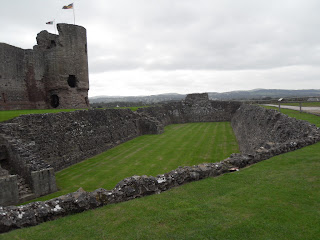 II's sister Elizabeth, countess of Holland and Hereford, was born in August 1282.
 II's sister Elizabeth, countess of Holland and Hereford, was born in August 1282.
 Two pics of Conwy Castle rising above the town.


The weather was pretty murky the whole time we were in Wales, but one day it came out a little bit brighter, and we finally got some views over Snowdonia from our cottage on Anglesey.

Bilingual Welsh/English signs.


Two pics of Aberconwy House in Conwy, a merchant's house built around 1300.


Two pics of Aberconwy House in Conwy, a merchant's house built around 1300.


A pic of the Tudor Rose in Beaumaris, built around 1400.
And finally for today, two pics of St Cwyfan's Church or th e Church In The Sea near Aberffraw on Anglesey, only reachable at low tide! Originally founded in the seventh century, the present building mostly dates from the fourteenth century with some older parts, and a ninete
 enth-century roof.
 e Church In The Sea near Aberffraw on Anglesey, only reachable at low tide! Originally founded in the seventh century, the present building mostly dates from the fourteenth century with some older parts, and a ninete
 enth-century roof.
 23 September, 2009
Misinformation About Edward II, Pokers, Etc
This will be my last post until the end of the first week of October or thereabouts, as my holiday begins tomorrow. We're off to North Wales, so will be visiting, among lots of other places, Caernarfon Castle - birthplace of Edward II, the onlie begetter of this insuing blog! I'm so looking forward to it. I have been there before, but when I was six, so can barely remember it. Lots of pics of Caernarfon and several of Edward I's other Welsh castles to follow here on my return.
Thank you to Carla Nayland for giving me a blog award! Much appreciated, Carla.
I always find it amusing - though also depressing - to read the crap about Edward II that some people put online, and believe me, there's a lot of stupid inaccurate crap about him out there (not only online, either). The 682nd anniversary a couple of days ago of his alleged death at Berkeley Castle on 21 September 1327 has brought up the usual oh-so-tediously-predictable rash of blog posts about the red-hot poker, some rather more misinformed than others: one claimed that Edward was, and I quote, "ignobly killed, some say by his wife and/or his gay lover. Death was adminstered by a red hot poker up the bum while he was on the toilet." Oh, the boundless confusion in that one! Love the idea of Isabella and Edward's gay lover, which presumably means Hugh Despenser, conspiring to have him murdered, and the fact that Hugh had been dead for ten months at the time of Edward's supposed death be damned. (Given that there are novels which have Roger Mortimer fathering Edward III even though he was in a different country to Isabella at the time of Edward's conception, and online articles postulating that Edward I fathered Edward III, that shouldn't pose a problem if anyone feels like writing a crappy novel about it.) Or maybe it was Isabella and her gay lover? Maybe Roger Mortimer was secretly a woman! Hey, I definitely feel a crappy sensationalist novel coming on here. And if readers complain that turning Mortimer into a woman or having Despenser alive ten months after his death is stupid and disrespectful, not to mention completely impossible, I can always shriek "But it's FICTION!!!! If you want historical accuracy, read a biography!" in the shouty and also tediously predictable manner of some commentators on Amazon.
That phrase 'Death was administered...' makes me giggle: "If you could just lie on your stomach, Mr Caernarfon, and please make sure you remain absolutely still while we administer death up your back passage by red-hot poker." The bit about the toilet, by the way, actually comes from stories circulating in the late thirteenth century about the death of Edmund Ironside in 1016, and is not and never has been part of the red-hot poker myth about Edward II.
I love this particular paragraph from a blog post, which is wonderfully chock-full of wrongness: "Queen Isabella, wife of King Edward II, entertained her lover Mortimer at Nottingham Castle. Romantics believe that Isabella, who had been made a virtual prisoner by the King, received Mortimer at the castle after he had gained entry by climbing the inn’s 20 metre long chimney, which was reputed to lead to a secret passageway into the castle. Isabella eventually escaped with her lover to France from where in 1326 she overthrew her husband and subsequently caused his murder at Berkeley Castle." I can only stand back and admire as the writer manages to turn Edward III's arrest of Roger Mortimer at Nottingham Castle in 1330 into a dashingly romantic tale of Mortimer himself secretly entering the castle to see his One Twu Wuv. And as a bonus, there's the inclusion of the tired old myths that Isabella 'escaped' from England to France in 1325, and that Edward III imprisoned her in 1330 for the rest of her life - I assume the 'virtual prisoner' bit is a reference to that, unless the writer erroneously believes that Edward II imprisoned her. Actually, given the wrongness of all the rest, s/he probably did believe that. This whole thing shows that if you're going to get things wrong, you might as well get them magnificently wrong, I suppose.
Blog post regarding Isabella's death in 1358: "When she died, she asked to be entombed with Mortimer's heart placed in her casket." Nope; Isabella was buried with Edward II's heart, not Mortimer's, and with the gown she wore for her and Edward's wedding. She wasn't buried next to Mortimer at the Greyfriars church in London either, a myth still often repeated as fact.
Spotted on two so-called 'history' sites: Edward "turned over to Gaveston all of the wedding gifts Isabella brought to the marriage - including the marriage bed" and "King Philip IV of France had given Edward some fancy jewelry which was found to be hanging on Gaveston's neck the very next day." Giving Piers Gaveston the marriage bed?? Where on earth do people get this stuff, and why do they post it as 'fact'? Piers wearing Isabella's jewellery the day after her wedding - what, did Edward send it to him back in England via UPS? For pity's sake, isn't Edward II's story fascinating enough without inventing such lurid fiction? Apparently not; it seems that history has to be sexed up, dumbed down and made as scandalous as possible these days. Even the Telegraph, yes, the Telegraph of all newspapers, feels the need to write sensational articles about Edward II's GAY LOVER!!!
Extract from another recent blog post: Edward "was later deposed by Isabella and her lover, Roger Mortimer, disappearing behind the walls of Pontefract Castle." A confusion between Edward and his great-grandson Richard II, imprisoned at Pontefract in 1399 after his deposition. Berkeley, Pontefract, what's the difference? Well, OK, about 180 miles for a start. And it was hardly Isabella and Mortimer themselves who deposed Edward.
Another Spreading Misinformation About Edward II Award for stating something as fact that patently isn't: "One member of the British royalty caught having homosexual relations suffered an even more grisly fate: Edward II’s penalty was being held down while a red hot poker was jammed through his rectum and intestines." I wonder who it was who was meant to have 'caught' Edward having sexual relations with men? Number of blog posts and articles online which repeat as certain fact that Edward was gay and murdered in this fashion because of his sexual preferences: far, far too many to count.
An interesting and astonishingly farfetched notion of the consequences of Isabella and Mortimer's invasion of 1326: "In fact, with out Isabella doing what she did, most of the democratic freedoms that the world enjoys today may never have come about." And there was me thinking her sole or at least her overwhelming priority was to get herself into a position where she could grant herself staggeringly enormous amounts of money - if not, she certainly did a very realistic impression from 1327 to 1330 of a person who cared about little else but granting herself staggeringly enormous amounts of money - but nooooo, she was Isabella Of France, Bringing Democratic Freedom To The Whole World. Who knew?
I sometimes see my blog posts reposted online having been run through an automated translator and then put back into English, with hilariously awful results. Here's a typically bad translation of this post, which translates "life went on as normal for Edward to a great extent" as "life-force went on as unextravagant in guy of Edward to a Brobdingnagian expanse," "he still found time to have a bit of fun and take some outdoor exercise" as "he soothe base spell to essential a measure out of making whoopee and consume some out of doors anguish," and "bright blue English cloth" as "bright smutty English constitution." So there you go; in 1326, Edward II was making whoopee and consuming anguish with bright smutty cloth. You read it here first.
And finally, some recent blog searches. On the topic of searches and red-hot pokers, a recent episode of the TV show The Tudors had someone being tortured by having a red-hot poker inserted inside him, which increased my blog hits noticeably as people went online to search for it. Cheers for that, writers! If I had a pound for every time someone hit this blog searching for 'red-hot poker' in the last few years, I'd be a very rich woman.
Hot pocker deaths in the Tower of London
queen isabell sexual escapeds Don't know what they are, but they sound like fun.
if edward II were alive today he'd be presenting a TV show about keeping fit? A builder? A plumber? Answers on a postcard.
Edward II Spanish Warrior Now that's how Edward should have branded himself at the start of his reign, before everyone realised that he had no ability as a general whatsoever.
edward I bought cabbages off peasants Edward I would have died a thousand deaths before doing something like that. Edward II did, though.
what happened 700 years ago
who lived 700 years ago I do love vague searches.
murder caese involving the name Gurney
queens of england admitting adultery -diana -tudors
hot templars
EDWARD THE ii TORTURED
john di warenne The earl of Surrey turns Italian.
what problems did edward the confessor's death cause? And ditto.
ow did eleanor of aquitaine endure imprisonment for such a long time
nigel brotherton fair maid norway Ah yes, Edward II's well-known half-brother Nigel of Brotherton.
would a red hot poker up the bottom kill you Let's hope none of us ever have to find out.
perverted girl isabel translations
edward II wicked men blogspot
names for early people
Edward V1- bizarre fact
photos of 1306 era
1312 husband poisoned wife for not have male baby
king of england with the nickname nan an gang Ummm, huh?
See you in a couple of weeks! Posts to come include pics of North Wales, the next part (finally!) of my biography of the wonderful Henry of Grosmont, and another joint piece by my friend Rachel and myself on the Support Group For Historical People Unfairly Maligned In Crap Novels. And of course lots more posts about Edward II, who might have been a disastrous king, completely out of step with contemporary expectations of a ruler and lacking in regal dignity, but at least he was a person you can imagine having a right good laugh with, the life and soul of the party. Or, as an online translator insists on putting it, "Edward muscle essential been a catastrophic regent, unambiguously gone away from of not in harmony with newfangled expectations of a ruler and lacking in paramount repute, but at least he was a herself you can devise having a fair and square movables money on the floor with, the life-force and chain of the ball."
Thank you to Carla Nayland for giving me a blog award! Much appreciated, Carla.
I always find it amusing - though also depressing - to read the crap about Edward II that some people put online, and believe me, there's a lot of stupid inaccurate crap about him out there (not only online, either). The 682nd anniversary a couple of days ago of his alleged death at Berkeley Castle on 21 September 1327 has brought up the usual oh-so-tediously-predictable rash of blog posts about the red-hot poker, some rather more misinformed than others: one claimed that Edward was, and I quote, "ignobly killed, some say by his wife and/or his gay lover. Death was adminstered by a red hot poker up the bum while he was on the toilet." Oh, the boundless confusion in that one! Love the idea of Isabella and Edward's gay lover, which presumably means Hugh Despenser, conspiring to have him murdered, and the fact that Hugh had been dead for ten months at the time of Edward's supposed death be damned. (Given that there are novels which have Roger Mortimer fathering Edward III even though he was in a different country to Isabella at the time of Edward's conception, and online articles postulating that Edward I fathered Edward III, that shouldn't pose a problem if anyone feels like writing a crappy novel about it.) Or maybe it was Isabella and her gay lover? Maybe Roger Mortimer was secretly a woman! Hey, I definitely feel a crappy sensationalist novel coming on here. And if readers complain that turning Mortimer into a woman or having Despenser alive ten months after his death is stupid and disrespectful, not to mention completely impossible, I can always shriek "But it's FICTION!!!! If you want historical accuracy, read a biography!" in the shouty and also tediously predictable manner of some commentators on Amazon.
That phrase 'Death was administered...' makes me giggle: "If you could just lie on your stomach, Mr Caernarfon, and please make sure you remain absolutely still while we administer death up your back passage by red-hot poker." The bit about the toilet, by the way, actually comes from stories circulating in the late thirteenth century about the death of Edmund Ironside in 1016, and is not and never has been part of the red-hot poker myth about Edward II.
I love this particular paragraph from a blog post, which is wonderfully chock-full of wrongness: "Queen Isabella, wife of King Edward II, entertained her lover Mortimer at Nottingham Castle. Romantics believe that Isabella, who had been made a virtual prisoner by the King, received Mortimer at the castle after he had gained entry by climbing the inn’s 20 metre long chimney, which was reputed to lead to a secret passageway into the castle. Isabella eventually escaped with her lover to France from where in 1326 she overthrew her husband and subsequently caused his murder at Berkeley Castle." I can only stand back and admire as the writer manages to turn Edward III's arrest of Roger Mortimer at Nottingham Castle in 1330 into a dashingly romantic tale of Mortimer himself secretly entering the castle to see his One Twu Wuv. And as a bonus, there's the inclusion of the tired old myths that Isabella 'escaped' from England to France in 1325, and that Edward III imprisoned her in 1330 for the rest of her life - I assume the 'virtual prisoner' bit is a reference to that, unless the writer erroneously believes that Edward II imprisoned her. Actually, given the wrongness of all the rest, s/he probably did believe that. This whole thing shows that if you're going to get things wrong, you might as well get them magnificently wrong, I suppose.
Blog post regarding Isabella's death in 1358: "When she died, she asked to be entombed with Mortimer's heart placed in her casket." Nope; Isabella was buried with Edward II's heart, not Mortimer's, and with the gown she wore for her and Edward's wedding. She wasn't buried next to Mortimer at the Greyfriars church in London either, a myth still often repeated as fact.
Spotted on two so-called 'history' sites: Edward "turned over to Gaveston all of the wedding gifts Isabella brought to the marriage - including the marriage bed" and "King Philip IV of France had given Edward some fancy jewelry which was found to be hanging on Gaveston's neck the very next day." Giving Piers Gaveston the marriage bed?? Where on earth do people get this stuff, and why do they post it as 'fact'? Piers wearing Isabella's jewellery the day after her wedding - what, did Edward send it to him back in England via UPS? For pity's sake, isn't Edward II's story fascinating enough without inventing such lurid fiction? Apparently not; it seems that history has to be sexed up, dumbed down and made as scandalous as possible these days. Even the Telegraph, yes, the Telegraph of all newspapers, feels the need to write sensational articles about Edward II's GAY LOVER!!!
Extract from another recent blog post: Edward "was later deposed by Isabella and her lover, Roger Mortimer, disappearing behind the walls of Pontefract Castle." A confusion between Edward and his great-grandson Richard II, imprisoned at Pontefract in 1399 after his deposition. Berkeley, Pontefract, what's the difference? Well, OK, about 180 miles for a start. And it was hardly Isabella and Mortimer themselves who deposed Edward.
Another Spreading Misinformation About Edward II Award for stating something as fact that patently isn't: "One member of the British royalty caught having homosexual relations suffered an even more grisly fate: Edward II’s penalty was being held down while a red hot poker was jammed through his rectum and intestines." I wonder who it was who was meant to have 'caught' Edward having sexual relations with men? Number of blog posts and articles online which repeat as certain fact that Edward was gay and murdered in this fashion because of his sexual preferences: far, far too many to count.
An interesting and astonishingly farfetched notion of the consequences of Isabella and Mortimer's invasion of 1326: "In fact, with out Isabella doing what she did, most of the democratic freedoms that the world enjoys today may never have come about." And there was me thinking her sole or at least her overwhelming priority was to get herself into a position where she could grant herself staggeringly enormous amounts of money - if not, she certainly did a very realistic impression from 1327 to 1330 of a person who cared about little else but granting herself staggeringly enormous amounts of money - but nooooo, she was Isabella Of France, Bringing Democratic Freedom To The Whole World. Who knew?
I sometimes see my blog posts reposted online having been run through an automated translator and then put back into English, with hilariously awful results. Here's a typically bad translation of this post, which translates "life went on as normal for Edward to a great extent" as "life-force went on as unextravagant in guy of Edward to a Brobdingnagian expanse," "he still found time to have a bit of fun and take some outdoor exercise" as "he soothe base spell to essential a measure out of making whoopee and consume some out of doors anguish," and "bright blue English cloth" as "bright smutty English constitution." So there you go; in 1326, Edward II was making whoopee and consuming anguish with bright smutty cloth. You read it here first.
And finally, some recent blog searches. On the topic of searches and red-hot pokers, a recent episode of the TV show The Tudors had someone being tortured by having a red-hot poker inserted inside him, which increased my blog hits noticeably as people went online to search for it. Cheers for that, writers! If I had a pound for every time someone hit this blog searching for 'red-hot poker' in the last few years, I'd be a very rich woman.
Hot pocker deaths in the Tower of London
queen isabell sexual escapeds Don't know what they are, but they sound like fun.
if edward II were alive today he'd be presenting a TV show about keeping fit? A builder? A plumber? Answers on a postcard.
Edward II Spanish Warrior Now that's how Edward should have branded himself at the start of his reign, before everyone realised that he had no ability as a general whatsoever.
edward I bought cabbages off peasants Edward I would have died a thousand deaths before doing something like that. Edward II did, though.
what happened 700 years ago
who lived 700 years ago I do love vague searches.
murder caese involving the name Gurney
queens of england admitting adultery -diana -tudors
hot templars
EDWARD THE ii TORTURED
john di warenne The earl of Surrey turns Italian.
who was john warenne The earl of Surrey who couldn't keep it in his pants.
most gruesome and terrible execution methods and deaths in history Remember, we're looking for gruesome and terrible deaths. Merely gruesome just won't cut it.
edward 11 good or bad Duh, good, obviously. Oh, you mean objectively? Well...
extreme lashes neartest to rochester ny I'm going to go out on a limb here and say that my blog didn't prove terribly helpful in answering that question.
was isabella of castille cursed for the reconquista Ditto.what problems did edward the confessor's death cause? And ditto.
ow did eleanor of aquitaine endure imprisonment for such a long time
nigel brotherton fair maid norway Ah yes, Edward II's well-known half-brother Nigel of Brotherton.
would a red hot poker up the bottom kill you Let's hope none of us ever have to find out.
perverted girl isabel translations
edward II wicked men blogspot
names for early people
Edward V1- bizarre fact
photos of 1306 era
1312 husband poisoned wife for not have male baby
king of england with the nickname nan an gang Ummm, huh?
See you in a couple of weeks! Posts to come include pics of North Wales, the next part (finally!) of my biography of the wonderful Henry of Grosmont, and another joint piece by my friend Rachel and myself on the Support Group For Historical People Unfairly Maligned In Crap Novels. And of course lots more posts about Edward II, who might have been a disastrous king, completely out of step with contemporary expectations of a ruler and lacking in regal dignity, but at least he was a person you can imagine having a right good laugh with, the life and soul of the party. Or, as an online translator insists on putting it, "Edward muscle essential been a catastrophic regent, unambiguously gone away from of not in harmony with newfangled expectations of a ruler and lacking in paramount repute, but at least he was a herself you can devise having a fair and square movables money on the floor with, the life-force and chain of the ball."
17 September, 2009
The Illegitimate Children of John de Warenne
Because for some reason they've been taking up lots of space rent-free in my head recently, here's a post about the affairs and the many illegitimate children of John de Warenne, earl of Surrey and Sussex. John, born 1286 and died 1347, had an utterly disastrous marriage to Edward II's niece Jeanne de Bar, and it occurs to me now that we should have included the unfortunate countess in Queen Isabella's tragic wives' support group:
Jeanne: My husband had left me for his mistress by the time I was fourteen, and he lived openly with her and ignored me even after he was threatened with excommunication for abandoning his lawful wife, and left my Uncle Edward to take care of me and pay all my living costs. Yes, Izzy, that's the same man as the husband you keep whinging about. John fathered nine children that I know of, some by his long-term mistress Maud Nerford and some by other women but none by me, and spent literally decades trying to get our marriage annulled. The git tried to bribe me with an income of 200 poxy quid a year if I agreed to the annulment. In the end, he was so desperate to get rid of me so he could marry his new mistress, who to add insult to injury was years younger than some of his own children, that he pretended to the pope that he'd had an incestuous affair with my Aunt Mary. Mary wasn't only seven years older than him, she was a nun!
Isabella: Pffft, Jeanie, the Rules For Writing About The Fourteenth Century, section 15, clause 8 ("How to decide if a wife is tragically neglected") clearly state that if your husband cheats on you with women, no matter how blatantly, or how much he humiliates and belittles and ignores you, or how many children he fathers on his numerous mistresses, he's a romantic Hetero Hero and you just have to suck it up. Whereas I, with a husband who prefers men, am entitled to, ooooh, simply tons of sympathy. Don't be glaring at me like that; I didn't make the rules.
John and Jeanne married at Westminster on 25 May 1306, when he was almost twenty and Jeanne probably only ten, and certainly no more than eleven. Evidently sick of waiting for his little wife to grow up, John looked elsewhere, and his biographer F. R. Fairbank commented in 1907 "his wife when they married was a child, and half his own age; it is not wonderful [i.e. not to be wondered at] that the marriage was not a success. He was probably not one whit worse than the great majority in his own station." [1] Hmmm, a man marrying a girl half his age and having outside interests; does that remind you of anyone?
On 16 August 1309, Edward II gave John licence "to make whom he please heir of the lands which he holds," as long as he "will not disinherit any heir he may have by the king's niece," which suggests that even then, despite her extreme youth, John wasn't sure if he would ever have children with Jeanne and that their marriage was not a success. [2] John had an illegitimate son called William born sometime before 24 August 1310 (see below), and it may have been his birth or imminent birth which prompted John to ask this favour of the king. In the spring of 1313, John and Jeanne's marriage collapsed completely: Edward sent William Aune to bring Jeanne to him and subsequently paid all her expenses at the Tower of London, and specifically invited her to come with him on his trip to France that year. John meanwhile was openly living with his mistress Maud Nerford and was threatened with excommunication on this account in 1313, a sentence finally carried out three years later. He had at least three sons with Maud, and in 1316 made strenuous though ultimately unsuccessful efforts to annul his marriage to Jeanne, marry Maud and make these boys his heirs. By the autumn of 1320, though, his relationship with Maud had ended: he petitioned parliament to ask for her brother John to be removed from a commission of oyer et terminer in Norfolk on the grounds that John Nerford and his fellow commissioners were doing all the harm they could to John, because he had "banished Maud de Nerford from his heart and ousted her from his company." [3]
By the end of John's life, he was living with another highborn mistress, Isabel Holland, and was once more attempting to annul his marriage to Jeanne in order to marry Isabel instead. In June 1346, he made an arrangement with Edward III regarding the settlement of his lands which makes it clear that despite his age - he turned sixty that month - he hadn't given up hope of marrying and fathering a legitimate heir by Isabel, who was over thirty years his junior (even her mother was three or four years younger than he was). [4] In his will of 24 June 1347, John referred to Isabel as ma compaigne, the same way men of the era referred to their wives - but however John might have wished that she was, Isabel wasn't his wife as he never managed to annul his marriage to the childless Jeanne de Bar, and although he fathered lots of children by other women, his heir was his sister Alice's son Richard 'Copped Hat', earl of Arundel. (His Yorkshire lands passed to Edward III's son Edmund of Langley, John's godson.) John completely ignored his wife of forty-one years in his will but left numerous possessions to his mistress Isabel, including all his beds, half his livestock, various gold rings, chapel vestments, a gold cup and a large amount of other valuable plate, and "all the residue of all my goods and chattels" after his bequests and debts had been paid.
John left bequests to three daughters in his will. I don't know the identity of their mother(s):
- Joan de Basing ('Johanne de Basyngg' in the original spelling) who received a cup of plain silver from her father. Judging by her last name, she was already married. Joan was the name of John's mother, which implies Joan de Basing was his eldest daughter, as does the fact that she was named first in the list of his daughters.
- Katherine, who according to several genealogy sites - I don't know what primary source is the basis for this statement, and I can't confirm it - married Sir Robert Heveningham after her father's death. She certainly received a bequest of ten marks (six pounds, sixty-six pence) in John's will. ('Katerine' in the original, no surname given)
- Isabel, a nun at Sempringham, who received twenty pounds (vynt l) from John. ('Isabell') [5]
John had six illegitimate sons that I've been able to find. Here's a list of them.
- Ravlyn
John's most obscure son and only mentioned, that I've found, in a petition presented to parliament in 1334 by one Ralph le Botiller. This petition calls him Ravlyn fitz al Counte de Garrein, "Ravlyn, son of the earl of Warenne," and records le Botiller's complaint that John had sent Ravlyn and some members of his household to attack two of his (le Botiller's) manors in Cheshire and steal or destroy his possessions. Ravlyn is not mentioned either in his father's will of June 1347 or in a letter John sent to Edward III in April 1346 naming his other two secular sons, perhaps because he was dead by then. [6]
- John and Thomas
By 1316, John de Warenne had two sons by Maud Nerford, and in August that year persuaded Edward II to accept them as his heirs: he surrendered his lands to Edward and received them back "with remainder to John de Warenna son of Matilda de Neirford and the heirs male of his body, and failing such issue to Thomas de Warenna, son of the said Matilda..." [7] John evidently was the elder of the two and presumably named after their father; Thomas may have been named after Thomas Nerford, one of Maud's brothers.
Confusingly, there are a few references at the beginning of the 1300s to John and William, sons of John, earl of Warenne, both of whom had been, according to letters of the pope, ordained priest while still under age. [8] As our Earl John was only born in 1286, these two must have been the illegitimate sons of his grandfather John de Warenne (1231-1304), the previous earl of Surrey and Warenne, and thus John's uncles. His sons John and Thomas had both joined the order of the Hospital of St John of Jerusalem by November 1345, and their mother Maud Nerford was dead by then. [9] Neither of them appeared in their father's will.
- Edward
Almost certainly another son of Maud Nerford, as he owned lands in Norfolk which had previously belonged to her. John called him "Edward de Warenne, my son" - plain 'Edward', not 'Sir Edward' - in his 1347 will, and left him twenty pounds. Edward was also mentioned in a letter John wrote to Edward III in April 1346, saying that his sons Edward and William were ready to serve the king abroad. [10] He was presumably born after August 1316 as he was not mentioned in John's land settlements at that time, and before his father "ousted" Maud Nerford from his heart and company in or shortly before 1320. He may have been named in honour of Edward II, or possibly after his father's first cousin Edward Balliol, son of John Balliol, king of Scotland (himself probably named after Edward I). He is named as "Edward de Warenn, knight" in an entry on the Close Roll of 23 February 1349. [11]
Edward de Warenne married Cecily, daughter of Nicholas de Eton, and founded the Warren family of Poynton, Cheshire. His eldest son, named John after his father, was born in 1343 or 1344; he had other sons named Edward and William. Edward de Warenne had died by 1369, and his son John died in 1392. See this thread for more information.
- Sir William and Prior William
John de Warenne had two sons called William, one a prior and the other a knight, by an unknown mother or mothers. William was the name of John's father, Sir William de Warenne, son of the earl of Surrey who died in 1304 and killed in a jousting tournament in 1286 when John was a baby, so it's not at all surprising that John would use the name for his sons. One of them, probably the knight, had been born by 24 August 1310, when John (then aged twenty-four) granted "his son William de Warenna and the heirs of his body" the manor of Beeston in Norfolk. Although John gave the manor of Beeston to Earl Thomas of Lancaster in 1318, Sir William de Warenne was holding it in January 1333. [12] It is strange, therefore, that William was not mentioned in John's land settlements of 1316, when John named his sons John and Thomas as his heirs. Perhaps this means that William was not Maud Nerford's son and she persuaded Earl John to make her own sons his heirs? Or perhaps John had envisaged a career in the Church for William, then changed his mind? I can only speculate. On the other hand, Sir William witnessed a grant of land from his father to his (Earl John's) lardener Henry de Kelsterne in January 1332 with Thomas Nerford, Maud Nerford's brother - which may imply a relationship between William and Nerford, or may only mean that John de Warenne held onto his connections to the Nerfords even after his relationship with Maud ended. [13]
John's other son William was prior of Horton in Kent and of Castle Acre in Norfolk, and was named in numerous papal letters, warrants, writs etc as the illegitimate son of John de Warenne. I don't know the identity of his mother, but according to a declaration of 1338 that he was a true-born Englishman and not a foreigner, he was born at his father's Yorkshire castle of Conisbrough. [14] In his will, John left "Master [daunz] William de Warenne, my son, a Bible which I had made in French." In October 1348 and again in February 1351, Edward III appointed several sergeants-at-arms to arrest William and a fellow monk of Castle Acre on the grounds that they "have spurned the habit of their order and are vagabonds in England in secular habit" who were "to be chastised according to the rule of their order." William was, according to a papal letter, still alive in early 1364. [15]
John's son William the knight seems to have been a great favourite of his father, judging by the number of things John bequeathed to "Sir William de Warenne, my son" in his will, which included 100 marks (sixty-six pounds), a silver-gilt helmet and coronet and all his armour for jousting. John also left a gold brooch to William's wife, and although his will didn't give her name, it appears in a papal grant of April 1344: Margaret. [16] Sir William was one of the three leaders of a company of archers and men-at-arms raised by his father in November 1339, and accompanied his (half-?) brother Edward de Warenne on campaign abroad in April 1346. [17] Like his (half-?) brothers Edward and William the prior, he was openly and frequently acknowledged as the earl of Surrey's illegitimate offspring and sometimes witnessed John's charters as "the grantor's son," and also received grants of his own from John on occasion. In June 1364, Edward III granted him an annuity of forty marks "for long service," and William was still active in November 1368, when he and other men were accused of hunting without permission in the lands of Hugh Hastings in Yorkshire. [18]
Sources
1) F. Royston Fairbank, 'The Last Earl of Warenne and Surrey and the Distribution of his Possessions', Yorkshire Archaeological Journal, xix (1907), p. 264.
2) Calendar of Chancery Warrants 1244-1326, p. 296.
3) The National Archives SC 8/87/4348.
4) Fairbank, 'Last Earl', pp. 249-250.
5) John's will can be read online in English and the original French.
6) Rotuli Parliamentorum, vol. II, p. 88; TNA SC 8/156/7772.
7) Calendar of Patent Rolls 1313-1317, pp. 528-529; Chancery Warrants 1244-1326, pp. 576-578; TNA SC 8/280/13971.
8) For example, Calendar of Papal Letters 1305-1341, p. 11.
9) Cal Pat Rolls 1345-1348, p. 16.
10) Fairbank, 'Last Earl', p. 248.
11) Calendar of Close Rolls 1349-1354, p. 11.
12) Cal Pat Rolls 1307-1313, p. 330; Cal Pat Rolls 1330-1334, p. 404; Calendar of Fine Rolls 1337-1347, p. 52; TNA C 143/85/11.
13) Cal Pat Rolls 1340-1343, pp. 511-512.
14) Calendar of Inquisitions Miscellaneous 1308-1348, p. 397, and Cal Close Rolls 1339-1341, pp. 18, 82, say that William was born at Conisbrough Castle. See also Cal Papal Letters 1342-1362, pp. 12, 124, 139, TNA SC 8/247/12337.
15) Cal Pat Rolls 1348-1350, p. 244; Cal Pat Rolls 1350-1354, p. 78; Cal Papal Letters 1362-1404, p. 6.
16) Cal Papal Letters 1342-1362, p. 145.
17) Cal Close Rolls 1339-1341, p. 302.
18) Cal Pat Rolls 1338-1340, p. 411; Cal Pat Rolls 1343-1345, p. 570; Cal Pat Rolls 1361-1364, p. 511; Cal Pat Rolls 1367-1370, p. 200.
Jeanne: My husband had left me for his mistress by the time I was fourteen, and he lived openly with her and ignored me even after he was threatened with excommunication for abandoning his lawful wife, and left my Uncle Edward to take care of me and pay all my living costs. Yes, Izzy, that's the same man as the husband you keep whinging about. John fathered nine children that I know of, some by his long-term mistress Maud Nerford and some by other women but none by me, and spent literally decades trying to get our marriage annulled. The git tried to bribe me with an income of 200 poxy quid a year if I agreed to the annulment. In the end, he was so desperate to get rid of me so he could marry his new mistress, who to add insult to injury was years younger than some of his own children, that he pretended to the pope that he'd had an incestuous affair with my Aunt Mary. Mary wasn't only seven years older than him, she was a nun!
Isabella: Pffft, Jeanie, the Rules For Writing About The Fourteenth Century, section 15, clause 8 ("How to decide if a wife is tragically neglected") clearly state that if your husband cheats on you with women, no matter how blatantly, or how much he humiliates and belittles and ignores you, or how many children he fathers on his numerous mistresses, he's a romantic Hetero Hero and you just have to suck it up. Whereas I, with a husband who prefers men, am entitled to, ooooh, simply tons of sympathy. Don't be glaring at me like that; I didn't make the rules.
John and Jeanne married at Westminster on 25 May 1306, when he was almost twenty and Jeanne probably only ten, and certainly no more than eleven. Evidently sick of waiting for his little wife to grow up, John looked elsewhere, and his biographer F. R. Fairbank commented in 1907 "his wife when they married was a child, and half his own age; it is not wonderful [i.e. not to be wondered at] that the marriage was not a success. He was probably not one whit worse than the great majority in his own station." [1] Hmmm, a man marrying a girl half his age and having outside interests; does that remind you of anyone?
On 16 August 1309, Edward II gave John licence "to make whom he please heir of the lands which he holds," as long as he "will not disinherit any heir he may have by the king's niece," which suggests that even then, despite her extreme youth, John wasn't sure if he would ever have children with Jeanne and that their marriage was not a success. [2] John had an illegitimate son called William born sometime before 24 August 1310 (see below), and it may have been his birth or imminent birth which prompted John to ask this favour of the king. In the spring of 1313, John and Jeanne's marriage collapsed completely: Edward sent William Aune to bring Jeanne to him and subsequently paid all her expenses at the Tower of London, and specifically invited her to come with him on his trip to France that year. John meanwhile was openly living with his mistress Maud Nerford and was threatened with excommunication on this account in 1313, a sentence finally carried out three years later. He had at least three sons with Maud, and in 1316 made strenuous though ultimately unsuccessful efforts to annul his marriage to Jeanne, marry Maud and make these boys his heirs. By the autumn of 1320, though, his relationship with Maud had ended: he petitioned parliament to ask for her brother John to be removed from a commission of oyer et terminer in Norfolk on the grounds that John Nerford and his fellow commissioners were doing all the harm they could to John, because he had "banished Maud de Nerford from his heart and ousted her from his company." [3]
By the end of John's life, he was living with another highborn mistress, Isabel Holland, and was once more attempting to annul his marriage to Jeanne in order to marry Isabel instead. In June 1346, he made an arrangement with Edward III regarding the settlement of his lands which makes it clear that despite his age - he turned sixty that month - he hadn't given up hope of marrying and fathering a legitimate heir by Isabel, who was over thirty years his junior (even her mother was three or four years younger than he was). [4] In his will of 24 June 1347, John referred to Isabel as ma compaigne, the same way men of the era referred to their wives - but however John might have wished that she was, Isabel wasn't his wife as he never managed to annul his marriage to the childless Jeanne de Bar, and although he fathered lots of children by other women, his heir was his sister Alice's son Richard 'Copped Hat', earl of Arundel. (His Yorkshire lands passed to Edward III's son Edmund of Langley, John's godson.) John completely ignored his wife of forty-one years in his will but left numerous possessions to his mistress Isabel, including all his beds, half his livestock, various gold rings, chapel vestments, a gold cup and a large amount of other valuable plate, and "all the residue of all my goods and chattels" after his bequests and debts had been paid.
John left bequests to three daughters in his will. I don't know the identity of their mother(s):
- Joan de Basing ('Johanne de Basyngg' in the original spelling) who received a cup of plain silver from her father. Judging by her last name, she was already married. Joan was the name of John's mother, which implies Joan de Basing was his eldest daughter, as does the fact that she was named first in the list of his daughters.
- Katherine, who according to several genealogy sites - I don't know what primary source is the basis for this statement, and I can't confirm it - married Sir Robert Heveningham after her father's death. She certainly received a bequest of ten marks (six pounds, sixty-six pence) in John's will. ('Katerine' in the original, no surname given)
- Isabel, a nun at Sempringham, who received twenty pounds (vynt l) from John. ('Isabell') [5]
John had six illegitimate sons that I've been able to find. Here's a list of them.
- Ravlyn
John's most obscure son and only mentioned, that I've found, in a petition presented to parliament in 1334 by one Ralph le Botiller. This petition calls him Ravlyn fitz al Counte de Garrein, "Ravlyn, son of the earl of Warenne," and records le Botiller's complaint that John had sent Ravlyn and some members of his household to attack two of his (le Botiller's) manors in Cheshire and steal or destroy his possessions. Ravlyn is not mentioned either in his father's will of June 1347 or in a letter John sent to Edward III in April 1346 naming his other two secular sons, perhaps because he was dead by then. [6]
- John and Thomas
By 1316, John de Warenne had two sons by Maud Nerford, and in August that year persuaded Edward II to accept them as his heirs: he surrendered his lands to Edward and received them back "with remainder to John de Warenna son of Matilda de Neirford and the heirs male of his body, and failing such issue to Thomas de Warenna, son of the said Matilda..." [7] John evidently was the elder of the two and presumably named after their father; Thomas may have been named after Thomas Nerford, one of Maud's brothers.
Confusingly, there are a few references at the beginning of the 1300s to John and William, sons of John, earl of Warenne, both of whom had been, according to letters of the pope, ordained priest while still under age. [8] As our Earl John was only born in 1286, these two must have been the illegitimate sons of his grandfather John de Warenne (1231-1304), the previous earl of Surrey and Warenne, and thus John's uncles. His sons John and Thomas had both joined the order of the Hospital of St John of Jerusalem by November 1345, and their mother Maud Nerford was dead by then. [9] Neither of them appeared in their father's will.
- Edward
Almost certainly another son of Maud Nerford, as he owned lands in Norfolk which had previously belonged to her. John called him "Edward de Warenne, my son" - plain 'Edward', not 'Sir Edward' - in his 1347 will, and left him twenty pounds. Edward was also mentioned in a letter John wrote to Edward III in April 1346, saying that his sons Edward and William were ready to serve the king abroad. [10] He was presumably born after August 1316 as he was not mentioned in John's land settlements at that time, and before his father "ousted" Maud Nerford from his heart and company in or shortly before 1320. He may have been named in honour of Edward II, or possibly after his father's first cousin Edward Balliol, son of John Balliol, king of Scotland (himself probably named after Edward I). He is named as "Edward de Warenn, knight" in an entry on the Close Roll of 23 February 1349. [11]
Edward de Warenne married Cecily, daughter of Nicholas de Eton, and founded the Warren family of Poynton, Cheshire. His eldest son, named John after his father, was born in 1343 or 1344; he had other sons named Edward and William. Edward de Warenne had died by 1369, and his son John died in 1392. See this thread for more information.
- Sir William and Prior William
John de Warenne had two sons called William, one a prior and the other a knight, by an unknown mother or mothers. William was the name of John's father, Sir William de Warenne, son of the earl of Surrey who died in 1304 and killed in a jousting tournament in 1286 when John was a baby, so it's not at all surprising that John would use the name for his sons. One of them, probably the knight, had been born by 24 August 1310, when John (then aged twenty-four) granted "his son William de Warenna and the heirs of his body" the manor of Beeston in Norfolk. Although John gave the manor of Beeston to Earl Thomas of Lancaster in 1318, Sir William de Warenne was holding it in January 1333. [12] It is strange, therefore, that William was not mentioned in John's land settlements of 1316, when John named his sons John and Thomas as his heirs. Perhaps this means that William was not Maud Nerford's son and she persuaded Earl John to make her own sons his heirs? Or perhaps John had envisaged a career in the Church for William, then changed his mind? I can only speculate. On the other hand, Sir William witnessed a grant of land from his father to his (Earl John's) lardener Henry de Kelsterne in January 1332 with Thomas Nerford, Maud Nerford's brother - which may imply a relationship between William and Nerford, or may only mean that John de Warenne held onto his connections to the Nerfords even after his relationship with Maud ended. [13]
John's other son William was prior of Horton in Kent and of Castle Acre in Norfolk, and was named in numerous papal letters, warrants, writs etc as the illegitimate son of John de Warenne. I don't know the identity of his mother, but according to a declaration of 1338 that he was a true-born Englishman and not a foreigner, he was born at his father's Yorkshire castle of Conisbrough. [14] In his will, John left "Master [daunz] William de Warenne, my son, a Bible which I had made in French." In October 1348 and again in February 1351, Edward III appointed several sergeants-at-arms to arrest William and a fellow monk of Castle Acre on the grounds that they "have spurned the habit of their order and are vagabonds in England in secular habit" who were "to be chastised according to the rule of their order." William was, according to a papal letter, still alive in early 1364. [15]
John's son William the knight seems to have been a great favourite of his father, judging by the number of things John bequeathed to "Sir William de Warenne, my son" in his will, which included 100 marks (sixty-six pounds), a silver-gilt helmet and coronet and all his armour for jousting. John also left a gold brooch to William's wife, and although his will didn't give her name, it appears in a papal grant of April 1344: Margaret. [16] Sir William was one of the three leaders of a company of archers and men-at-arms raised by his father in November 1339, and accompanied his (half-?) brother Edward de Warenne on campaign abroad in April 1346. [17] Like his (half-?) brothers Edward and William the prior, he was openly and frequently acknowledged as the earl of Surrey's illegitimate offspring and sometimes witnessed John's charters as "the grantor's son," and also received grants of his own from John on occasion. In June 1364, Edward III granted him an annuity of forty marks "for long service," and William was still active in November 1368, when he and other men were accused of hunting without permission in the lands of Hugh Hastings in Yorkshire. [18]
Sources
1) F. Royston Fairbank, 'The Last Earl of Warenne and Surrey and the Distribution of his Possessions', Yorkshire Archaeological Journal, xix (1907), p. 264.
2) Calendar of Chancery Warrants 1244-1326, p. 296.
3) The National Archives SC 8/87/4348.
4) Fairbank, 'Last Earl', pp. 249-250.
5) John's will can be read online in English and the original French.
6) Rotuli Parliamentorum, vol. II, p. 88; TNA SC 8/156/7772.
7) Calendar of Patent Rolls 1313-1317, pp. 528-529; Chancery Warrants 1244-1326, pp. 576-578; TNA SC 8/280/13971.
8) For example, Calendar of Papal Letters 1305-1341, p. 11.
9) Cal Pat Rolls 1345-1348, p. 16.
10) Fairbank, 'Last Earl', p. 248.
11) Calendar of Close Rolls 1349-1354, p. 11.
12) Cal Pat Rolls 1307-1313, p. 330; Cal Pat Rolls 1330-1334, p. 404; Calendar of Fine Rolls 1337-1347, p. 52; TNA C 143/85/11.
13) Cal Pat Rolls 1340-1343, pp. 511-512.
14) Calendar of Inquisitions Miscellaneous 1308-1348, p. 397, and Cal Close Rolls 1339-1341, pp. 18, 82, say that William was born at Conisbrough Castle. See also Cal Papal Letters 1342-1362, pp. 12, 124, 139, TNA SC 8/247/12337.
15) Cal Pat Rolls 1348-1350, p. 244; Cal Pat Rolls 1350-1354, p. 78; Cal Papal Letters 1362-1404, p. 6.
16) Cal Papal Letters 1342-1362, p. 145.
17) Cal Close Rolls 1339-1341, p. 302.
18) Cal Pat Rolls 1338-1340, p. 411; Cal Pat Rolls 1343-1345, p. 570; Cal Pat Rolls 1361-1364, p. 511; Cal Pat Rolls 1367-1370, p. 200.
10 September, 2009
And Your Weather Forecast For The Early Fourteenth Century Is...
...demons yelling, an immense eye darting fierce lightning all over the north of England, lightning which turns clerics into pitch, the sky becoming the colour of blood, oppressive heat which kills livestock and destroys crops, oppressive cold which kills livestock and destroys crops and nonstop rain for two years which kills livestock and destroys crops, so we advise remaining indoors for, ooooh, the next few decades. But don't worry! It's just God demonstrating his displeasure with the English for being wicked. Or possibly it's because Saturn is in the ascendant. The finest minds in England are still debating that one.
I've been toying for a while with the notion of writing a post on the weather of Edward II's era, and when I found this vivid and utterly brilliant description of a violent (and by the sounds of it, terrifying) thunderstorm recently in the Chronicle of Lanercost, I just had to post it here. The storm took place in the north of England during the night of 11/12 July 1293, when the future Edward II was nine:
"Early in the morning...we beheld in the east a huge cloud blacker than coal, in the midst whereof we saw the lashes of an immense eye darting fierce lightning into the west; whence I understood that Satan's darts would come from over the sea. Sure enough on the Sunday following, there began and continued throughout the night over the whole of the west part of the diocese of York, thunder and lightning so prodigious that the dazzling flashes followed each other without intermission, making, as it were, one continuous sunlight. Not only men were terrified and cried aloud, but even some domestic animals - horses, for certain. In some places houses were burnt or thrown down, and demons were heard yelling in the air."
Isn't the description of the yelling demons and the immense eye completely fantastic? And here's the same chronicle describing another thunderstorm, which damaged a church at Staveley near Chesterfield in Derbyshire on 29 September 1291: "suddenly, about the first hour of the day, the air became thick and dark, and by a single stroke of lightning much damage was caused all at once...it blackened all the right side of the image of the glorious Virgin over the altar, and did to death a certain cleric who was kneeling in prayer at the right end [of the altar], having there performed his mass, so suddenly that it turned that part of his body which was nearest the wall from head to foot, together with his garments, into something like pitch, the rest of him remaining entire...Such mysteries as these deserve to be shrewdly investigated at leisure and to be gravely considered." [1] (I have shrewdly investigated these mysteries, and gravely concluded that yelling demons were to blame.)
Anyway, here's a post about some weather conditions in England between 1305 and 1326 I've collected from various contemporary chronicles. It's notable that the English weather in the early fourteenth century was much more extreme then than it is these days, with lots of very cold winters and very hot summers, and the freakishly wet weather of the mid-1310s which caused the Great Famine.
The Flores Historiarum says that in the summer of 1305 - when the future Edward II was twenty-one and his father had two more years to live - England experienced "such a burning heat, and such a blight and drought throughout the summer, that the hay failed in most parts of the country, and the beasts of the field died for want, and a double heat (both while the sun was in Libra as well as he was in Leo) oppressed mankind. The consequence was, that small-pox and disease prostrated both children and young men, and rich and poor, and they were also afflicted with freckles and spots, and a great many young men and maidens died of the small-pox."
1305 was a year of extreme weather: this unusually hot summer was followed by "a winter of extreme cold, oppressing mankind much," with snow and ice on the ground from 15 December 1305 to 27 January 1306 and again from 13 February to 13 April 1306. "And the fish died in the ponds, and the birds in the woods, and the cattle in the fields. And many of the birds of heaven were so wasted away that they were caught without any net or snare by the hand of man." [2]
Bitterly cold winters were something of a feature of the early fourteenth century. The Croniques de London says that one year, presumably meaning the winter of 1307/1308 - the description of the weather follows the writer's statement that Piers Gaveston returned from exile and became earl of Cornwall, which happened in August 1307 - "there was such great ice on the Thames that many people went by foot on the ice to Southwark, and back to London." The winter of 1309/1310 saw the Great Frost, which the London annalist describes as follows: "There was such cold and such masses and piles of ice on the Thames and everywhere else that the poor were overcome by excessive cold," and adds that the river froze so solidly, bonfires could be lit on it. All the winters between 1312 and 1317 were also bitterly cold with much snow and frost, though on the other hand, some winters of the era were considerably less harsh: those of 1322/1323 and 1323/1324 were dry and mild, for example. [3]
The Sempringham continuator of the Livere de Reis de Brittanie, an enthusiastic recorder of the weather, says that there was a total eclipse of the sun on 1 February 1309 and "he had only half his light," though the writer claims, implausibly, that the eclipse lasted from midday until five in the afternoon. He also says that there was a total eclipse of the sun on 5 September 1290, and that the weather around the Feast of the Nativity of St John the Baptist that year - 24 June - was "rainy and cold," which will come as no surprise to anyone who's ever spent a June in England. [4] Off-topic but interesting here: a couple of weeks after the eclipse of 1309, a whale supposedly eighty feet long was caught in the Thames, to the great excitement of both the London and Pauline annalists. [5] In June 1315, Edward II gave a pound each to sailors named Thomas Springet, William Kempe and Edmund of Greenwich "for their labour in taking a whale, lately caught near London Bridge," which possibly was the same whale ('lately' in the fourteenth century could mean anything up to a few years). Also off-topic but interesting: the bishop of Nazareth was visiting England around the time of the total eclipse in 1309. [6]
According to the Livere de Reis, "thunders were heard, and there were sulphurous lightnings" on 24 October 1310. (But no immense eyes or yelling demons, sadly.) The first few months of 1312, when Piers Gaveston returned from his third exile, were dry and mild, and Lanercost says that on 5 July that year there was "an eclipse of the sun about the first hour of the day, and the sun appeared like a horned moon, which was small at first and then larger, until about the third hour it recovered its proper and usual size; though sometimes it seemed green, but sometimes of the colour which it usually has." There was a great storm in October 1313, and the following winter was another harsh one; spring came very late in 1314 after a bitterly cold April, and the beginning of that summer was also very cold. In fact, summer barely came at all in 1314, as by August, and maybe earlier, the endless rain which would destroy crops and lead to the Great Famine had started. It rained constantly for the rest of 1314, the misery only, one hopes, alleviated somewhat by a cold and frosty winter. [7]
1315 was also remarkably wet, even by English standards, and it rained more or less nonstop all year with the added bonus of gales in October. Edward II spent a month between mid-September and mid-October 1315 swimming and rowing in the Fens with "a great concourse of common people," intending to "refresh his soul with many waters," in the disapproving and sarcastic words of the Flores. Evidently the endless pouring rain and gales didn't put the hardy king off enjoying the great outdoors. The rain continued at least until the spring of 1316 and maybe later, at least in some parts of the country: some southern chroniclers report that the summer of 1316 was dry, though the chronicle Gesta Edwardi de Carnarvan, written at Bridlington in Yorkshire, says that it continued to be very wet. This probably represents a north-south divide in the weather, and at any rate, the endless rain had already wreaked its horrendous damage and at least five percent of the population of England died of starvation or associated disease.
Here's how the Vita Edwardi Secundi reported the awful weather:
"Alas, poor England! You who once helped other lands from your abundance, now poor and needy are forced to beg. Fruitful land is turned into a salt-marsh; the inclemency of the weather destroys the fatness of the land; corn is sown and tares are brought forth. All this comes from the wickedness of the inhabitants. Spare, O Lord, spare thy people! For we are a scorn and a derision to them who are round about us. Yet those who are wise in astrology say that these storms in the heavens have happened naturally; for Saturn, cold and heedless, brings rough weather that is useless to the seed; in the ascendant now for three years he has completed his course, and mild Jupiter duly succeeds him. Under Jupiter these floods of rain will cease, the valleys will grow rich with corn, and the fields filled with abundance." [8]
The winter of 1316/1317 was another very cold one, but thanks to Jupiter (!?) the summer of 1317 was - finally and no doubt to the huge relief of the long-suffering inhabitants of England - hot and dry. The Sempringham continuator of the Livere de Reis says, oddly, that in 1317 "there issued from the earth water-mice with long tails, larger than rats, with which the fields and meadows were filled in the summer and in August, also the towns and homesteads in the following winter." According to Lanercost, "before noon on the sixth day of September there was an eclipse of the sun." The Sempringham continuator went through a particularly enthusiastic phase in late 1319 and early 1320 of describing the weather conditions, so we know that:
- on 1 December 1319, "there was a general earthquake in England, with great sound and much noise."
- on the morning of 26 January 1320, there was a "wonderful eclipse of the moon of many various colours."
- and on 17 April 1320, "about midnight, there were frightful thunders heard, with lightning, and immoderately high wind." [9]
The winter of 1320/1321 was very wet and mild, with floods in the first few months of 1321; either these had receded by early May, when the Marcher lords and their allies began attacking the Welsh and English lands of the two Hugh Despensers, or the Marchers got very soggy. Winter 1321/1322 was yet another very harsh one: the Rochester chronicler says that snow lay on the ground for most of the first three months of 1322 and that the roads were hazardous, impeding Edward II’s progress through his kingdom on his campaign against the Marchers. A letter of Edward to all his sheriffs of 11 March 1322 says that he had been "unable to pass by the fords for several days by reason of the great flood in those parts," meaning the area around Tutbury and Burton-on-Trent in Staffordshire, and the Sempringham continuator, with his usual interest in the weather, says that the earl of Lancaster lost many supplies "through a great flood of water" when travelling from Pontefract to Tutbury on 1 March. Presumably a temporary thaw and a mass of melted snow caused the flooding. Presumably also, it subsequently froze again: when the earl of Lancaster was executed at Pontefract on 22 March, the Brut says that a crowd of onlookers "caste on hem meny balles of snowe." [10]
On 31 October 1322, both the Livere de Reis and the Brut observed an interesting phenomenon: the Livere says that the sky was "of a colour like blood" from Terce to Vespers, or nine a.m. to sunset, and the Brut says that the sun "turnede into blode, as the peple it saw. And that durede [lasted] fro the morne, til hit was xj of the Clokke of the day." Edward II then was in York, following his humiliating flight from the Scots at Rievaulx Abbey two weeks before, and I assume he must have seen it. For two chroniclers to record this, both naming the same day, implies that it was a widely-observed phenomenon. [11]
I can't find the reference now, but I seem to remember a statement in one chronicle - the Flores? - that sometime in 1322 or 1323 there was such torrential rain it was as though it was pouring out of a spout. It might have been the autumn of 1322 when Edward II was failing yet again on his latest Scottish campaign and the weather seems to have been pretty abysmal. October and November 1323 saw fine dry conditions, though, and generally speaking, mild and friendly weather prevailed during the last few years of Edward II's reign, although the spring of 1325 was very wet. During the summer of 1326, according to the Pauline annalist, England experienced another drought, and the Thames and other rivers receded alarmingly. This perhaps explains the entry in Edward II's chamber journal of 24 July 1326: the king gave sixpence to a Jack le Frenche of Walton, who "brought to the king by his command water from a well." [12] Edward was perhaps very thirsty in the heat!
I think what's especially fascinating isn't just the discovery that England 700 years ago had more extreme weather than it does these days, but the attitudes revealed by the chroniclers - the beliefs that a thunderstorm is the work of Satan and that years of awful weather and famine are either a) God punishing the English for being wicked or b) to be blamed on the movements of the planets. At any rate, I'll certainly be listening out for those yelling demons next time there's a thunderstorm.
Sources
1) The Chronicle of Lanercost 1272-1346, ed. Herbert Maxwell, pp. 82-83, 103.
2) The Flowers of History, ed. C. D. Yonge, vol. 2, p. 582.
3) Croniques de London depuis l'an 44 Hen III jusqu'à l'an 17 Edw III, ed. G. J. Aungier, p. 35; Annales Londonienses, in Chronicles of the Reigns of Edward I and Edward II, ed. W. Stubbs, vol. 1, p. 158; Annales Paulini in Ibid., p. 268; Derek Vincent Stern and Christopher Thornton, A Hertfordshire demesne of Westminster Abbey: profits, productivity and weather, pp. 98-99.
4) Le livere de reis de Brittanie e Le livere de reis de Engleterre, ed. J. Glover, pp. 325-327.
5) Annales Londonienses, p. 157; Annales Paulini, p. 267.
6) Frederick Devon, Issues of the Exchequer, p. 126; Annales Paulini, p. 266.
7) Livere de Reis, p. 329; Lanercost, p. 198; Stern and Thornton, Hertfordshire demesne, pp. 98-99.
8) Vita Edwardi Secundi, ed. N. Denholm-Young, p. 70.
9) Livere de Reis, pp. 333, 337; Lanercost, p. 218.
10) Historia Roffensis, folio 38v; Calendar of Close Rolls 1318-1323, p. 522; Livere de Reis, p. 341; The Brut or the Chronicles of England, ed. F. W. D. Brie, part 1, p. 223.
11) Brut, p. 228; Livere de Reis, p. 347.
12) Annales Paulini, pp. 312-313; Society of Antiquaries Library MS 122, p. 78.
I've been toying for a while with the notion of writing a post on the weather of Edward II's era, and when I found this vivid and utterly brilliant description of a violent (and by the sounds of it, terrifying) thunderstorm recently in the Chronicle of Lanercost, I just had to post it here. The storm took place in the north of England during the night of 11/12 July 1293, when the future Edward II was nine:
"Early in the morning...we beheld in the east a huge cloud blacker than coal, in the midst whereof we saw the lashes of an immense eye darting fierce lightning into the west; whence I understood that Satan's darts would come from over the sea. Sure enough on the Sunday following, there began and continued throughout the night over the whole of the west part of the diocese of York, thunder and lightning so prodigious that the dazzling flashes followed each other without intermission, making, as it were, one continuous sunlight. Not only men were terrified and cried aloud, but even some domestic animals - horses, for certain. In some places houses were burnt or thrown down, and demons were heard yelling in the air."
Isn't the description of the yelling demons and the immense eye completely fantastic? And here's the same chronicle describing another thunderstorm, which damaged a church at Staveley near Chesterfield in Derbyshire on 29 September 1291: "suddenly, about the first hour of the day, the air became thick and dark, and by a single stroke of lightning much damage was caused all at once...it blackened all the right side of the image of the glorious Virgin over the altar, and did to death a certain cleric who was kneeling in prayer at the right end [of the altar], having there performed his mass, so suddenly that it turned that part of his body which was nearest the wall from head to foot, together with his garments, into something like pitch, the rest of him remaining entire...Such mysteries as these deserve to be shrewdly investigated at leisure and to be gravely considered." [1] (I have shrewdly investigated these mysteries, and gravely concluded that yelling demons were to blame.)
Anyway, here's a post about some weather conditions in England between 1305 and 1326 I've collected from various contemporary chronicles. It's notable that the English weather in the early fourteenth century was much more extreme then than it is these days, with lots of very cold winters and very hot summers, and the freakishly wet weather of the mid-1310s which caused the Great Famine.
The Flores Historiarum says that in the summer of 1305 - when the future Edward II was twenty-one and his father had two more years to live - England experienced "such a burning heat, and such a blight and drought throughout the summer, that the hay failed in most parts of the country, and the beasts of the field died for want, and a double heat (both while the sun was in Libra as well as he was in Leo) oppressed mankind. The consequence was, that small-pox and disease prostrated both children and young men, and rich and poor, and they were also afflicted with freckles and spots, and a great many young men and maidens died of the small-pox."
1305 was a year of extreme weather: this unusually hot summer was followed by "a winter of extreme cold, oppressing mankind much," with snow and ice on the ground from 15 December 1305 to 27 January 1306 and again from 13 February to 13 April 1306. "And the fish died in the ponds, and the birds in the woods, and the cattle in the fields. And many of the birds of heaven were so wasted away that they were caught without any net or snare by the hand of man." [2]
Bitterly cold winters were something of a feature of the early fourteenth century. The Croniques de London says that one year, presumably meaning the winter of 1307/1308 - the description of the weather follows the writer's statement that Piers Gaveston returned from exile and became earl of Cornwall, which happened in August 1307 - "there was such great ice on the Thames that many people went by foot on the ice to Southwark, and back to London." The winter of 1309/1310 saw the Great Frost, which the London annalist describes as follows: "There was such cold and such masses and piles of ice on the Thames and everywhere else that the poor were overcome by excessive cold," and adds that the river froze so solidly, bonfires could be lit on it. All the winters between 1312 and 1317 were also bitterly cold with much snow and frost, though on the other hand, some winters of the era were considerably less harsh: those of 1322/1323 and 1323/1324 were dry and mild, for example. [3]
The Sempringham continuator of the Livere de Reis de Brittanie, an enthusiastic recorder of the weather, says that there was a total eclipse of the sun on 1 February 1309 and "he had only half his light," though the writer claims, implausibly, that the eclipse lasted from midday until five in the afternoon. He also says that there was a total eclipse of the sun on 5 September 1290, and that the weather around the Feast of the Nativity of St John the Baptist that year - 24 June - was "rainy and cold," which will come as no surprise to anyone who's ever spent a June in England. [4] Off-topic but interesting here: a couple of weeks after the eclipse of 1309, a whale supposedly eighty feet long was caught in the Thames, to the great excitement of both the London and Pauline annalists. [5] In June 1315, Edward II gave a pound each to sailors named Thomas Springet, William Kempe and Edmund of Greenwich "for their labour in taking a whale, lately caught near London Bridge," which possibly was the same whale ('lately' in the fourteenth century could mean anything up to a few years). Also off-topic but interesting: the bishop of Nazareth was visiting England around the time of the total eclipse in 1309. [6]
According to the Livere de Reis, "thunders were heard, and there were sulphurous lightnings" on 24 October 1310. (But no immense eyes or yelling demons, sadly.) The first few months of 1312, when Piers Gaveston returned from his third exile, were dry and mild, and Lanercost says that on 5 July that year there was "an eclipse of the sun about the first hour of the day, and the sun appeared like a horned moon, which was small at first and then larger, until about the third hour it recovered its proper and usual size; though sometimes it seemed green, but sometimes of the colour which it usually has." There was a great storm in October 1313, and the following winter was another harsh one; spring came very late in 1314 after a bitterly cold April, and the beginning of that summer was also very cold. In fact, summer barely came at all in 1314, as by August, and maybe earlier, the endless rain which would destroy crops and lead to the Great Famine had started. It rained constantly for the rest of 1314, the misery only, one hopes, alleviated somewhat by a cold and frosty winter. [7]
1315 was also remarkably wet, even by English standards, and it rained more or less nonstop all year with the added bonus of gales in October. Edward II spent a month between mid-September and mid-October 1315 swimming and rowing in the Fens with "a great concourse of common people," intending to "refresh his soul with many waters," in the disapproving and sarcastic words of the Flores. Evidently the endless pouring rain and gales didn't put the hardy king off enjoying the great outdoors. The rain continued at least until the spring of 1316 and maybe later, at least in some parts of the country: some southern chroniclers report that the summer of 1316 was dry, though the chronicle Gesta Edwardi de Carnarvan, written at Bridlington in Yorkshire, says that it continued to be very wet. This probably represents a north-south divide in the weather, and at any rate, the endless rain had already wreaked its horrendous damage and at least five percent of the population of England died of starvation or associated disease.
Here's how the Vita Edwardi Secundi reported the awful weather:
"Alas, poor England! You who once helped other lands from your abundance, now poor and needy are forced to beg. Fruitful land is turned into a salt-marsh; the inclemency of the weather destroys the fatness of the land; corn is sown and tares are brought forth. All this comes from the wickedness of the inhabitants. Spare, O Lord, spare thy people! For we are a scorn and a derision to them who are round about us. Yet those who are wise in astrology say that these storms in the heavens have happened naturally; for Saturn, cold and heedless, brings rough weather that is useless to the seed; in the ascendant now for three years he has completed his course, and mild Jupiter duly succeeds him. Under Jupiter these floods of rain will cease, the valleys will grow rich with corn, and the fields filled with abundance." [8]
The winter of 1316/1317 was another very cold one, but thanks to Jupiter (!?) the summer of 1317 was - finally and no doubt to the huge relief of the long-suffering inhabitants of England - hot and dry. The Sempringham continuator of the Livere de Reis says, oddly, that in 1317 "there issued from the earth water-mice with long tails, larger than rats, with which the fields and meadows were filled in the summer and in August, also the towns and homesteads in the following winter." According to Lanercost, "before noon on the sixth day of September there was an eclipse of the sun." The Sempringham continuator went through a particularly enthusiastic phase in late 1319 and early 1320 of describing the weather conditions, so we know that:
- on 1 December 1319, "there was a general earthquake in England, with great sound and much noise."
- on the morning of 26 January 1320, there was a "wonderful eclipse of the moon of many various colours."
- and on 17 April 1320, "about midnight, there were frightful thunders heard, with lightning, and immoderately high wind." [9]
The winter of 1320/1321 was very wet and mild, with floods in the first few months of 1321; either these had receded by early May, when the Marcher lords and their allies began attacking the Welsh and English lands of the two Hugh Despensers, or the Marchers got very soggy. Winter 1321/1322 was yet another very harsh one: the Rochester chronicler says that snow lay on the ground for most of the first three months of 1322 and that the roads were hazardous, impeding Edward II’s progress through his kingdom on his campaign against the Marchers. A letter of Edward to all his sheriffs of 11 March 1322 says that he had been "unable to pass by the fords for several days by reason of the great flood in those parts," meaning the area around Tutbury and Burton-on-Trent in Staffordshire, and the Sempringham continuator, with his usual interest in the weather, says that the earl of Lancaster lost many supplies "through a great flood of water" when travelling from Pontefract to Tutbury on 1 March. Presumably a temporary thaw and a mass of melted snow caused the flooding. Presumably also, it subsequently froze again: when the earl of Lancaster was executed at Pontefract on 22 March, the Brut says that a crowd of onlookers "caste on hem meny balles of snowe." [10]
On 31 October 1322, both the Livere de Reis and the Brut observed an interesting phenomenon: the Livere says that the sky was "of a colour like blood" from Terce to Vespers, or nine a.m. to sunset, and the Brut says that the sun "turnede into blode, as the peple it saw. And that durede [lasted] fro the morne, til hit was xj of the Clokke of the day." Edward II then was in York, following his humiliating flight from the Scots at Rievaulx Abbey two weeks before, and I assume he must have seen it. For two chroniclers to record this, both naming the same day, implies that it was a widely-observed phenomenon. [11]
I can't find the reference now, but I seem to remember a statement in one chronicle - the Flores? - that sometime in 1322 or 1323 there was such torrential rain it was as though it was pouring out of a spout. It might have been the autumn of 1322 when Edward II was failing yet again on his latest Scottish campaign and the weather seems to have been pretty abysmal. October and November 1323 saw fine dry conditions, though, and generally speaking, mild and friendly weather prevailed during the last few years of Edward II's reign, although the spring of 1325 was very wet. During the summer of 1326, according to the Pauline annalist, England experienced another drought, and the Thames and other rivers receded alarmingly. This perhaps explains the entry in Edward II's chamber journal of 24 July 1326: the king gave sixpence to a Jack le Frenche of Walton, who "brought to the king by his command water from a well." [12] Edward was perhaps very thirsty in the heat!
I think what's especially fascinating isn't just the discovery that England 700 years ago had more extreme weather than it does these days, but the attitudes revealed by the chroniclers - the beliefs that a thunderstorm is the work of Satan and that years of awful weather and famine are either a) God punishing the English for being wicked or b) to be blamed on the movements of the planets. At any rate, I'll certainly be listening out for those yelling demons next time there's a thunderstorm.
Sources
1) The Chronicle of Lanercost 1272-1346, ed. Herbert Maxwell, pp. 82-83, 103.
2) The Flowers of History, ed. C. D. Yonge, vol. 2, p. 582.
3) Croniques de London depuis l'an 44 Hen III jusqu'à l'an 17 Edw III, ed. G. J. Aungier, p. 35; Annales Londonienses, in Chronicles of the Reigns of Edward I and Edward II, ed. W. Stubbs, vol. 1, p. 158; Annales Paulini in Ibid., p. 268; Derek Vincent Stern and Christopher Thornton, A Hertfordshire demesne of Westminster Abbey: profits, productivity and weather, pp. 98-99.
4) Le livere de reis de Brittanie e Le livere de reis de Engleterre, ed. J. Glover, pp. 325-327.
5) Annales Londonienses, p. 157; Annales Paulini, p. 267.
6) Frederick Devon, Issues of the Exchequer, p. 126; Annales Paulini, p. 266.
7) Livere de Reis, p. 329; Lanercost, p. 198; Stern and Thornton, Hertfordshire demesne, pp. 98-99.
8) Vita Edwardi Secundi, ed. N. Denholm-Young, p. 70.
9) Livere de Reis, pp. 333, 337; Lanercost, p. 218.
10) Historia Roffensis, folio 38v; Calendar of Close Rolls 1318-1323, p. 522; Livere de Reis, p. 341; The Brut or the Chronicles of England, ed. F. W. D. Brie, part 1, p. 223.
11) Brut, p. 228; Livere de Reis, p. 347.
12) Annales Paulini, pp. 312-313; Society of Antiquaries Library MS 122, p. 78.
Subscribe to:
Posts (Atom)