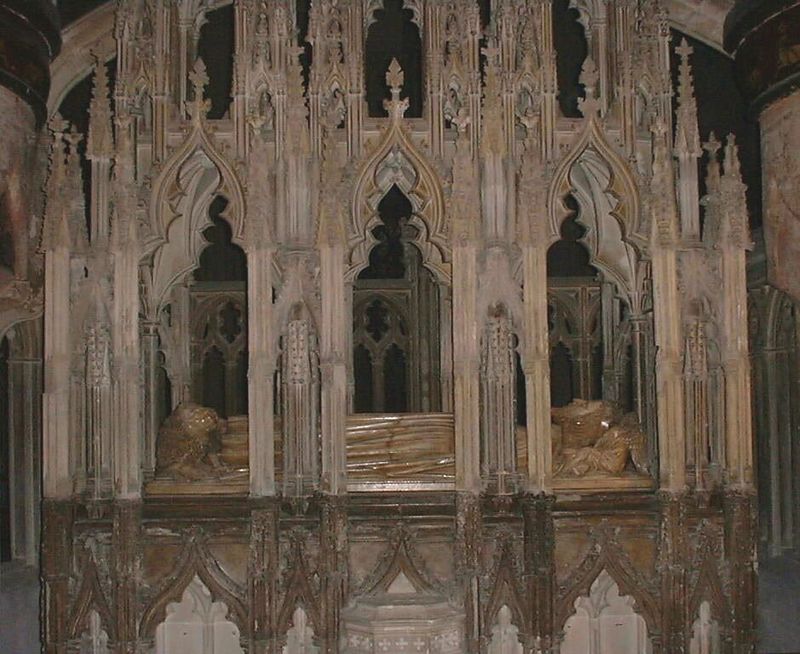
Today marks the 679th anniversary of Edward II's death...allegedly. I suppose most people know, or think they know, the story of Edward's terrible death - the 'red-hot poker' narrative that's passed into legend.
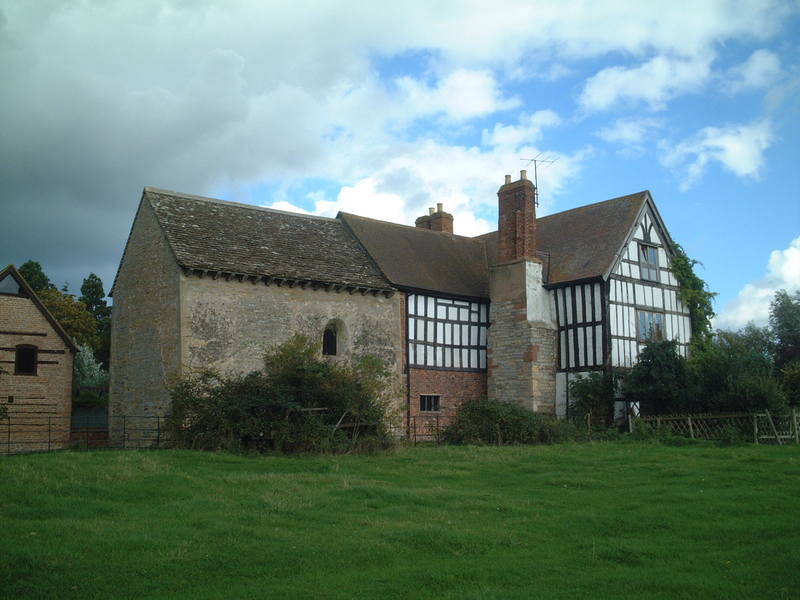
After Edward II's forced abdication in January 1327, he was first 'imprisoned' at Kenilworth Castle, under the care of his cousin Henry of Lancaster, who treated him with respect and honour. In April, he was transferred to Berkeley Castle, Gloucestershire, where his jailor was Thomas, Lord Berkeley - the son-in-law of Roger Mortimer. Berkeley had been imprisoned for several years by Edward, and his father had died during his own imprisonment, so he had little reason to like the king.
The chronicle of Geoffrey le Baker, written about thirty years later, mentions Edward's ill-treatment. He was held in a cell above the rotting corpses of animals, in an attempt to kill him indirectly. But Edward was extremely strong, fit and healthy, and survived the treatment, until on the night of 21 September 1327, he was held down and a red-hot poker pushed into his anus through a drenching-horn. His screams could be heard for miles around.
This has become the standard narrative of Edward's death, but there are problems with taking it at face value. Baker hated Queen Isabella (the 'iron virago') and was constructing a narrative of 'Edward as martyr'. The chronicles written shortly after Edward's death (
Anonimalle Chronicle, a shorter continuation of the
Brut, Lichfield Chronicle, Adam Murimith) variously state only that he died (with no explanation given), that he died of a 'grief-induced illness', or that he was strangled or suffocated. The official pronouncement of Edward's death, in September 1327, claimed that he died of 'natural causes'. It wasn't described as murder until November 1330, when Roger Mortimer was accused of 'having [Edward] murdered at Berkeley' during his show trial.
The earliest reference to the 'red-hot poker' method is found in a longer continuation of the
Brut, written in the 1330s. However, many other fourteenth-century chronicles do not repeat this allegation. None of the men who killed Edward - for the purposes of this post, I'm assuming that he really was murdered in 1327 - ever spoke about it publicly. Therefore, we're dealing with rumour and hearsay, how the chroniclers
thought he'd been murdered.
Admittedly, I find it very hard to view Edward's death objectively - I'm very fond of him, and would rather believe that he didn't die in such a vile way. However, the red-hot poker story does seem implausible. The idea was to kill him in such a fashion that no marks of violence would be visible on his body. However, why then kill him in such an agonising fashion that his screams could be heard for miles around? Why torture him, so that his (dead) face wore an expression of agony, if you were trying to pretend that his death was natural? Surely strangling or smothering, or even poison, would have been more effective. These methods would also have left physical traces on Edward's body, but if his eyes were closed and his body covered up, they would have been missed by the people viewing his body.
Here are some other ideas on the story:
- Mary Saaler, in her 1997 biography of Edward II, quotes Adam Murimith's comment that Edward was killed
per cautelam, by a trick, and wonders if this phrase became corrupted to
per cauterium, a branding-iron.
- Pierre Chaplais and Ian Mortimer have commented on the death of King Edmund Ironside in 1016, said to have been murdered in a similar way to Edward, while sitting on the privy. The story was often repeated in thirteeth-century chronicles.
- And finally, Edward's brother-in-law the earl of Hereford was killed at the Battle of Boroughbridge in 1322 when he was skewered through the anus by a spear pushed up through the bridge.
It's my belief that the grotesque 'anal rape' narrative of Edward's death (
Dr Ian Mortimer's phrase) is nothing more than a reflection of the popular belief that Edward was the passive partner in sexual acts with men, and that this means of death represented Edward receiving his 'just desserts'. The deaths of the earl of Hereford and Edmund Ironside may have provided the inspiration for this.
Similarly, the castration (or emasculation) of Edward's favourite, the younger Despenser, in November 1326, was said by the chronicler Jean Froissart to be a punishment for his sexual relations with Edward. Whether this is true or not is impossible to say, but I think the narratives of both men's deaths reflect the widespread belief that they had sexual relations and were punished for them. Often, a story that begins as a joke or a rumour takes on the aura of 'truth' - such as the death of Edward's descendant George, Duke of Clarence, who died in the Tower of London in 1478. He is supposed to have drowned in a 'butt of malmsey'. It's difficult to ascertain whether this is the truth, or merely reflects his reputation as a drunkard.
Perhaps the story also represents a general human willingness to believe the most gruesome story - after all, being murdered with a red-hot piece of metal in the anus is far more 'interesting' than being smothered. And perhaps we shouldn't discount the early account of Edward's death from 'grief-induced illness', the accusation against Mortimer notwithstanding. At first sight it's not very plausible, but it is possible - given that Edward had lost his throne, his friends were dead, his family had turned against him, and he never saw his children again. If Edward was murdered in 1327, I'm far more inclined to believe that he was suffocated or strangled. He was a strong man and would have resisted, but of course he could have been murdered while he was asleep, or drugged.
But a far more fascinating question is - was Edward really murdered in 1327? Some modern historians incline to the view that he wasn't - which will be the subject of a further post shortly!
Until then, I'm going to raise a glass to King Edward II, who may or may not have died exactly 679 years ago. Cheers, Your Grace!