Gabriele did this meme recently, and I thought it would be fun to write about Edward II! So, here's five funny things you (probably) didn't know about the poor maligned sweetie....
[By the way, Edward II is currently in joint lead in my 'favourite medieval king of England' poll, on the left - eight people have voted for him, excluding me. Yay for you all!!]
- Edward kept a pet lion, which accompanied him on his travels around the country in a cart, tied to a silver chain. Edward's lion-keeper was Adam of Lichfield. He also kept a camel in the stables of his manor of Langley.
- On Easter Monday every year, the ladies and damsels of Queen Isabella 'caught' him in bed in the morning, and dragged him out. One assumes he didn't sleep naked that night... :) He then had to pay them a 'ransom' to be released. (He inherited this sweet tradition from his parents)
- He had a great sense of humour, not something you often associate with medieval kings! His 1305 letter to the count of Evreux, half-brother of Philip IV, shows his dry, ironic humour and wit: [some historians write of this as a 'curious' letter, missing the point that it's obviously intended to be humorous]
"We send you a big trotting palfrey which can hardly carry its own weight, and some of our bandy-legged harriers from Wales, who can well catch a hare if they find it asleep, and some of our running dogs which go at a gentle pace - for well we know that you take delight in lazy dogs. And, dear cousin, if you want anything else from our land of Wales, we can send you plenty of wild lads, if you wish, who will well know how to teach breeding to the young heirs and heiresses of great lords."
Edward also had a strongly developed taste for the slapstick; he paid his court painter Jack of St Albans fifty shillings for dancing on the table, which "made him laugh beyond measure", and another time paid a servant twenty shillings for frequently falling off his horse in an amusing manner! [I was pleased to see that these episodes are mentioned on comedian Richard Herring's website: How wonderful that such a moment gets recorded in history. And also that a man arsing around gets paid a huge amount of cash for his troubles. I imagine there was a lot of blokes changing their arm (or leg) and jumping up on tables and doing funny dances after that.... Good on him and his crazy dance. I wonder how it went.
Another bloke was given twenty shillings by the king for often falling off his horse and again causing the slapstick loving king merriment. He may have had a rubbish sense of humour, but he was happy to pay top dollar, long before "You've Been Framed" was even in the planning stages.]
- Edward and Isabella's 1313 trip to visit her father Philip IV in France was pretty eventful. Edward actually saved Isabella's life at one point, when the silken pavilion where they were sleeping caught fire. Edward scooped Isabella up and rushed outside, despite the fact that they were both naked. Another day, they were late for their audience with King Philip because they'd overslept. And on 19 June 1313 - the first anniversary of Piers Gaveston's death - the twenty-nine-year-old king paid Bernard the Fool and fifty-four others to dance naked for him....
- When Edward fled to Wales in October 1326, he took lots of his possessions with him, loaded onto carts (which must have slowed down the fleeing considerably, surely?) These included a "red retiring robe rayed with threads of saffron, decorated with bears" and a "black cap lined with red velvet, decorated with butterflies and white pearls". I think that's so sweet...Edward wearing a robe covered with bears! I can't help picturing them as teddy bears.
14 January, 2007


10 January, 2007
Abandonment and Abduction: The Eventful Life of Alice de Lacy
[This is part two of my series 'Women of Edward II's Reign'. Part one, on Eleanor de Clare, can be read here.]
Alice de Lacy, countess of Lincoln, Salisbury, Lancaster, Leicester and Derby, was born on Christmas Day 1281 and died 2 October 1348, at the age of nearly sixty-seven. Her father, Henry de Lacy, was earl of Lincoln; her mother, Margaret Longespée, was countess of Salisbury in her own right. Margaret was the great-granddaughter and ultimate heiress of William Longespée, or Longsword, one of the illegitimate sons of Henry II (died 1189). His nickname became his descendants' family name.
Alice's two brothers died in childhood, in bizarre accidents: Edmund drowned in a well at Denbigh Castle and John fell to his death from a parapet at Pontefract Castle. Alice thus became the heiress to two earldoms, and a great prize on the marriage market. King Edward I snapped her up for his nephew Thomas of Lancaster, and they married on 28 October 1294. Alice was twelve years and ten months old, Thomas probably fifteen or sixteen. Her father Earl Henry came to an agreement with the king for the earldom of Lincoln to pass into the royal family, should Alice die childless (as in fact she did). In 1296, Thomas inherited the earldoms of Lancaster, Leicester and Derby from his father Edmund.
Unfortunately, the marriage of Alice and Thomas - which seemed such a splendid match for both - proved completely disastrous. Alice mostly lived alone in her castle of Pickering, Yorkshire, while Thomas took a host of mistresses ("He defouled a great multitude of women and noble wenches"). He fathered at least two illegitimate children, Thomas and John, but Alice remained childless. The two seemed to have detested each other.
Alice's father Earl Henry died on 5 February 1311, at the age of about sixty. Although he was a staunch enemy of Piers Gaveston - who had disrespectfully nicknamed him Monsieur Boele-Crevée or 'Mister Burst-Belly' - he was generally a moderate and a royalist, by far the oldest and most experienced of the English earls, and his death deprived England and Edward II of a respected mediator. Henry's son-in-law Thomas of Lancaster inherited all his lands, and paid homage to Edward for them shortly after Henry's death. He angered Edward by refusing to acknowledge Piers Gaveston, who - naturally - accompanied the king. Thomas of Lancaster now possessed five earldoms, and was by the richest and most powerful man in England. His annual income was a huge eleven thousand pounds.
Lancaster's inheritance of his father-in-law's lands and titles really marks the time when his relations with his cousin the king worsened considerably. From 1311 until his execution eleven years later, Lancaster remained in permanent opposition to Edward. The two men loathed and despised each other.
As is usual in the Middle Ages, married women mostly disappear from the records. With a total absence of personal letters or anything else, Alice's attitude to her husband's relentless, and ultimately fruitless, opposition to his cousin Edward II is not known. Little, in fact, is known about Alice's life, until she was involved in one of the most bizarre events of Edward II's reign....
In early May 1317, Alice was abducted from her manor of Canford, Dorset, by John de Warenne, earl of Surrey - or rather, by some of his household knights, including one named Sir Richard de St Martin - and taken to the Warenne stronghold of Castle Reigate. John de Warenne was Edward II's nephew by marriage, though only two years the king's junior; he was unhappily married to Joan of Bar, daughter of Edward II's eldest sister Eleanor, and had been trying to divorce her since 1311 in order to marry his mistress Maud de Nerford, by whom he had several children. For some reason, he held a grudge against Thomas of Lancaster and blamed him for his inability to secure a divorce. This may be because Lancaster had persuaded the Bishop of Chichester to prosecute Warenne for his adultery (Warenne was actually excommunicated in 1316).
Alice's own feelings about her abduction are uncertain. Most modern historians believe that she was not unwilling, given the unsatisfactory nature of her marriage to Lancaster; Roy Martin Haines says that "her acquiescence is highly likely". Unfortunately, it's almost impossible to cut through all the gossip, conjecture and innuendo in contemporary chronicles to get to the truth.
Alice's whereabouts from 1317 to 1322 are uncertain. I'm not certain if she and Lancaster divorced, though it seems likely. She is often assumed to have left Lancaster for another man, Eubolo Lestrange, who is inevitably described in Edward II novels as a "lame squire". However, their marriage took place more than seven years after her abduction.
Lancaster became obsessed with getting revenge on Warenne - he attacked his Yorkshire estates, including Sandal and Conisbrough castles, and a private war broke out between the two earls, which was never really settled. After his defeat at the battle of Boroughbridge in March 1322, Edward II sent Warenne to accompany Lancaster to Pontefract Castle, for his trial.
Lancaster suspected that Alice's abduction took place with Edward II's knowledge and consent, and had in fact been planned at the Council meeting which had taken place in Clarendon in 1317.
Lancaster's biographer, J. R. Maddicott, believes that Warenne was the "instrument of court policy", but it's also possible that it was the men who were dominant at Edward's court in 1317 - Roger Damory, Hugh Audley, William Montacute and the Despensers - who planned the abduction, not Edward himself. The aim was surely to prevent Lancaster's becoming reconciled with Edward, which the courtiers feared as this would mean the end of their influence over the pliable king.
Thomas of Lancaster apparently made little effort to have Alice returned to him. He probably missed her earldoms more than he missed her! After his execution, Alice - unfortunately - suffered harsh and vindictive treatment at the hands of Edward II and the two Hugh Despensers. Although the earldom of Lincoln was restored to her in December 1322, she was, according to Paul Doherty, imprisoned and threatened with execution by the Despensers; "they claimed she was the real cause of her husband's execution and should suffer the fate specially reserved for the murderers of husbands - being burnt alive."
Alice, with no protector, had no choice but to hand over many of her lands, including the extremely rich lordship of Denbigh in North Wales, which was given to the Elder Despenser. The king forced her to pay a huge indemnity of twenty thousand pounds, countless millions or hundreds of millions in modern money.
Unfortunately for Alice, the 'regime change' of 1327 brought little or no improvement to her situation. Given Queen Isabella's very public criticism of her husband and Despenser's treatment of the wives and widows of their enemies, and given also that Isabella was Alice's niece by marriage, Alice probably expected her lands to be returned to her. In fact, Isabella's lover Roger Mortimer took possession of Denbigh, and Isabella herself appropriated much of Alice's rightful inheritance.
Alice was re-married, sometime before 10 November 1324, to Sir Ebolo Lestrange, in what may have been a love-match; Ebolo described her in documents as his 'dear and loving companion' and never claimed the title of earl as he was entitled to do, in right of his wife. He was involved in Edward III's 1330 plot to bring down Isabella and Mortimer, and he and Alice were rewarded by the return of many of her estates. The early 1330s were probably the most secure and happy of Alice's adulthood; she and her second husband were the recipients of many honours, grants of land and money, and responsibility.
Ebolo died in September 1335 and was buried in Barlings Abbey, Lincolnshire. A short time later, in or before March 1336, Alice was abducted by Sir Hugh de Frene(s); historian Michael Prestwich describes the incident thus, in his The Three Edwards:
"...[I]n a dramatic scene in Bolingbroke Castle in 1336 she was again abducted, this time by Hugh de Frenes. He entered the castle with the complicity of some of her servants, and seized her in the hall. She was permitted to go up to her chamber to collect her things together, and when she came down was placed firmly on horseback. Only then did she realize the gravity of her situation, and she promptly fell off in an attempt to escape. She was put back, with a groom mounted behind her to hold her on, and led off to Somerton Castle. There, according to the record, Hugh raped her in breach of the king's peace. Since she was by then in her mid-fifties, it is likely Hugh was attracted more by her vast estates than by her physical charms. As frequently happened in medieval cases of rape, the couple soon married; it is possible that she was not a wholly unwilling victim."
It's also possible that Alice had no choice whatsoever in the matter! The abduction is a further demonstration of the dangers of being a great heiress in fourteenth-century England. A few weeks after Alice's ordeal, the teenage Margaret Audley was herself abducted by Ralph Stafford; Margaret was the sole heiress to her mother's third of the vast de Clare inheritance. Her aunts Elizabeth and Eleanor de Clare were also abducted and forcibly married, by Theobald de Verdon in 1316 and William la Zouche in 1329 respectively.
Unfortunately for Hugh de Frene (or de Freyne or de Frenes), but fortunately for poor Alice, he didn't live very long to enjoy his abducted wife's vast inheritance; he died in December 1336 or January/February 1337. Alice lived until October 1348 and was buried next to Ebolo at Barlings Abbey.
Alice is referred to in documents of Edward II's reign as "Dame Aleyse comtesse de Nicole" (Lady Alice, countess of Lincoln) or "Aleise de Lacy, countess de Nichole". In later life, she called herself 'countess of Lincoln' and 'widow of Ebolo Lestrange' but never 'countess of Lancaster' or 'widow of the earl of Lancaster/Hugh de Frene'. Her life is fascinating, and she really deserves to be better known! Anyone interested in her should read the excellent article by Linda E. Mitchell, in her Portraits of Medieval Women.
EDIT: After reading some more about Alice's later life in Edward III's reign, I've realised that I painted rather too rosy a picture of her position. In fact, Edward III assumed control of most of Alice's inheritance and gave it to William Montacute, his great friend who had helped him overthrow Mortimer. Montacute also received Alice's earldom of Salisbury. She never recovered her great lordship of Denbigh, which was also given to Montacute. A few years later, Montacute's son and Mortimer's grandson clashed over it, in a legal battle, and Edward III awarded it to Mortimer.
Poor Alice - abducted and raped, then deprived of much of her inheritance. She really illustrates the precarious position of women in the fourteenth century - even wealthy well-connected ones....
07 January, 2007
Happy New Year
So here we are in 2007! Unbelievable, isn't it? Sounds strangely futuristic to me, somehow. Hope you all had better weather over the festive period than I did in the Lake District - I spent 2 weeks and 2 days there, and saw the sun for a grand total of about 3 hours. Most of that was on the last day. The rest of the time, it was grey, murky, foggy and pouring down. Ugh....
2007 will be a big year on 'Edward II', as it's the 700th anniversary of his becoming king. I'm delighted to see that over 200 people have voted on my poll (see left) about Edward's fate in 1327. That's great - please keep the votes coming in! And don't forget to vote for 'your favourite medieval king', too. I'm also pleased to see that Edward II has 4 votes - I voted for him, obviously, and I'm sure Susan did too, so that's another 2 people who like him more than all the other medieval kings! Yay! :)
Until I get round to writing another post, here's a link to Susan's recent post on the fate of three of Hugh le Despenser the younger's five (or possibly six) daughters: Joan, Eleanor and Margaret, sent to convents in January 1327, a few weeks after the execution of their father. They were forcibly veiled by Queen Isabella, a fact rather conveniently ignored by Isabella's recent biographers, such as Alison Weir and Paul Doherty. Weir writes only that the little girls "became nuns" and entirely ignores the role Isabella played - a puzzling omission. Or perhaps not - maybe I'm just being cynical, but it seems odd to me that a biography as historically accurate as Weir's is should suddenly get the facts wrong when it comes to her beloved Isabella doing something that could be seen in a negative light by modern readers....
20 December, 2006
Merry Christmas!
The blog will take a break while I'm on my holidays....back on or around 7 January.
Before I go, just a few words on Edward II's Christmases. It was his custom to play dice on Christmas night, and in 1316, at Clipstone in Nottinghamshire, used up the large sum of five pounds playing (the King was an inveterate gambler.)
Edward enjoyed the tradition of the "King of the Bean" or the Lord of Misrule, on Twelfth Night. In 1317, he gave that year's King, William de la Bech, "a silver-gilt chased basin, with ewer to match", and the next year, to Thomas de Weston, a squre of his household, "a silver-gilt basin with stand and cover, and a silver-gilt pitcher to match".
In 1317, Edward had a "great wooden table" placed in the Great Hall of Westminster Palace just in time for Christmas, and around the same time took possession of a "great hanging of wool, woven with figures of the King and Earls upon it" with "a border of green cloth round the said hanging, for saving the same from being damaged in hanging it up." At Christmas/New Year 1311/12, Queen Isabella sent out gifts of wild boar meat and Brie to, among others, the Earls of Lancaster and Hereford and Piers Gaveston's wife Margaret, and there are records of the "sumptuous gifts of plate" Edward gave to friends and household knights.
If you're interested in how Christmas and New Year were celebrated in the Middle Ages, here's a handful of sites (there are plenty more):
Christmas Traditions In England During the Middle Ages
Medieval Christmas
Tales of the Middle Ages - Christmas
Have a very merry Christmas and a happy New Year, everybody!
17 December, 2006
The Childhood of Edward II
Edward II was born on 25 April 1284 in Caernarfon Castle, one of his father’s great Welsh fortresses, unfinished at this time. His mother Eleanor of Castile, daughter of King Fernando III, was probably forty-two at the time – she seems to have been born in late 1241 – and Edward was her sixteenth and youngest child. His father, King Edward I, was almost forty-five.
Edward’s first nurse was the Welshwoman Mary, or Mariota, Maunsel, who fell ill and was replaced by Alice de Leygrave in the summer of 1284, when Edward was taken from Caernarfon to Chester. Although she had only looked after him for the first few months of his life, Edward never forgot about Mary. In 1307, he gave her 73 acres of land, to hold rent-free for the rest of her life, and in 1312, granted her a hundred shillings per year for life 'out of the yearly issues of the king's mills at Karnarvan'. Alice de Leygrave and her daughter Cecily later joined Queen Isabella’s household as damsels, and Edward also granted them and other family members land and favours. Alice was described in a document of 1313 as "the king's mother...who suckled him in his youth."
In April 1284, the heir to the throne was Edward’s brother Alfonso, born in November 1273 and thus ten and a half when his little brother was born. The King and Queen had already lost two sons (John, aged five, in 1271 and Henry, aged six, in 1274) but Alfonso seems to have been healthy – his marriage to Margarete, daughter of Count Floris V of Holland, was being arranged this year, and the Alfonso Psalter was in preparation, presumably to celebrate the wedding. His death on 19 August 1284 seems to have come out of the blue and been a terrible shock, not only to his parents, but to the country as a whole – the populace was used to thinking of him as their future king. (it’s worth bearing in mind that if he had lived to become king, ‘Alfonso’ would be a common English name!)
At the age of not quite four months, Edward became heir to the throne. Little is known about his early life, but he had his own household from a very young age, as was common for royal boys. His sisters, or some of them, presumably lived with him, but as heir to the throne, Edward was the centre of the household. He lived most of the time at Langley, near St Albans (known since 1428 as King's Langley), which his mother Queen Eleanor held of the king’s cousin, Earl Edmund of Cornwall, and which was granted to Edward himself in 1302. Langley was a manor house on a hill, attractively arranged around three courtyards.
Edward's tutor was Sir Guy Ferre, who seems to have failed to impose any discipline on Edward - he went to bed when he liked, developed a taste for gambling, and - more significantly - a predilection for 'peasant' activities such as digging, thatching and shoeing horses, which would earn him huge censure later in life.
Just past his second birthday, in May 1286, his parents departed England for Gascony, which was ruled by the English crown. They would not return for more than three years - which had a huge impact on the young Edward's relationship with his parents. Fifteen months after their return, Queen Eleanor was dead, and King Edward I gradually became an increasingly remote and terrifying figure. Without wanting to be too psychoanalytical, Edward's whole life shows his desperate need to love and be loved, probably because of the lack of parental affection in his childhood.
In July 1289, the five-year-old Edward was taken, with four of his five sisters, to Dover to greet their parents on their return from Gascony. The sisters were: Eleanor, aged 20; Joan, aged 17; Margaret, aged 14; and Elizabeth, aged almost 7. The missing sister was Mary, aged 10, who was at Amesbury Priory with the children’s grandmother, Queen Eleanor of Provence. It must have been a nerve-racking occasion for the little boy, to meet the formidable parents he surely couldn’t remember. As the heir to the throne, he was more important than his older sisters, and one imagines that the king examined his only surviving son anxiously. There were few concerns, however; Edward, as he would remain all his life, was a healthy, sturdy boy.
Edward I started to make arrangements for Edward’s marriage - an issue of great importance. (See my previous post on the Maid of Norway). He also started marrying off his daughters. On 28 November 1290, a couple of months after the death of the little Maid, Queen Eleanor died suddenly in Harby, Notts. She was in her late forties. Edward, as her only surviving son, inherited her lands and became Count of Ponthieu and Montreuil at the age of six.
A few months later, on 26 June 1291, his grandmother Eleanor of Provence also died, in her late sixties. Eleanor was the widow of Henry III, who had died in 1272. For all her faults, Queen Eleanor was a devoted mother and grandmother, always concerned about her grandchildren, and her death deprived little Edward of a kindly, affectionate figure who always did her best for him. On 1 September 1290, she sent a letter to her son, Edward I, who was planning to take his six-year-old son to the north (presumably to meet the Maid on her arrival in Scotland, though that's not certain):
"We feel uneasy about his going. When we were there, we could not avoid being ill, on account of the bad climate. We pray you therefore, deign to provide some place in the south, where he can have a good and temperate climate, and dwell there while you visit the north."
1290 and 1291, in fact, were bad years for Edward and his family relations. His mother and grandmother died, his sisters Joan and Margaret married, another sister, Mary, was veiled as a nun. In 1293, his eldest sister Eleanor finally married too. The remaining sister, Elizabeth, who was only twenty months older than Edward, probably stayed at Langley with him until her own wedding in February 1297.
It's possible that her future husband Jan, son and heir of Count Floris V of Holland (Jan’s sister Margarete had been betrothed to Alfonso) also lived with them at Langley. Jan was born sometime in 1284, so was the same age as Edward, and grew up in England. He succeeded his father in June 1296, and returned to England in early 1297 to marry Elizabeth. She was fourteen and a half, and he twelve. Always a sickly youth, he died in 1299, childless.
Later in the 1290s, ten boys were placed in Edward's household as his companions and royal wards, or pueri in custodia, accompanied by their tutors. Hugh le Despenser the younger was one. Another was Piers Gaveston, who was placed in Edward’s household sometime at the end of the 1290s – a fateful decision by King Edward I. The Gavestons or Gabestons were minor nobility from Gascony (Piers was emphatically not a peasant and Edward's 'bit of rough', as he's often portrayed) and the family of Piers' mother, Claramunde de Marsan, were landowners in Bearn. His father Arnaud's tomb in Winchester Cathedral still exists. Piers was probably a year or two older than Edward, handsome, athletic, witty and a great jouster and soldier. Edward fell deeply in love.
The records for Edward’s household still survive for the year 1292/93, when he was eight/nine years old. They show that he lived at Langley from 23 November 1292 to 13 April 1293, then went on a typical 'royal progress' across Southern England, staying one or two nights in each place - the enormous size of his household, hundreds of people, meant that longer stays were generally not welcomed by the local populace. In 1294, the Dunstable annalist commented about Edward: "Whatever he spent on himself and his followers, he took without paying for it. His officials carried off all the victuals that came to market...not only whatever was for sale, but even things not for sale..." It's worth remembering that Edward was barely ten years old at the time!
Edward spent eight nights in Bristol in late September 1293 for his eldest sister Eleanor’s wedding to Count Henri III of Bar (they then stayed with him for a few weeks before travelling to Bar) His cousins Thomas and Henry of Lancaster - sons of Edward I's brother, Earl Edmund of Lancaster - stayed with him for a few days in June 1293. They were about three and six years his senior, so about twelve and fifteen, and brought a large retinue with them, who had to be fed at the expense of Edward's household. Also in their company was the future Duke Jan II of Brabant, who was eighteen in 1293 and had married Edward’s sister Margaret in 1290. Jan also grew up at the English court, and lived in England till his father died in the spring of 1294 (at a tournament in Bar, arranged by Count Henri to celebrate his marriage to Eleanor). All together, the three young men brought sixty horses and forty-three grooms, and Edward's clerk (who recorded the expenses) fumed over it. Every day, he wrote "They are still here" and on the last day "Here they are still. And this day is burdensome...because strangers joined them in large numbers".
As he gew older, Edward spent more and more time with his father, often in Scotland. He took part in the siege of Caerlaverock in 1300, when he was sixteen. The herald-poet wrote of Edward in the Caerlaverock Roll of Arms: "...He was of a well proportioned and handsome person/Of a courteous disposition, and well bred". On 7 February 1301, still aged sixteen, Edward was created Prince of Wales and Earl of Chester, during Parliament at Lincoln. This was a huge territorial endowment, composed of all the royal lands in Wales and the rich lands of the earldom of Chester. Edward, Prince of Wales, Earl of Chester, Count of Ponthieu and Montreuil, was now a great feudal magnate in his own right; and his lonely childhood was over.
10 December, 2006
Women of Edward II's reign: Eleanor de Clare
Beginning an occasional new feature, in which I look at some of the women of Edward II's reign. Today, Edward's niece, Eleanor de Clare.
Eleanor was born in the great castle built by her father, Caerphilly in Glamorgan, in October or November 1292. Her mother was Joan of Acre, the second oldest of Edward I's five surviving daughters, and her father was Gilbert 'the Red' de Clare, earl of Gloucester and Hertford. Joan was twenty at the time of Eleanor's birth, Gilbert forty-nine. Eleanor was Edward I's eldest granddaughter, and about eighteen months younger than her brother Gilbert, future earl of Gloucester. She had two younger sisters: Margaret, probably born in the first half of 1294 and the wife of Piers Gaveston, and Elizabeth, born in September 1295. Eleanor was only eight and a half years younger than her uncle Edward II.
Little is known about the childhood of the Clare sisters. Their brother Gilbert grew up, after 1299, in the household of their step-grandmother Queen Margaret, who was probably only about nine years older than Gilbert. Their father Gilbert the Red died in December 1295 at the age of fifty-two, only a few weeks after the birth of his youngest child Elizabeth, and in 1296, the widowed Joan was assigned Bristol Castle as a residence for her children. In early 1297, when Eleanor was four, Joan married her husband's squire Ralph de Monthermer, without her father's consent; he was hoping to marry her to the count of Savoy. Joan is supposed to have taken her young children with her to plead her case to her father, presumably hoping that the presence of his young grandchildren would persuade the king to be lenient. It didn't work, and de Monthermer was imprisoned for a time, although Edward I finally had to accept the inevitable, as he couldn't unmarry the couple.
At the age of thirteen and a half, Eleanor was married to Hugh le Despenser the Younger. Their wedding took place on 26 May 1306 at Westminster, in the presence of the king. Queen Margaret was probably not present, as she had given birth to the king's youngest child - another Eleanor - several weeks earlier. The king was close to sixty-seven and would die just over a year later. (Little Eleanor, Eleanor de Clare's aunt, died at the age of five in 1311.) Eleanor's mother Joan of Acre was surely present; she had another eleven months to live. I don't know if Hugh le Despenser's mother Isabel Beauchamp, daughter of the earl of Warwick, witnessed the wedding; she died a mere four days later. Another guest was Eleanor's uncle, the future Edward II, who had been knighted with Hugh (and almost 300 others) four days earlier. Already Prince of Wales, earl of Chester and count of Ponthieu and Montreuil, he was created duke of Aquitaine at this time. His beloved companion Piers Gaveston was knighted on the day of Hugh and Eleanor's wedding.
Hugh, who was somewhere in his late teens, was hardly a brilliant match for the king's eldest granddaughter. Although he was an earl's grandson, the step-grandson of another earl (Norfolk, who died this year) and brother-in-law of the king's nephew Henry of Lancaster, he had no hope of inheriting a title. His father's lands, mostly in the Midlands and Buckinghamshire, were extensive, but until the elder Hugh died, Hugh could expect to hold practically no land. Edward II gave him the former Templar manor of Sutton in Norfolk in 1309, his only gift to Hugh before he became royal favourite. In 1310, Hugh the Elder handed over half a dozen manors to his son, who evidently lived in somewhat straitened circumstances.
In an age where land was power, Hugh was a nonentity, which limited Eleanor's own influence. However, she was a familiar face at court, where she often attended Queen Isabella as lady-in-waiting, accompanying her on the royal trip to France in 1313. Isabella, Eleanor's aunt by marriage though several years younger, had a group of noblewomen who attended her on a rota basis, as they all had husbands and families and feudal responsibilities of their own. Eleanor had her own retinue, headed by her chamberlain John de Berkhamsted.
Away from court, her relationship with Hugh was pretty successful, to judge by the large number of children they had together. She was also close to her uncle Edward II, who paid all her expenses when she was at court, and even sometimes when she wasn't - a privilege not extended to his other nieces. She appears in contemporary documents as 'Lady Alianore le Despenser'. Edward's affection for her did not, however, extend to her husband at this time.
Eleanor and Hugh's lives changed completely when her brother Gilbert, earl of Gloucester was killed at the battle of Bannockburn in June 1314, when he was twenty-three. Eleanor's second cousin, Robert Bruce, king of Scotland, kept an overnight vigil over Gloucester's body, and sent it back to England with full honours and without demanding payment for it, as he was entitled to do. Gloucester's widow Matilda - sister of Robert Bruce's queen, Elizabeth - claimed to be pregnant, a pretence she kept up for a full three years. (Honestly, you couldn't make this up.) Her motives are obscure; perhaps she miscarried and couldn't accept it. Edward II was happy to support this pretence; the Gloucester lordship was extremely rich and he would have been much happier if Gloucester's son had inherited the lot. As things stood, though, Gloucester's three sisters were equal heirs to the inheritance. Under medieval law, sisters inherited equally; the law of primogeniture applied only to men.
Finally, in 1317, the lands were divided. Countess Matilda had earlier been assigned her widow's dower, one third of the lands, which would be divided out among the three sisters when she died in 1320. Hugh and Eleanor's share was Glamorgan, and a few manors in England. Her younger sisters were by this time married to men Edward II trusted, Margaret to Hugh Audley and Elizabeth to Roger Damory; Audley and Damory were thereby catapulted to wealth and huge influence. The division of the Clare lands can be seen as one of the most significant events of Edward's reign, as Hugh le Despenser, ambitious and unscrupulous, used Eleanor's inheritance to force himself into power. He was chosen as Edward's chamberlain in 1318, used this proximity to the king to make Edward infatuated with him, and attempted to take over the entire Clare inheritance in South Wales.
The story of Hugh's rise to power has been told many times, so I won't repeat it here. The great Edward II historian J.R.S. Phillips has described him as the "classic example of a man on the make who succeeded in making it". It's a shame that we have no idea what Eleanor thought of her husband's misdeeds, his extortion of lands and property including some that belonged to Eleanor's sister Elizabeth, and his relationship with her uncle. That Hugh was Edward's lover seems 99% sure to me; Edward was infatuated with him. However, Hugh and Eleanor's sexual relationship also continued, as a few of their children were born after the start of Hugh's relationship with Edward.
There are even hints that Eleanor herself was involved in a sexual relationship with her uncle. This is stated directly in the Chronographia Regum Francorum, and the two are oddly linked in a document of the 1320s which mentions medicines bought for them 'when they were ill'. Edward sent her many presents, and after one short visit gave her the substantial sum of a hundred pounds. This was approximately half of Hugh and Eleanor's annual income prior to her brother's death. It has been postulated that the chronicler who castigates Edward for his 'sinful and illicit unions' had Edward's affair with his niece Eleanor in mind, rather than - or as well as - his sexual relationships with other men. However, this affair is far from certain, and in the absence of firm evidence we should give Edward and Eleanor the benefit of the doubt.
Edward II and Hugh definitely trusted Eleanor, however. In 1324 she was put in charge of the household of John of Eltham, Edward and Isabella's younger son, and it's often stated that she was put in Isabella's household as a 'housekeeper', or rather spy, with permission to read all Isabella's correspondence and keep an eye on her. Edward and Isabella's relationship had spectactularly deteriorated by 1324, and, sliding into war with her native France, Edward didn't trust her at all. However, I'm not sure how Eleanor is meant to have watched Isabella day and night - as she's alleged to have done - and also been in charge of Isabella's son somewhere away from the 'long-suffering' queen.
In 1326, Hugh and Edward II suffered the inevitable consequences of their tyranny, and fell from power. How Eleanor felt about the hideous death of her husband of twenty years can only be surmised. Whether she was a willing participant in Hugh's misdeeds, or if she had ever tried to mitigate Hugh's harshness, is unknown; if she did try, she was apparently unsuccessful. Perhaps she loved him; later, she had a splendid tomb built for him at Tewkesbury Abbey. In October 1326, she was in the Tower of London with her ten-year-old cousin John of Eltham, who had been left by his father the king in nominal charge of London. She surrendered the Tower to the mob, and was imprisoned there, for two years. Three of her daughters were taken from her and forcibly veiled, and her eldest son was imprisoned until 1331. Later, she lost her lands; Glamorgan was given to Edward III's queen, Philippa, although Edward III restored them to her after the downfall of his mother and Roger Mortimer.
In early 1329, Eleanor was abducted from Hanley Castle, Worcestershire, by William la Zouche, and married to him. Zouche was a distant cousin of Roger Mortimer, and was one of the men who arrested Hugh le Despenser in South Wales. He also besieged Eleanor's teenaged son at Caerphilly in late 1326/early 1327. Whether Eleanor consented to the marriage is unknown, but it was a fairly common problem for the Clare women, because of their huge wealth. In 1316 her sister Elizabeth was abducted and married to Theobald de Verdon, and in the 1330s Eleanor's niece Margaret Audley, daughter of her sister Margaret, suffered the same fate when she was taken by Ralph Stafford. Eleanor, who was thirty-six in early 1329, bore a son, also William, to her second husband. He was her tenth or eleventh child, and became a monk at Glastonbury Abbey.
Eleanor outlived her second husband, and died in June 1337 at the age of forty-four. She is buried at Tewkesbury Abbey, with many of her ancestors and descendants; she and Hugh le Despenser, and their son Hugh the Even Younger, were major benefactors of the abbey. Eleanor's fascinating life is the subject of Susan Higginbotham's novel, The Traitor's Wife.
03 December, 2006
Blog Birthday, and Betrothals
'Edward II' is one year old today. Yay!
This post is about Edward II's betrothals before Isabella; the women he might have married had things turned out differently. The first of these was Margaret, the 'Maid of Norway'.
A little background information: Alexander III ascended the throne of Scotland in 1249, aged not quite eight. In 1251, he married Margaret, daughter of Henry III of England; she was almost exactly a year his senior. The couple had three children: Margaret, 1260-1283, Alexander 1264-1284, and David, 1272-1281. Queen Margaret died in 1275. Young Alexander married (yet another) Margaret, daughter of the count of Flanders, in 1282, but had no children. King Alexander's daughter married Erik II, King of Norway, in 1281. (He was known as 'Erik the Priest-Hater'; I love that!) Oddly, he was thirteen and she was twenty-one. Margaret gave birth to the couple's only child, a daughter inevitably named Margaret, and died around 9 April 1283, possibly in childbirth.
In March 1286, King Alexander III died in a bizarre accident when he rode his horse off an embankment in the dark; his body was found the next day. All three of his children had pre-deceased him, and although his second wife Yolande de Dreux was pregnant, her child was stillborn in November 1286. The Guardians of Scotland ruled Scotland during this time. The Queen of Scotland was now little Margaret, the Maid of Norway, aged three - Alexander III's granddaughter and only living descendant. She was known as “dame Margarete Reyne de Escoce” (Lady Margaret, Queen of Scotland).
In 1289 and 1290, King Erik, the Guardians and Edward I of England - brother-in-law of Alexander III and great-uncle of the Maid - signed treaties agreeing to the marriage of the Maid to King Edward's only surviving son, the future Edward II. Lord Edward was six in 1290, a little younger than his intended wife, and a papal dispensation had to be obtained for the marriage, as they were first cousins once removed (Margaret was the great-granddaughter of Henry III, Edward his grandson).
Edward I intended his son to rule Scotland in right of his wife, as well as England (of course, it turned out that Edward II couldn't even rule one country, never mind two, but that probably wasn't obvious when he was only six). In 1284, on the death of his son, Alexander III had signed a treaty with the earls and barons of Scotland that acknowledged the Maid as his heir, but he almost certainly intended her to reign jointly with her future husband, rather than as sole Queen Regnant.
During the summer of 1290, Edward I prepared two ships at Great Yarmouth and sent them to collect the little Queen from Norway. One was loaded with casks of wine, the other with meat, fish, sugar, spices, wine, beer, peas, beans and nuts. Margaret boarded one of the ships to be taken to her new home, but unfortunately for Scotland and the plans of Edward I, she died in the Orkneys shortly after her arrival there. She was seven years old, the Queen who never laid eyes on her kingdom (the Orkneys belonged to Norway at this time). Her body was taken back to Norway, and buried in Bergen, next to her mother. No less than thirteen men arose to claim the throne of Scotland.
It's really fascinating to contemplate what might have happened if the Maid had lived. Firstly, there would have been no Hundred Years War, at least not as we know it, as Edward II and Margaret's son (assuming they had one) would have had no claim to the French throne as Edward III did through his mother Isabella. Would England and Scotland really have been peacefully united three centuries earlier than really happened? And what about the conflicts Edward II had with his barons - would they have been lessened, with no need for Edward to fight in Scotland? And on a personal level, would the marriage of Edward and Margaret have been happier than Edward and Isabella's - and would Edward have ruled longer with no rebellion of Isabella and her lover Mortimer?
In 1294, Edward I arranged another betrothal for his son, with Philippa, daughter of Guy de Dampierre, count of Flanders. Little is known about Philippa, but she was probably a good bit older than Edward, who was ten in 1294; her parents were married in 1265. Her sister Margaret was married in 1282 to Alexander, son of Alexander III (see above. Incidentally, Margaret's son by her second marriage, Duke Reinald II of Guelders, married Edward II and Isabella's daughter Eleanor of Woodstock in 1332. He was almost thirty years her senior).
In February 1297, King Edward and Count Guy swore to uphold the marriage of their children(“covenances de faire mariage entre Edward nostre chere fiuz, e Phelippe fille au dit conte”). Now, however, her sister Isabella was mentioned as a possible substitute. The reason was that poor Philippa was now being held prisoner by Philip IV of France, who was determined that the match should not go ahead (for reasons too complicated to go into here, but there were huge tensions between Count Guy and King Philip, and King Edward was an ally of Guy). Philippa was held in Paris until her death in 1306. Edward I made peace with Philip in 1298 and abandoned Count Guy - and any idea of a marriage alliance between England and Flanders.
In 1299, Edward I and Philip IV signed a treaty, in an attempt to solve the long-standing conflicts between France and England. In September that year, Edward I married Marguerite, younger half-sister of Philip; Edward was now sixty and had been a widower for nine years. Marguerite's date of birth is not known, but might gave been as late as 1282, making her forty-three years younger than her husband and a mere two years older than his youngest child by Eleanor of Castile, Edward II.
Although a marriage between Marguerite and Edward II, instead of Edward I, was never suggested, I can't help wondering how different things might have been if they had married. She was closer to his age than her niece Isabella, and would probably have made him a more understanding and compassionate consort.
The treaty of 1299 also made provision for the marriage of Edward II and Isabella. She was the sixth of the seven children of Philip IV by Jeanne, Queen of Navarre, and her three elder brothers were all kings of France in turn; Louis X, Philip V and Charles IV. Isabella also had a younger brother, Robert, who was probably born in 1297; he died in July 1308, six months after Isabella married Edward II.
It's a little known fact that Isabella also had two elder sisters: Marguerite and Blanche. As with all Philip IV's children, with the exception of Louis X (who was born on 4 October 1289), their dates of birth are not known. Marguerite was the eldest daughter, born perhaps 1288 or 1290, and Blanche was probably born about 1293. The dates of their deaths are not known either, but both were certainly dead by 1299, or one of them may well have been betrothed to Edward II instead of Isabella. Probably Blanche, as Marguerite was promised in 1294 to Fernando IV, King of Castile. Again, it's interesting to consider whether Edward II's reign would have turned out differently; or would Isabella's elder sisters have taken the same actions that she did?
Isabella herself was probably born sometime between July 1295 and January 1296, so she was more than eleven years younger than Edward and only three years old when her marriage was arranged (Edward was fifteen). Their formal betrothal took place on 20 May 1303. On 27 November 1305, Pope Clement V, eager for the union of Edward and Isabella, and the peace between England and France he assumed would follow it, tried to arrange their proxy wedding. On this day, he signed a dispensation to allow Isabella to marry despite her young age - she was ten, or close to it, to Edward's twenty-one. On 3 December, in the presence of notaries at the Louvre, Isabella appointed her uncle Louis of Evreux to act as her proxy. However, King Edward rejected the proposal.
The wedding finally took place in Boulogne on 25 January 1308, six months after Edward II succeeded to the throne. He was twenty-three and nine months, Isabella almost certainly only twelve. Edward showed no interest in Isabella until years after the wedding - understandably - and even before it, never seems to have sent her any letters or gifts, though he communicated often with her uncle Louis of Evreux.
If Edward II had married another woman, would the rebellion of 1326 still have taken place, or something like it? Would Edward still have been forced to abdicate? Would the Hundred Years War have still taken place, if Edward II had lived to the 1340s? There's no way of knowing, but I find it fascinating to speculate...
29 November, 2006
The Execution of Roger Mortimer
Roger Mortimer, Lord of Wigmore and first earl of March, 25 April 1287 to 29 November 1330. He was the second cousin twice removed of Edward II and the fourth cousin once removed of Queen Isabella, his mistress.
Roger was born on the same day as Edward II, but three years later. Today marks the 676th anniversary of his execution at Tyburn, at the age of forty-three.
Roger was arrested in Nottingham Castle on 19 October 1330, in the hastily planned and executed seizure of power by the young Edward III, aged not quite eighteen. Apparently, Edward III wished to execute him immediately, but was persuaded by Henry, earl of Lancaster, to put Roger on trial before Parliament. Roger was first taken to Leicester, then imprisoned in the Tower of London until his trial on 26 November.
In keeping with several other so-called 'trials' of this time, of Thomas of Lancaster and the Despensers, Roger was not permitted to speak in his own defence when he was taken before Parliament at Westminster. In fact, he was gagged to make sure he couldn't speak. He was also bound, with ropes or chains. He was charged with fourteen crimes, including: the murder of Edward II; procuring the death of Edward's half-brother Kent; and taking royal power and using it to enrich himself, his children and his supporters.
The outcome of the 'trial' was never in doubt. Roger was found guilty of these crimes, and 'many others', by notoriety, that is, his crimes were 'notorious and known for their truth to you and all the realm'.
On 29 November 1330, Roger was taken from the Tower. He was forced to wear the black tunic he had worn to Edward II's funeral three years earlier, a pointed reference to his hypocrisy, and dragged behind two horses to Tyburn, where he would be hanged. His clothes were taken off him, so he died naked. Verses of the 52nd Psalm were read out loud to him - 'Why do you glory in mischief?' - and he was allowed to speak a few words to the crowd. He didn't mention Edward II, or Queen Isabella, but admitted his role in the judicial murder of the earl of Kent.
Roger was not, as is often stated, the first person to be executed at Tyburn (executions had taken place there for well over a century, since the 1190s), but he was the first nobleman to be hanged there. Tyburn was the execution site for common criminals, and hanging was the method used to dispatch them. Noblemen were usually beheaded. The Despensers were an exception, but in 1322 Edward II had commuted Thomas of Lancaster's sentence to be hanged, drawn and quartered to beheading, and in 1312 even Piers Gaveston was given the nobleman's death, because he was the earl of Gloucester's brother-in-law. The site and method chosen for Roger's execution were a deliberate attempt to treat him as a common criminal. At least Edward III spared him the full horrors of the traitor's death, and death came within a few minutes - a relief, as medieval hanging victims often took hours to die.
Roger's burial site is uncertain. He is stated to have been buried at the Grey Friars church in Shrewsbury, but a year after his death, his widow Joan de Geneville petitioned Edward III for his body to be removed to Wigmore, and it was the Franciscans of Coventry who were licensed to deliver it. Wherever his final resting place was, his tomb is now lost.
Unfortunately the story that, twenty-eight years later, Isabella chose to be buried at the Grey Friars in London because it was Roger's final resting place, is not true, though it's still often repeated today. It is possible, however, that Roger's body lay there for a while before his final burial, though this hardly seems sufficient reason for Isabella to have been buried there (her aunt Marguerite was also buried there, in 1318).
Roger Mortimer was a fascinating man who deserves to be much better known. He was intelligent, competent, and ruthless, and, in the end, proof of the adage that power corrupts and absolute power corrupts absolutely. Power went to his head at least as much as it did to Hugh Despenser's, and he repeated the avaricious and tyrannical mistakes of the previous favourite, and added a few of his own.
Thanks to Edward III's lack of vindictiveness, however, Roger's descendants thrived in the later fourteenth century. His grandson Roger was restored to the earldom of March in 1354, his great-grandson Edmund married Edward III's granddaughter Philippa of Clarence, and his great-great-grandson Roger was heir to the throne of England in the late 1390s.
In memoriam: Roger Mortimer, 1287-1330, usurper of a king and lover of a queen, de facto king of England, died on this day 676 years ago.
24 November, 2006
Entrails and Emasculation
Hugh le Despenser the Younger, Lord of Glamorgan, royal chamberlain, royal favourite, politician, pirate and extortionist, circa 1287/90 to 24 November 1326.
[As a matter of interest, Hugh was the fourth cousin twice removed of Edward II, the fifth cousin of Queen Isabella, the third cousin once removed of Roger Mortimer and his (Hugh's) wife Eleanor, and the second cousin of Mortimer's wife Joan de Geneville.]
Today marks the 680th anniversary of Hugh's hideous execution. On 16 November 1326, he and Edward II were captured in South Wales by Henry of Lancaster - Edward's first cousin and Hugh's brother-in-law (Henry's late wife Maud Chaworth was Hugh's elder half-sister). There's some dispute about where Hugh and Edward were when they were taken - possibly at Neath Abbey, or in open countryside near Llantrisant, supposedly during a terrific storm.
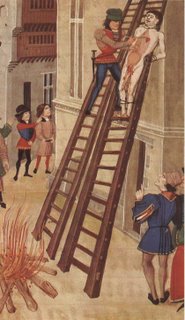
Hugh's execution, from a fifteenth-century manuscript of Froissart's chronicles. Is that really his penis hanging to his knees?? No wonder Edward liked him so much.
Below, the Despenser arms.

[As a matter of interest, Hugh was the fourth cousin twice removed of Edward II, the fifth cousin of Queen Isabella, the third cousin once removed of Roger Mortimer and his (Hugh's) wife Eleanor, and the second cousin of Mortimer's wife Joan de Geneville.]
Today marks the 680th anniversary of Hugh's hideous execution. On 16 November 1326, he and Edward II were captured in South Wales by Henry of Lancaster - Edward's first cousin and Hugh's brother-in-law (Henry's late wife Maud Chaworth was Hugh's elder half-sister). There's some dispute about where Hugh and Edward were when they were taken - possibly at Neath Abbey, or in open countryside near Llantrisant, supposedly during a terrific storm.

Hugh's execution, from a fifteenth-century manuscript of Froissart's chronicles. Is that really his penis hanging to his knees?? No wonder Edward liked him so much.
Below, the Despenser arms.
Edward II was taken to Kenilworth and treated with all respect, as befitted the king. Hugh, along with Robert Baldock, Archdeacon of Middlesex and Treasurer of England, and Simon of Reading, Hugh's marshal, were placed in the care of Thomas Wake, supporter of Roger Mortimer and Isabella. (Baldock, a cleric, was placed in the not-so-tender care of Adam Orleton, Bishop of Hereford, and died 'horribly abused' in Newgate prison a few months later.) They were taken to Hereford, where Mortimer and Isabella were waiting for them.
Thomas Wake was in fact Hugh's nephew by marriage. He was twenty-nine in 1326, born in May 1297, and extremely well-connected. He was Roger Mortimer's first cousin - their mothers were sisters - and his sister Margaret was married to Edward II's half-brother the earl of Kent. (She was the mother of Joan 'the Fair Maid of Kent' and the grandmother of Richard II). In 1316, Edward II tried to arrange the marriage of the nineteen-year-old Wake to Piers Gaveston's four-year-old daughter Joan, but Wake rejected the alliance, for which he had to pay a huge fine of 1000 marks, and instead married Blanche of Lancaster. Born in about 1302, she was the eldest child of Henry of Lancaster and Maud Chaworth. Wake, unsurprisingly, supported his cousin Mortimer and father-in-law in 1326. (In 1328/29 he turned against Mortimer, and was forced to flee the country.)
Wake did his best to make Hugh's journey as humiliating as possible. He was tied onto the meanest horse that could be found, and forced to wear a tabard bearing his coat of arms reversed. He was led through towns and villages to be made a public laughing stock; drums and trumpets marked the people's joy at the downfall of the hated favourite and tyrant. All kinds of rubbish and filth were thrown at him.
Isabella wanted Hugh to be executed in London. However, in an attempt to kill himself, Hugh was refusing to eat and drink anything, and she was afraid that he might be able to starve to death before his arrival in the capital. This suggests that he was under very close guard to ensure that he didn’t cheat Mortimer and Isabella of their revenge on him. Therefore, the execution took place in Hereford eight days after his capture. (Is it possible that, even in a climate as damp as Britain's in November, that a man could live for eight days with no water at all?)
On his arrival, a crown of nettles was placed on Hugh's head and Biblical verses were written, or carved, into his skin. On his shoulders, a verse from the Magnificat: 'He has put down the mighty from their seat and hath exalted the humble.' On his chest, verses from Psalm 52, beginning 'Why do you boast in mischief, o mighty man?' (Four years and five days later, the same verse was read out to Roger Mortimer at his own execution.)
Illustration from a fifteenth-century manuscript, showing Isabella, Roger Mortimer and the future Edward III at Hereford. Hugh's execution can be seen in the background - he's lying on a table.
His trial took place in the main square of Hereford, in the presence of Queen Isabella and her son, who had turned fourteen a few days earlier, Edward II's half-brother Kent, Roger Mortimer, and countless supporters. As had happened at the trial of Thomas of Lancaster in 1322, Hugh was not permitted to speak in his defence (though he was probably so weak from lack of sustenance that it's doubtful he could have defended himself anyway). The list of charges against him was read out by Sir William Trussell, a supporter of Thomas of Lancaster who had been forced to flee the country in 1322. This list of charges still survives; some of them are true, some a little bit true, some utterly ridiculous.
The oddest charge is that Hugh had Lady Baret tortured, by having her limbs broken, until she went insane. As far as I know, this is the only reference to the crime, and it's not even known for sure who Lady Baret was. It does seem strange that nobody else mentions a noblewoman being tortured, or that neither she nor her family presented petitions in Edward III's reign. On the other hand, the charge is surely too specific to have been plucked out of thin air.
Simon of Reading was accused of 'insulting the queen', a nicely vague but convenient charge, which obviously deserved to be punished with the horrors of the full traitor's death. It's hard to avoid the conclusion that his real crime was loyalty to Hugh, as he's a totally obscure figure who doesn't appear to have taken part in any of Hugh's schemes, nor shared Hugh's power.
Trussell read out the verdict:
Hugh, you have been judged a traitor, since you have threatened all the good people of the realm, great and small, rich and poor, and by common assent you are also a thief. As a thief you will hang, as a traitor you will be drawn and quartered, and your quarters will be sent throughout the realm. And because you prevailed upon our lord the king, and by common assent you returned to the court without warrant, you will be beheaded. And because you were always disloyal and procured discord between the king and our very honourable lady the queen, and between other people of the realm, you will be disembowelled, and your entrails will be burnt.
Go to meet your fate, traitor, tyrant, renegade! Go to receive your own justice, traitor, evil man, criminal!
Hugh was roped to four horses - not the usual two - and dragged through the streets to the castle. He was hanged and half-strangled on a gallows fifty feet high, then lowered and tied onto a ladder. The executioner climbed an adjacent ladder and cut off his penis and testicles (according to several chroniclers; this was not part of his sentence), and cut out his entrails and his heart. All these parts were flung onto a fire below him. Finally, his body was lowered to the ground to be beheaded.
Apparently, Hugh ‘suffered with great patience, begging forgiveness from the bystanders.’ According to Paul Doherty, Mortimer and Isabella feasted and celebrated while watching. They must have had incredibly strong stomachs. There were hundreds, maybe even thousands, of people present; the din of their triumphant shouting and cheering was tremendous. Simon of Reading was hanged ten feet below Hugh, as 'his guilt was less'. It's doubtful that many people present at his death had any idea who he was.
Hugh’s head was parboiled in salt water and placed on London Bridge, while his body was cut into four and displayed on the city walls of York, Carlisle, Bristol and Dover - almost the four corners of England.
After Roger Mortimer’s execution four years later, Edward III gave permission for Hugh’s family to retrieve his remains and bury him. His tomb at Tewkesbury Abbey still exists (you can see my photo of it in a previous post).
It's hard to imagine that many people grieved for Hugh, at least outside his family. Edward II certainly did, but he was in no position to avenge his friend's death - which he would have done, mercilessly, if he'd been able to.
Hugh's widow Eleanor de Clare was imprisoned in the Tower of London. Three of Hugh's five daughters, Joan, Eleanor and Margaret, were forcibly veiled as nuns, by Queen Isabella's direct order, about five weeks after his death. The eldest of the three was about ten. His other two daughters were spared, Isabel because she was already married, and Elizabeth because she was a baby, or possibly still in utero. Elizabeth le Despenser later married Maurice, Lord Berkeley, son of Edward II's jailor - and grandson of Roger Mortimer. After the downfall of Mortimer and Isabella, Hugh's four sons, especially the eldest (also named Hugh, inevitably) began the long but ultimately successful process of restoring the Despenser family fortunes and reputation. Hugh's great-grandson Thomas Despenser was created earl of Gloucester in 1397, and married Constance of York - great-granddaughter of Edward II and Isabella.
In memoriam: Hugh le Despenser the Younger, executed exactly 680 years ago. Not A Very Nice Guy, but an interesting one. ;) I'll be toasting him with a glass of bubbly later!
15 November, 2006
Edward II in custody 1327: part two, escapes
In the summer of 1327, the Dunheved brothers and their gang continued their efforts to free Edward from captivity. He was now at Berkeley, and evidently the gang discovered this and moved from Warwickshire to Gloucestershire to put their plans into action.
The reasons for the Dunheveds' great loyalty to Edward II are uncertain (see the post below this one for some biographical details of them). Edward seems to have been the kind of man who repelled many, or most, people with his odd and unkingly behaviour, but in a very few people, he inspired intense loyalty and love. The gang itself was small, but Alison Weir points out that 'there must have been... a network of conspirators throughout the south-west' supporting them. Supposedly, some of the 'great ones of the land' were supporting them - who, is uncertain.
One of these conspirators was Donald, earl of Mar, nephew of King Robert Bruce. Donald was born around 1300, son of Gratney, earl of Mar and Robert Bruce's sister Christina. He was taken to England as a hostage in 1306 with many members of his family, though Edward I ordered that he didn't have to be held in chains, because of his tender age. At some point, he ended up in Edward II's household, where he grew so devoted to the king that he refused to return to Scotland after Edward was forced to release all the Scottish hostages in 1314. Donald took part in Edward's campaign against the Marchers in 1321/22, and was at Bristol with the elder Despenser in October 1326. He managed to flee the city before Isabella and Mortimer took it, and returned to Scotland. He was implicated in the earl of Kent's conspiracy against Isabella and Mortimer in 1330, and was in the Welsh marches not far from Berkeley in June 1327, trying to rescue Edward.
What very few people realise, and what is truly fascinating, is that the Dunheved brothers succeeded in freeing the ex-king Edward II from Berkeley Castle in the summer of 1327. The exact details are unclear - 'shrouded in secrecy', you might say - but that Edward was temporarily free is certain. Somehow, members of the organised and extremely competent Dunheved gang, presumably hiding out in the numerous woods in the vicinity, gained entry to Berkeley Castle in June. Paul Doherty remarks that building work was being carried out on the castle at this time, and that perhaps members of the gang infiltrated the group of workmen. Alternatively, one man may have entered the castle dressed as a priest (as some of the gang were). Once one or several men were in, they could open a postern gate for the others. The looted and ransacked the castle, overcame Edward's guards, and fled outside with Sir Edward of Caernarvon, as he was now known.
The evidence for this extraordinary capture comes from a contemporary letter, written on 27 July 1327 at Berkeley Castle and addressed to the Chancellor, John de Hothum. The author was either John Walwayn, a royal clerk presumably investigating the affair, or Lord Thomas Berkeley himself. The author states that the Dunheved gang had been indicted for 'abducting the father of our lord the King [Edward III] out of our guard, and feloniously plundering the said castle'. Twenty-one men are named. On 1 August, Thomas Berkeley was given special powers to hunt down these men. By 20 August, one of them, William Aylmer, had been arrested at Oxford. Doherty speculates that Aylmer turned King's evidence and betrayed his former friends, as all evidence against him was quashed and he was released. Most of the other gang members were captured. The priests and friars were - illegally - not given benefit of clergy, as they should have been; Isabella and Mortimer had no time for such niceties. Most of the men just disappeared. There's some dispute about the fate of the Dunheveds themselves - Thomas, the friar and Edward's confessor, apparently died in Newgate prison, and Stephen evidently managed to evade capture. It seems likely that he joined the conspiracy of Edward's half-brother, Edmund earl of Kent, in 1330.
Doherty draws attention to an interesting murder case of 1329, before King's Bench. A man named Gregory Foriz was accused of murder; William Aylmer was named as one of his associates, and Henry earl of Lancaster (see my previous post) stood as Foriz's guarantor. This connection possibly points to a deeper conspiracy, involving Lancaster - the greatest magnate in England and a man starting to exercise profound misgivings about the regime of Isabella and Mortimer. He would rebel against them in late 1328.
There's no direct evidence that Edward was ever recaptured. However, as Weir points out, the letter of 27 July makes no reference to capturing Edward, only the men who'd freed him, so presumably he was already back at Berkeley. On the other hand, would Walwayn or Berkeley have dared to put down in writing that Edward was still at liberty? Obviously, Roger Mortimer and Queen Isabella couldn't afford to broadcast the fact that the ex-king was at large.
To judge by indirect evidence, however, it seems that Edward was back at Berkeley by early September (unfortunately...;) Around this time, yet another plot was hatched to free him from Berkeley, by a Welsh lord named Rhys ap Gruffydd, yet another man who would support Kent in 1330. Edward was very popular in Wales, and Mortimer was detested, thanks to his empire-building. Rhys and his uncle had long been loyal supporters of Edward, and Rhys fled to Scotland around the time of Edward's deposition. His plot was discovered on 7 September, when he was betrayed to William Shalford, Roger Mortimer's lieutenant in South Wales. Shalford wrote to Mortimer on 14 September that 'if the Lord Edward was freed, that Lord Roger Mortimer and all his people would die a terrible death by force and be utterly destroyed, on account of which Shalford counselled the said Roger that he ordain a remedy in such a way that no one in England or Wales would think of effecting such deliverance'. [Not the original letter, but from a court case of 1331 when Shalford was accused of being an accessory to Edward's murder.]
On the night of 23 September, nine days after Shalford's letter, Edward III was informed of his father's death...
Subscribe to:
Posts (Atom)