14 March, 2021

Eleanor Despenser, Edward II and Queen Isabella (1)

Edward II and his eldest niece Eleanor Despenser née de Clare were always close and often spent time together, but in the last couple of years or so of his reign, is it possible that their relationship had become something more? Something incestuous? One Flemish chronicle states outright that the two became lovers, and that the reason for Eleanor's imprisonment in the Tower of London after her uncle and her husband's downfall - she was incarcerated from November 1326 until February 1328 - was because she might be pregnant by the king. [1] No English chronicle, however, even hints at an incestuous affair, with the possible exception of the Leicester chronicler Henry Knighton. He wrote a few decades later, rather cryptically, that while Queen Isabella was staying in her native France in 1325/26, Eleanor behaved as though she were Edward II's queen (quae ut regina habebatur in regno dum regina in remotis agebat). [2] Despite the lack of information in chronicles on the matter, there is evidence from Edward II's extant chamber accounts of 1324 to 1326 which perhaps suggest that something more might have gone on between the two than mere familial affection. In two posts, I'll take a look at Eleanor's relations with her uncle, and also with her aunt-in-law, Isabella of France.

Born in Caerphilly Castle in October 1292 as the second child and eldest daughter of Edward I's second daughter Joan of Acre (b. 1272) and Gilbert 'the Red', earl of Gloucester and Hertford, Eleanor de Clare was only eight and a half years younger than Edward II (b. 25 April 1284). She and her younger sisters Margaret and Elizabeth were all closer in age to their uncle than their mother, his sister, was, and confusingly, Eleanor was about three years older than her aunt-in-law Queen Isabella. There is much evidence throughout Edward II's reign of his great affection for his eldest niece and his fondness for her company, though for many years he more or less ignored the existence of her husband Hugh Despenser the Younger. Given the closeness which developed between the two men in and after late 1318, Edward's distrust and dislike for Hugh for many years is fascinating and puzzling. Edward, as prince of Wales and duke of Aquitaine, attended Eleanor's wedding to Hugh in May 1306. I suspect he was the godfather of their second son Edward Despenser, born before November 1315 and possibly as early as 1310, but before Hugh rose to power as royal chamberlain and favourite in the late 1310s, information about the Despenser children is hard to come by.

On 1 April 1308, while Edward II was at Windsor Castle and fortifying it against his own barons who had demanded Piers Gaveston's exile, he found the time to send 20 marks to Eleanor Despenser to cover her expenses while staying at the royal castle of Rockingham, Northamptonshire. A few weeks later on 8 May, Edward gave Eleanor 10 marks to travel from Rockingham to visit him at Westminster. In 1313/14, a year when his accounts survive, Edward gave his eldest niece frequent sums of money, between £3 and £10 every few days or weeks, and this probably wasn't unusual. [3] On 21 October 1310 he gave a messenger 20 marks, a huge sum, for bringing him news of Eleanor - perhaps that she had given birth - and she must have visited him on or shortly before 7 March 1309, when he granted a favour to one of her damsels, Joan, at her request. [4] This means Johane 'Jonette' Priour; she and her mother Emma 'Emmote' Priour were Eleanor's attendants for many years, and Johane later went to work for Queen Philippa. On the other hand, from 1314 until 1317 Edward refused to partition the massive inheritance of his late nephew the earl of Gloucester, not even to benefit Eleanor, one of the earl's three sisters and co-heirs. The king's undoubted affection for Eleanor wasn't enough for him to hand over her lands to her and her husband until he absolutely had to. In an article of 2006, Michael Prestwich drew attention to an account of Edward II of 1319/20 in which he and Eleanor were linked together in a rather unusual way when medicines were bought for 'the king and Eleanor Despenser, when ill'. [5]

In or before 1323, Edward II acquired a ship which he named after Eleanor, La Alianore la Despensere, the contemporary spelling of her name. It was a Spanish ship, lost off the Isle of Wight, which the king bought or otherwise acquired, and renamed. Edward owned a ship named La Isabele presumably after his queen, but I've never seen any evidence that he had ships named after his sisters, his other nieces or even his children, so calling one the Alianore la Despensere is pretty revealing of his feelings. Edward also owned a ship called La Despenser, supposedly a gift to him from Hugh the Younger, but it was Edward who paid out £130 for it. Figures. [6]

Eleanor was with Edward and her husband at the royal manor of Cowick in Yorkshire when she gave birth to one of her many children at the beginning of August 1323 - just about on the date when, several hundred miles away, Roger Mortimer escaped from the Tower. The king gave her £100 for the expenses of 'her childbed' (son gesine). [7] This was Eleanor and Hugh's fourth daughter, Margaret Despenser. She spent her early years in the care of a Yorkshire knight named Sir Thomas Houk, whose manor of Hook lay just eight miles from Cowick. At Christmas 1324, Edward II sent Houk a gift of 20 marks. [8] Earlier that year, Eleanor had been in the Tower of London with Queen Isabella: on 17 February 1323, the two women sent virtually identical letters on behalf of Roger Mortimer's wife Joan Geneville. Eleanor was then several months pregnant. As of 1324 or earlier, Eleanor and Hugh's third daughter, Eleanor, was in the care of Hugh's sister Lady Hastings, with the king and queen's two daughters.

On 26 October 1324, as I wrote in a recent post, Edward II crossed the Thames from the Tower to a house called La Rosere in Southwark, to make love in private with a woman whose identity is unknown. A few days later, on or before 1 November 1324, Eleanor Despenser sent her uncle a gift of clothes made of medley cloth and lined with expensive miniver fur. In Edward's account, when he gave Eleanor's servant 40 shillings for bringing him the clothes, they were described as j robe de iiij garnamenz, i.e. a complete set of clothes. [9] On 2 December 1325, Edward visited the heavily pregnant Eleanor at the royal manor-house of Sheen and dined with her, and sailed along the Thames back to Westminster. He gave an offering of 30 shillings to the Virgin Mary on or before 14 December in gratitude that God had granted Eleanor a prompt delivery of her child. On 3 December the day after Edward's visit, Eleanor again sent a servant to her uncle with vne robe de iiij garnamenz, a set of clothes, and the servant received 20 shillings this time. [10] So hmmmmm. A coincidence? 

Several things occur to me. In 1325, Eleanor and Hugh Despenser owned manors right across the south of England and also held most of South Wales, so I wonder why Edward accommodated his niece at one of his own manors for the last two months of her pregnancy when there were untold dozens of her own manors where she could have given birth. Eleanor moved into Sheen on or just before 12 October 1325, and Edward visited her there from 12 to 17 October, gave her money for her expenses, bought firewood for her chamber, and gave her gifts of caged goldfinches, caged larks and three swans. A few weeks earlier on 16 September, Eleanor had sent Edward letters while she was staying at Tonbridge in Kent, a castle which by right belonged to her sister Margaret and Margaret's husband Hugh Audley, but Audley was in prison and Margaret had been held at Sempringham Priory in Lincolnshire since May 1322. 

Eleanor sending the king gifts of clothes on two occasions seems an oddly wifely thing to do, and for Edward to visit his niece days before she gave birth (or possibly on the day she gave birth) also seems a little unusual, perhaps. On 9 April 1325, he had given her a gift of 100 marks, and on 8 July bought her two gallons of honey to make a sweet called sucre de plate. [11] A child born around 2 or 14 December would have been conceived around early or mid-March, and it is possible that Eleanor had just learned that she was pregnant on 9 April 1325 (this was at least her ninth or tenth pregnancy), and perhaps three months later craved something sweet. Hugh Despenser, by the way, was at Westminster on 28 and 30 November and on 3 December, and his and Eleanor's eldest son Huchon was also at court in December 1325. Hugh was also with the king and Eleanor at Sheen on 16 October. [12] Eleanor probably remained at Sheen for a while recovering from the birth while Edward II and Hugh Despenser spent the festive season in Suffolk, and on 1 January 1326, Eleanor sent her uncle a dappled-grey palfrey horse with saddle and equipment. She also sent him letters, and Edward sent her letters in early February. Later in 1326, she and Edward's younger son John of Eltham, her cousin, who turned ten years old in mid-August 1326, travelled together from Sheen to Kenilworth Castle and stayed there for a while.

In early June 1326, Eleanor Despenser was staying at Leeds Castle while Edward II and Hugh Despenser were a few miles away at Saltwood Castle meeting the pope's envoys, and Edward sent Eleanor a gift of 20 marks. He sent twenty-five crew members of the ship La Despenser to bring her to him at the Tower of London in a barge on 17 June, and they and Hugh Despenser stayed there for a few days. Edward and Eleanor dined secretly or privately - that word priuement again, which is used to describe the king's encounter with his lover in October 1324 - in the park of Windsor Castle on 11 July 1326. Exactly two weeks later they sailed along the Thames together: Edward sent letters to Eleanor's husband Hugh, who had made a quick visit to Wales, while he and Eleanor were in a boat near the bridge of Kingston-on-Thames, and spent 18d on roach and dace for Eleanor in Byfleet. On 28 July, they were still together in Henley-on-Thames (it was a terribly hot dry summer, and it seems that the king was sailing rather aimlessly along the Thames a lot that month, presumably because it was cooler on the river).

On 25 July 1326, when Edward II gave out three shillings in alms to a group of fisherwomen in Kennington, his account states that the women received the money en la p[re]sence le Roi e ma dame, 'in the presence of the king and my lady'. [13] Ma dame here means Eleanor Despenser. In every other document of Edward II's reign, ma dame or la dame used alone without a name always meant Queen Isabella. The same applies to Edward I's household ordinance of 1279, where la dame means Queen Eleanor, and in Edward III's accounts, where ma dame means Queen Philippa. [14] This perhaps tends to give weight to Henry Knighton's statement that Eleanor Despenser was treated as though she were Edward's queen in 1325/26. In Edward II's accounts, his daughters Eleanor of Woodstock and Joan of the Tower, his niece Jeanne de Bar, countess of Surrey, and his sister-in-law Alice Hales, countess of Norfolk, were not called ma dame. It's unfortunate that Edward II's only surviving sister in England, Mary the nun, doesn't appear in his accounts of 1324 to 1326, which would provide a useful comparison. Although they were children, Edward II's daughters outranked Edward II's niece, so you might expect them to be addressed as ma dame as well. They weren't. Eleanor Despenser was. And so was Queen Isabella. They were the only two ladies thus named. 

As Edward II's extremely illuminating chamber accounts unfortunately don't survive from before 1322 (assuming they ever existed), and then only in fragments until 1324, it's hard to tell whether the numerous references to Eleanor Despenser in the extant accounts of 1324 to 1326 are unusual. Her gifts of clothes to the king do, however, strike me as a bit odd, and the timing of the first delivery of them, just days after Edward made love with an unknown lover, might be revealing, given that we know she sent him clothes just after his visit to her on 2 December 1325. Was his lover of October 1324 Eleanor? That would certainly provide an explanation for why he wanted to keep her identity hidden from his household staff. And although, as far as I can work out, the custom for royal and noble ladies to seclude themselves for weeks before giving birth was a later development, it seems odd for a royal man to visit a heavily pregnant royal woman days before she bore a child, or even on the day she bore the child, if he wasn't the father. I honestly don't know. I can't prove conclusively, of course, that Edward II and his eldest niece had an incestuous relationship, but I will say that Henry Knighton's statement makes more sense in the light of what I've found in Edward's accounts.

Sources

1) See Seymour Phillips, Edward II, p. 483.

2) Chronicon Henrici Knighton, Monachi Leycestrensis, vol. 1. ed. J.R. Lumby, p. 434.

3) James Conway Davies, The Baronial Opposition to Edward II: Its Character and Policy, p. 91, notes 3 and 7.

4) Issues of the Exchequer, ed. F. Devon, p. 124; Calendar of Chancery Warrants 1244-1326, p. 283.

5) Michael Prestwich, 'The Court of Edward II', The Reign of Edward II: New Perspectives, ed. Gwilym Dodd and Anthony Musson. p. 71.

6) The National Archives E 101/379/7, fo. 7; E 101/380/4, fos. 19r, 32v; Society of Antiquaries of London Manuscript 122, pp. 4, 7, 16.

7) TNA E 101/379/17, membrane 2.

8) E 101/380/4, fo. 22r.

9) E 101/380/4, fo. 19v.

10) SAL MS 122, pp. 40, 41, 43.

11) E 101/380/4, fo. 31r; SAL MS 122, pp. 9, 14, 28-9, 36.

12) TNA SC 1/49/146, 146A, 147 and 148.

13) SAL MS 122, pp. 45-6, 51, 66, 75, 78-9.

14) T.F. Tout, Chapters in the Administrative History of Medieval England, vol. 2, p. 162; Life-Records of Chaucer, ed. M.M. Crow and C.C. Olson, pp. 164, 169.

08 March, 2021

John of Gaunt and the Lancastrian Inheritance

Recently it was the anniversary of John of Gaunt's birth on 6 March 1340. John, the fourth but third eldest surviving son* of Edward III and Philippa of Hainault, was born in the abbey of St Bavo in Ghent, in modern-day Belgium. Ghent was called 'Gaunt' in England in the fourteenth century and afterwards, and therefore John of Ghent has always been known as John of Gaunt.

* His older brothers were Edward of Woodstock (b. June 1330), William of Hatfield (b. and d. early 1337) and Lionel of Antwerp (b. November 1338). His older sisters were Isabella of Woodstock (b. June 1332) and Joan of Woodstock (b. c. January 1334).

Below, from the parliament rolls in 1383: la ville de Gaunt, 'the town of Ghent'.


A lot of people, I noticed in the flurry of posts and articles about him recently, misunderstand John of Gaunt's possession of the Lancastrian lands, so here's some information about it. John married his first wife Blanche of Lancaster (c. 25 March 1342 - 12 September 1368) in Reading on 19 May 1359. Blanche was the younger daughter and co-heir, with her sister Maud (b. c. 4 April 1340), duchess of Lower Bavaria and countess of Hainault and Holland, of her father Henry of Grosmont (b. c. 1310/12), first duke of Lancaster and earl of Lincoln, Leicester and Derby. After Henry's death on 23 March 1361, his lands in thirty-four English counties and in Wales were divided equally between his two daughters. Although there's no record of her death, Maud and Blanche's mother Isabella Beaumont must have died before Henry, because otherwise she would have been assigned dower, and, as a third of the Lancastrian lands, it would have been considerable and we would have a record of it. 

Blanche and her husband John of Gaunt received the Lancastrian lands in the north of England and some of the lands in the Midlands, including the Yorkshire castles of Pontefract and Pickering, the Lincolnshire castle of Bolingbroke, the Staffordshire castle of Tutbury, and Dunstanburgh Castle in Northumberland, built in the 1310s and early 1320s by Blanche's great-uncle Thomas of Lancaster. Maud, who in 1352 married Wilhelm von Wittelsbach, a son of the late Holy Roman Emperor Ludwig or Louis of Bavaria, and lived on the continent, received the lands in Wales, the south of England and some in the Midlands, including five castles in South Wales and the castles of Newcastle-under-Lyme and Leicester. In an inquisition of 1362, the Savoy Palace in London, re-built on a magnificently opulent scale by Duke Henry after he inherited it from his father in 1345 but described rather hilariously in the inquisition as 'certain tenements called the Saveye', was said to have been held jointly by Maud and her brother-in-law John of Gaunt in the year since Henry's death. Maud also received the French lordship of Beaufort, once held by her great-uncle John of Lancaster (d. 1317). As well as the Lancastrian estates held by their father Duke Henry, grandfather Earl Henry, great-uncles Thomas and John of Lancaster and great-grandfather Edmund of Lancaster, the two sisters also inherited the lands of the de Lacy family which formerly belonged to their father's aunt-in-law Alice de Lacy, countess of Lincoln (1281-1348), and the lands and lordships in England and Wales once held by their paternal grandmother Maud Chaworth (1282-1322). See family trees below.

Maud of Lancaster outlived her father by only a year, and died at the age of 22 on 9 or 10 April 1362. According to a continental chronicle, she was buried in the Benedictine abbey of Rijnsburg near Leiden, a city now in the South Holland province of the Netherlands. She and her husband Wilhelm (b. 1330), duke of Lower Bavaria and count of Hainault and Holland, had had a daughter in 1356 when Maud was 16, but the little girl died in infancy. Wilhelm of Bavaria, incidentally, was John of Gaunt's first cousin: Wilhelm's mother Margareta of Hainault (1310-56), Holy Roman Empress, was the eldest sister of John's mother Queen Philippa. The unfortunate Wilhelm became insane around 1357/58 and had to be incarcerated for his own safety, and Edward III sometimes addressed letters to Wilhelm’s younger brother and heir Albrecht as the man in charge of looking after him. For thirty years until his death in 1388, poor Wilhelm was held in a tower of Le Quesnoy Castle (Le Quesnoy is a town now in the Nord department of France near the Belgian border), and Maud of Lancaster - the situation was so awful and tragic for both of them - lost her husband in all but name when she was still only a teenager. She remained near her husband on the continent, however, and the fact that she was buried in Rijnsburg surely indicates that she didn't die in England. Poor Maud, despite the unimaginable wealth she inherited, her life was short and sad. Incidentally, I'm not even going to bother to deal with the rumour that John of Gaunt had his sister-in-law poisoned; it's too silly to waste my time on. In Maud's inquisition post mortem of April/May 1362, jurors announced that "[t]he lady Blanche of Lancaster her sister, aged 20 years and married to Sir John, earl of Richmond, is her heir." Blanche and John now held all the Lancastrian inheritance, and John was made the second duke of Lancaster in November 1362 when his father Edward III celebrated his fiftieth birthday by raising his three middle sons to higher titles.

The Lancastrian heir after Blanche was her and John of Gaunt's only surviving son Henry of Lancaster (or Henry of Bolingbroke, as Shakespeare calls him), later King Henry IV, born in Bolingbroke, Lincolnshire in April 1367. A medieval custom called the 'courtesy of England' allowed a man who married an heiress to keep her entire inheritance after her death, for the rest of his own life, as long as they had at least one child together who lived long enough to take a breath. (Women, by contrast, held only a third of their late husband's lands as dower, but this right applied in all circumstances and not only when a couple had children.) John of Gaunt was the father of Blanche of Lancaster's children, and therefore, had the right to hold all her lands after her death at the age of 26 in September 1368 until his own death thirty years later in February 1399. John did not and could not inherit the Lancastrian estate, because he was not the child of Henry of Grosmont. His wife and his son, not John himself, were the Lancastrian heirs. 

On John's death in February 1399, his and Blanche's son Henry of Lancaster should have come into his inheritance from his long-dead mother, though in fact did not because his cousin Richard II had exiled him from England some months earlier. As well as the extensive Lancastrian lands, Henry held another rich estate. His wife Mary de Bohun (c. 1370-94) was the co-heir, with her older sister Eleanor (c. 1366-99), of their father Humphrey de Bohun (1342-73), earl of Hereford, Essex and Northampton. Like his father, Henry of Lancaster benefited from the 'courtesy of England', because he was the father of Mary's children. After her death in 1394, therefore, he was entitled to hold Mary's one-third of the de Bohun inheritance for the rest of his life; another third was held by his sister-in-law Eleanor and her husband Thomas of Woodstock, duke of Gloucester, John of Gaunt's youngest brother; and the remaining third was held by Eleanor and Mary's long-lived mother Joan Fitzalan, Humphrey de Bohun's widow, as dower. When Joan died in 1419, her dower lands were shared out between two of her grandchildren: Henry V, Mary de Bohun's eldest son and heir, and Anne, countess of Stafford, Eleanor de Bohun's only living secular child and heir. Another beneficiary of the 'courtesy of England' was John of Gaunt's older brother Lionel of Antwerp (1338-68), whose first wife Elizabeth de Burgh (1332-63) inherited the earldom of Ulster and a third of the earldom of Gloucester, and another was Gaunt's nephew-in-law Edmund Mortimer, earl of March (1352-81), who outlived his wife Philippa of Clarence (1355- c. 1379), Lionel and Elizabeth's daughter and heir.

There were several factors which neither John of Gaunt nor anyone else could have anticipated which allowed him to hold *all* the Lancaster lands for decades: the early death of his sister-in-law Maud at age 22; the death in infancy of Maud's only daughter some years earlier; and the insanity of Maud's husband Wilhelm von Wittelsbach, duke of Lower Bavaria and count of Hainault and Holland, and the fact that Wilhelm had to be incarcerated in c. 1358 for the remaining thirty years of his life. Otherwise, assuming that Maud and Wilhelm's daughter wasn't stillborn, Wilhelm would have been entitled, as Maud's widower and the father of her child, to hold half of the Lancastrian estate until his death in 1388. He was, however, unable to travel to England and claim his late wife's lands. Obviously, Wilhelm wasn't English, but there was a process called denization that allowed foreigners to hold, though not to inherit, lands in England. Two of the many people granted denization were Lucia Visconti, widow of Edmund Holland, earl of Kent (d. 1408), and Beatriz of Portugal, widow of Thomas Fitzalan, earl of Arundel (d. 1415), so that they could hold their dower lands from their late husbands. I'm not entirely certain about the law regarding the holding of lands in the case of insanity, though there are numerous examples in the chancery rolls of guardians being appointed to look after lands held by those deemed to suffer from 'idiocy' (not my word). Even if Wilhelm had been able to leave his tower at le Quesnoy and travel to England, given his condition it seems doubtful that he would have been able to hold Maud's lands. Certainly, there's no record of him ever receiving any income from them. It may be that his and Maud's daughter was stillborn in 1356, and if that was the case, the little girl's birth wouldn't have 'counted' for the purposes of the courtesy of England.

And finally, let's examine what would have happened if John of Gaunt and Blanche of Lancaster had had no children. This, admittedly, is a big what-if, as it wipes out Blanche's son Henry IV, his son Henry V, her daughter Philippa, queen of Portugal, and Philippa's Portuguese children the Illustrious Generation, among numerous others. Primogeniture, whereby the eldest son inherited everything, did not apply to female heirs, who inherited equal parts of an estate, and being the eldest daughter conferred no advantage. This was why Maud and Blanche of Lancaster were joint and equal heirs to their father Henry of Grosmont in 1361. They had an older sister, Isabella of Lancaster, who is mentioned on record in 1338/39 but who must have died young; if she had lived, Isabella would have been another joint and equal heir to the Lancastrian fortune. 

If Henry of Grosmont, first duke of Lancaster, had had younger brothers, the eldest of the brothers if alive, or his children if dead, would have been heir to a putative childless Blanche. Duke Henry, however, had no brothers, but six sisters: in birth order, they were Blanche (d. 1380), Isabella (d. 1348/9), Maud (d. 1377), Joan (d. 1349), Eleanor (d. 1372) and Mary (d. 1362). Blanche the eldest was married to Thomas, Lord Wake for thirty-three years but had no children, and Isabella the second was veiled as a nun of Amesbury Priory and became its prioress. Maud's heirs were her daughters, Elizabeth de Burgh, duchess of Clarence and countess of Ulster (1332-63), and Maud Ufford, countess of Oxford (1345/6-1413); Joan's heir was her only son, John, Lord Mowbray (1340-68); Eleanor's heir was her eldest son, Henry, Lord Beaumont (1339-69); and Mary's heir was her eldest son, Henry, Lord Percy, later the first earl of Northumberland (1341-1408). 


If, for whatever reason, Blanche of Lancaster had never had children, her surviving aunts and the children of her other aunts would have been co-heirs to the vast Lancastrian estate on her death, in line with the law that female heirs, or their children if they were dead, received equal portions of an inheritance. If John of Gaunt and Blanche had had no child who lived long enough to take a breath, John would have had no claim to any part of his wife's lands after her death. 'Old John of Gaunt, time-honoured Lancaster' would not have been Lancaster. And finally, assuming that John and Blanche did have their children but that Wilhelm von Wittelsbach and Maud of Lancaster's daughter lived for a while after her birth in 1356 and Wilhelm didn't become incapacitated in c. 1358, John would have had to share the Lancastrian estate with his German cousin and brother-in-law until Wilhelm's death in 1388.

Sources: Calendar of Inquisitions Post Mortem 1361-65, nos. 118, 299; Calendar of Close Rolls 1360-64, pp. 201-11.

28 February, 2021

Laurence Hastings, Earl of Pembroke (d. 1348) and his Illegitimate Brother Sir William Hastings (d. 1349)

Laurence Hastings, earl of Pembroke, was born in Allesley, Warwickshire either on 20 March 1320 or 20 March 1321. His proof of age says that he was born on "the feast of St Cuthbert, 14 Edward II", which is 20 March 1321 (Edward II's fourteenth regnal year ran from 8 July 1320 to 7 July 1321), but confusingly, the proof was taken in May 1341 and says that Laurence was then "21 years of age and more". Edward III allowed Laurence to take possession of his late father's inheritance, because he had proved his age and sworn homage, on 24 May 1341. So most probably, the jurors who took part in the proof of age erred on Edward II's regnal year and meant to say that Laurence was born on 20 March 1320, i.e. the feast of St Cuthbert, 13 Edward II. Because things are rarely as straightforward in medieval inquisitions post mortem and proofs of age as you'd hope, an inquisition in Bedfordshire on 23 April 1325 stated that Laurence Hastings was "aged 6 about the feast of the Annunciation last", which gives a date of birth of c. 25 March 1319, not 1320. Inquisitions in Shropshire and Monmouth in July 1325, however, said that Laurence was "aged 5 on the feast of St Cuthbert last". [1] Given Laurence's unusual first name, which doesn't appear previously in the Hastings family (and the feast of St Laurence is 10 August, not in March), I assume he was named after a godfather. Pity his parents didn't call him Cuthbert.

Laurence was the sole heir of his mother Juliana Leyb(o)urne (1303/4-67), a landowner in Kent and countess of Huntingdon by her third marriage, though, in the end, Juliana outlived her son by nearly twenty years; the sole heir of his father John, Lord Hastings (1286-1325) and his grandfather John, Lord Hastings (1262-1313); and the co-heir, with his father's cousins Joan and Elizabeth Comyn, of his great-uncle Aymer de Valence, earl of Pembroke (d. 1324). Laurence was betrothed in 1325, aged five, to Hugh Despenser the Younger's third daughter Eleanor, Edward II's great-niece, but Queen Isabella forced Eleanor into a nunnery a few weeks after Hugh's execution. In 1328 or 1329* Laurence married Agnes, one of the eight daughters of Roger Mortimer and Joan Geneville, first earl and countess of March, instead. Their only son and Laurence's heir, John Hastings, earl of Pembroke, was born in Sutton Valence, Kent on 29 August 1347, and his godparents were William, prior of Leeds in Kent, Sir John Pulteney (d. 1349), former mayor of London, and Maud Say. Laurence died sometime between 28 and 31 August 1348 when his son was exactly a year old, and the boy became a royal ward. John Hastings married firstly Edward III and Queen Philippa's fifth and youngest daughter Margaret of Windsor (b. 20 July 1346), who died in the early 1360s most probably before the couple were old enough to consummate the marriage, and secondly, Anne Manny or Mauny (b. c. 24 July 1354), co-heir of her mother Margaret, countess of Norfolk, and a great-granddaughter of Edward I. John and Anne's only child and heir, another John Hastings, was born on c. 11 November 1372. [2] 

* Chronicler Adam Murimuth states that Laurence and Agnes married in late May or early June 1328, but as Roger Mortimer's biographer Ian Mortimer points out in his Greatest Traitor (pp. 294, 323), it is perhaps unlikely that Agnes would have married such a great heir as Laurence Hastings before Roger himself became an earl in October 1328. Inquisitions taken in Kent, Berkshire and Herefordshire in 1349 state that Laurence married Agnes Mortimer "in his seventh year", though this also seems too early. [3] At any rate, Laurence and Agnes married when they were both still children, most probably in 1329. Agnes's date of birth and her place in the birth order of Roger Mortimer and Joan Geneville's many children are unknown, but it is unlikely that she was much older than Laurence, and might have been selected as his bride because she was the Mortimer daughter closest to his age. The same applies to Laurence's first fiancée, Hugh Despenser and Eleanor de Clare's third daughter Eleanor Despenser: she was raised with Edward II and Queen Isabella's daughters Eleanor of Woodstock (b. 1318) and Joan of the Tower (b. 1321), implying that she was of similar age to them and to Laurence Hastings. Roger Mortimer was granted Laurence's marriage, presumably by Queen Isabella, on 17 February 1327. [4]

Sometime around 9 or 12 March 1349 a few months after Earl Laurence died, a man named Sir William Hastings died as well, perhaps of the plague which was then raging in England. William's inquisition post mortem and various entries in the chancery rolls state that he was 1) illegitimate ("he has no heir because he was a bastard") and 2) Laurence's brother. Helen Matthews' The Legitimacy of Bastards: The Place of Illegitimate Children in Later Medieval England (2019) claims that William was Laurence's illegitimate son. Laurence, however, was himself only born in 1320 and was only 28 when he died in 1348, so was far too young to have fathered a son who was old enough to be a knight and a landowner by the time of his death in 1349. An inquisition held in Abergavenny in early 1354 states outright that William was Laurence's brother ("...giving the values at the time of the deaths of the said earl and William de Hastings, his brother, and at the present time"). [5] On 2 September 1348 just days after Laurence died, the following entry appears on the Fine Roll: "Grant to William de Hastynges, brother of Laurence de Hastynges, earl of Pembroke, and Robert de Elford, executors of the will...". [6] A petition Laurence sent to Pope Clement VI, which Clement only granted in June 1349 a few months after Laurence's death, also confirms the two men's relationship: "Laurence de Hastings, earl of Pembroke. For plenary remission to himself, his wife, William de Hastings his brother, and John de Reygate, knights...". [7] 

William's identity is, therefore, beyond all doubt: he was a brother of Laurence, earl of Pembroke, he was a "bastard", and he used the name Hastings, and therefore he must have been an illegitimate son of Laurence's father John, Lord Hastings. There is much evidence that Laurence was on excellent terms with and extremely close to his illegitimate half-brother, and after Laurence turned 21 in the early 1340s and came into his inheritance, he gave William several of his manors in Kent, Berkshire, Surrey, Herefordshire and Wales, for William to hold for the rest of his life when they would revert to Laurence and his rightful heirs. William's IPM duly stated that the heir to the manors he had held from Laurence was Laurence's son John, who turned two years old in August 1349. In one of the manors William had held, Paddington ('Padingden'), it was stated on 16 April 1349 that all his tenants there "are now dead, except ten" - a horrifying example of the awful reality of the Black Death. [8] 

Laurence's father John, Lord Hastings, born c. 29 September 1286, was seventeen or eighteen years older than his wife Juliana Leybourne - she was said to be three years old in July/September 1307 and six in March/April 1310 - and had to wait a long time until she was old enough to consummate their marriage. [9] The date of their wedding is not recorded, though there's a reference to "John de Hastinges and Juliana his wife" on 8 June 1319, and on 3 April 1319 Edward II referred to a previous grant of four manors which Juliana's grandmother, Juliana Leybourne the elder, had made to John Hastings. [10] Juliana was still only fifteen, perhaps recently sixteen, when she gave birth to Laurence in March 1320, and had no more children with any of her three husbands; perhaps Laurence's birth was a difficult one. Given her youth, it's not really surprising to learn that John Hastings had a relationship with another woman that resulted in a child, assuming that William Hastings was conceived and born in the period when Juliana Leybourne was too young to sleep with her husband. John died on 20 January 1325, aged thirty-eight, two months before his son's fifth birthday.

John, Lord Hastings apparently named his illegitimate son after his older brother William Hastings, who was born in October 1282 and for many years was the Hastings heir, but died not long before 1 March 1311 leaving no children from his marriage to Eleanor Martin, two years before his and John's father John the elder died in February 1313. [11] The inquisition post mortem of the illegitimate Sir William Hastings in 1349 calls him William de Hastynges le neveu, 'the nephew', presumably to differentiate him from the long-dead William Hastings (d. 1311), his uncle. Confusingly, an entry on the Close Roll assigning dower lands to Agnes Mortimer as the widow of Laurence Hastings in July 1349 calls William both le neveu and le frere, 'the brother'. [12] Presumably, this means nephew of William Hastings (d. 1311) and brother of Laurence, the late earl of Pembroke. On 3 September 1348 six months before he died, the illegitimate Sir William Hastings was one of two people who acknowledged a debt of 400 marks to Laurence Hastings' stepfather William Clinton, earl of Huntingdon (d. 1354), Juliana's third husband; the other man was Laurence's co-executor Robert El(le)ford. [13] The 3rd of September 1348 was just days after Laurence died.

Again confusingly, a grant in May 1345 by Laurence Hastings to his mother Juliana Leybourne and stepfather William Clinton talks of "Alice late the wife of William de Hastynges, Laurence's uncle." [14] As the illegitimate Sir William Hastings was still alive, this Alice can't have been his widow as the wording indicates, so this must mean the legitimate William Hastings who died in 1311 and was indeed Laurence's uncle. This William's widow was in fact named Eleanor, née Martin, and she died in December 1342 after outliving her husband for more than thirty years. It would seem therefore that 'Alice' was an error for Eleanor Hastings née Martin. I can't see any evidence that the illegitimate Sir William Hastings ever married, and his inquisition post mortem states that he died without an heir of his body. 

As for Laurence's widow Agnes Mortimer, she married her second husband John Hakelut or Haclut sometime before 12 November 1351; on 28 October 1348, he had been one of the three attorneys she appointed to receive her Hastings dower lands. Edward III exempted John Hakelut "from knighthood, for life" in May 1342. On 1 March 1354, Edward ordered an investigation into the "very many damages, grievances, injuries, extortions and oppressions" which the couple and their officials had committed in eleven manors in the Welsh lordship of Abergavenny "which came into his [the king's] hands as escheats by the death of William de Hastynges" and were part of the inheritance of Agnes's then six-year-old son John Hastings. [15] John Hakelut died before 12 February 1357, and Agnes died on 25 July 1368, a few weeks before her son turned twenty-one. She had dictated her will at her house in London on 10 October 1367 requesting burial at the Minoresses' house in the city, and left a suit of green cloth of gold to the Priory of Abergavenny, "where my lord [Laurence Hastings] lies buried". [16] Laurence's father John was also buried there in 1325, and his wooden effigy can still be seen today. Agnes's will mentions her daughter Joan, to whom she left "the benefit of the marriage of Ralph de Greystoke, and a bed with her father's arms". I'm not sure whether Joan's father was Laurence Hastings, earl of Pembroke, or John Hakelut, and if anyone does know, please tell me. Agnes can't have been much more than about thirty-two, thirty-three or so when she wed Hakelut in c. 1351 and might only have been in her late twenties, so was certainly still young enough to have another child. She probably named her daughter after her mother Joan Geneville, dowager countess of March (d. 1356), and her will referred to "John de Hastings, my son" and "Joan, my daughter" without a last name, which perhaps indicates that Joan was John Hakelut's daughter.

Sources

1) Calendar of Inquisitions Post Mortem 1317-27, no. 612; CIPM 1336-46, no. 337; Calendar of Close Rolls 1341-3, p. 95; Calendar of Fine Rolls 1337-47, p. 117.

2) CIPM 1347-52, no. 118; CIPM 1365-9, no. 266; CIPM 1370-3, no. 148; CIPM 1374-7, no. 148; CIPM 1384-92, nos. 11-31.

3) CIPM 1347-52, no. 287.

4) Calendar of Patent Rolls 1327-30, p. 22.

5) CIPM 1347-52, nos. 118, 287, 497; CFR 1347-56, pp. 113, 330, 352, 354; CCR 1349-54, p. 550; Calendar of Inquisitions Miscellaneous 1348-77, no. 78.

6) CFR 1347-56, p. 95.

7) Petitions to the Pope 1342-1419, p. 162.

8) CIPM 1347-52, nos. 118, 287, 497; CPR 1340-3, p. 515; CPR 1348-50, pp. 191, 274; CPR 1350-4, p. 329; CPR 1354-8, p. 58; CCR 1349-54, pp. 28, 40.

9) CIPM 1300-07, no. 410; CIPM 1307-17, nos. 220, 412.

10) CPR 1317-21, pp. 324, 375.

11) CFR 1307-19, p. 83.

12) CFR 1347-56, p. 118; CCR 1349-54, p. 40.

13) CCR 1346-9, p. 587.

14) CCR 1343-6, pp. 567-8.

15) CPR 1340-3, p. 426; CPR 1350-4, p. 199; CPR 1354-8, p. 58; CIPM 1347-52, no. 118.

16) CFR 1356-68, p. 33; CIPM 1365-9, no. 226; Testamenta Vetusta, vol. 1, pp. 71-2.

25 February, 2021

The Relationship of Queen Isabella and Roger Mortimer (4)

Part one; part two; part three.

Here are some examples of the accounts of Isabella of France and Roger Mortimer's relationship that appear even in books published as non-fiction. And yes, all the following extracts are from non-fiction, not novels, published in the twenty-first century.

Firstly, in works of non-fiction, it's usually assumed that sources will be cited to back up an author's statements. I'd love to see a source for the allegations that Edward II fantasised about Piers Gaveston when making love with his wife, and that Roger "took Isabella roughly then tenderly'". Secondly, I loathe the sexism inherent in the idea that men "take" women, as though women are passive recipients and not active agents in their own sex lives. The Middle Ages used gendered intimate language that described women as being "taken" by men, sure; but we live in the twenty-first century. Thirdly, why is not possible that Edward might have enjoyed making love with Piers and with Isabella? Does bisexuality not exist? Edward fathered an illegitimate child, after all, as did Piers, and I found evidence that Edward made love with a woman in London in 1324 (see blog post).

Fourthly, what the actual freaking heck is a "heated warrior"? A warrior who's been standing in front of a radiator? Or who appears in a recipe for Warrior Stroganoff or something? "Pre-heat the oven to 200C. Cook the warrior for 120 minutes or until thoroughly heated." Fifthly, like so much of the nonsense written about Isabella of France and Roger Mortimer, this paragraph comes off as the writer's fantasy. "Eeeeewwww, it'd be so disgusting to have to sleep with a man who has sex with men, but imagine getting to have awesome rough sex then tender lovemaking with a hawt hyper-masculine warrior instead! Phwoooarrrrr!" Sixthly, the absurdity of Edward II of all people, the man described by chroniclers as "one of the strongest men in his realm" and "of enormous strength", who famously dug ditches, thatched roofs, worked with metal and went rowing, having "smooth, girlish hands". What on earth is that based on except stereotypes and prejudices about gay men? Sexism and homophobia in one ghastly paragraph.

"Physical attraction there clearly was". Excuse me, but where is this clear? Because of the "emotional logic" that a beautiful woman and a man claimed without a source to be "athletic" simply must have fallen in lust and in love? The author assumes that Isabella and Roger's relationship was "an all-consuming bond" and "a passionate affair" even though, as is correctly pointed out, there's little evidence for any of these claims. If I wrote such exaggerated stuff about Edward II and Piers Gaveston or Hugh Despenser the Younger, about the all-consuming bond the men formed and the combustible combination of their temperaments and the depth of their shared political interests and the sheer obviousness of their physical attraction and the way they absolutely must have had a passionately sexual affair, people would express cynicism and demand to see some references, and they'd be absolutely right to do so. Somehow, though, when it comes to Isabella of France and Roger Mortimer, sources are not deemed necessary, and any objectivity goes out of the window. The alleged "emotional logic" of their association is all that matters. As I said in a previous post, the idea that Isabella of France rejected Edward II because she'd fallen in love and lust with Roger Mortimer is a narrative that's been created. Despite numerous writers' efforts to claim otherwise, it is not a fact, though it's usually treated like one, and as such an undeniable fact that sources are not required. This extract is at least better written and less obviously a fantasy than the first extract, above, but it's equally unsourced and equally over-romanticised.

Nobody knows what happened between Isabella and Roger in private, and we have no way of knowing. We have no idea, none at all, that their relationship was "passionate" or even that they had a mutual physical attraction. Sure, they might well have done. But it's not certain, as claimed. It also strikes me as rather superficial to claim that simply because Isabella was a "famous beauty" that Roger Mortimer must necessarily have wanted to have sex with her, or that because Roger was allegedly "athletic", Isabella must necessarily have wanted to have sex with him. Edward II himself was described as handsome and physically impressive by chroniclers, but I've never seen anyone assuming that any man or woman he encountered must have wanted to have sex with him for that reason. He and Piers Gaveston, and Hugh Despenser, were "of an age", and Edward and Hugh had "shared political interests" and were involved in a "power play" in the 1320s, and Piers was also an "athletic figure" (unlike Roger, we do at least have a fourteenth-century chronicle that calls Piers that). None of that is evidence that Edward II had passionate sex and an all-consuming bond with Piers and Hugh. It's not evidence that Queen Isabella had passionate sex and an all-consuming bond with Roger Mortimer either.

We have "fiery passion", stated as a fact, their sexual relationship beginning while they were in France in 1325/26 stated as a fact, Isabella's "devotion" to Roger for the remaining thirty-two years of her life after 1326 stated as a fact. How can we possibly know that? Telepathy? The relationship with Roger "gave Isabella personal satisfaction", apparently. Where's that from, the recently-discovered "Secret Diary of Queen Isabella Aged 30¾"? And the bit about Isabella thinking that Roger's threat to stab her being proof of the depth of his feelings for her makes me cringe. Yet again, this is the typical modern narrative that's been created and is entirely unsourced, that Isabella's marriage had always been loveless and unsatisfactory, then she finds this awesome passionate lover who feels so strongly about her and is so possessive, jealous and domineering that he threatens to stab her if she leaves him. The bit about threatening to kill Isabella with a knife at least has a footnote or endnote and a reference, because it was one of the charges against Roger at his trial in November 1330; notice that's the only endnote in the entire section. This is entirely typical of modern narratives about the alleged relationship between Isabella and Roger; either no sources at all are cited, or on the rare occasions when they are, as I pointed out in the first part of this post, they don't at all say what modern writers claim they say.

Isabella and Edward's marriage certainly went badly wrong in and after 1322, thanks mostly to Edward allowing Hugh Despenser to come between them, but how do we know it was "loveless"? How do we know it lacked passion? Isabella repeatedly called Edward "my very sweet heart" (mon tresdouz coer) in a letter to him in 1325, and in another letter of 1326 called him "our very dear and very sweet lord and friend". In late 1325, distressed at the state of her marriage and Hugh Despenser the Younger's intrusion into it, she forced Edward to choose between herself and Hugh by offering him an ultimatum; but, alas, he chose Hugh. But somehow, modern writers just know that she was lying about her fear of Hugh and her desire to return to her husband, and when she said, twice that we know of, that she wanted Edward to send Hugh away so that she felt safe enough to go back to him and resume their marriage, what she really meant was "I'm in love with Roger Mortimer and having awesome sex with him, and Edward repulses me". It seems that in 1325/26, it was Edward rejecting Isabella, spurning her attempts to heal their marriage and demonstrating his preference for Hugh, reinforcing Isabella's loathing for Hugh and her determination to destroy him, and leaving her with little choice but to remain in France and press on with her attempts to do so. So maybe we should write lots of fevered prose about Edward II and Hugh Despenser the Younger's awesome sex life and amazing all-consuming bond and how the sex Edward had with Hugh was obviously superior to the sex he had with Isabella, and pretend this is some kind of fact.

The pics below are from a book published in 2005, in which we learn that Edward II and Piers Gaveston fathering children proves that they were capable of "normal sexual relations", with the obvious implication that their own relationship was abnormal, that Edward's relationship with Hugh Despenser was "perverted", and that Edward consummating his marriage means he "had at last played the man". So that's nice. We also learn that a man having a relationship with another man is an insult to "femininity", whatever that means, and that the awesome and powerful Queen Isabella was a helpless heroine in a pirate romance that the 1950s would have rejected as outdated and regressive, who "succumbs to a strong and lusty adventurer" and "surrenders herself to his embraces". Notice that Isabella's alleged "profound revulsion" for her husband is stated as though it's a fact, and the way a man who lived 700 years ago is described as "unequivocally heterosexual" as though anyone could possibly know that. Like the first example, above, this comes across as a classic case of projection; wow, this hyper-masculine manly virile heterosexual audacious strong lusty adventurer is so darn hawt and sexy, and I'd find it so icky and horrible to have a husband who liked men, and I just know Isabella must have felt the same!


Below: hey, look what I stumbled on in the archives! An actual photo from 1326 of Queen Isabella succumbing to her Strong And Lusty Adventurer! (Or, as one of my Facebook friends said, possibly recoiling from his halitosis.)

21 February, 2021

Edward II's Secret (Female) Lover, October 1324

I've talked before about a house in Southwark, more or less opposite the Tower of London and more or less where City Hall now stands in central London, called La Rosere. Edward II acquired La Rosere in October 1324 from Agnes Dunley (Anneys de Doneleye as her name appears in Edward's accounts) and another house called La Cage, next to it, from William Latimer in February 1325. Edward's accounts from October 1324 until the summer of 1326 are full of references to both houses, and La Rosere in particular: he spent a lot of money restoring the property, having the kitchen plastered and tiled, planting shrubs around it, building a jetty, and so on, and spent quite a bit of time there.

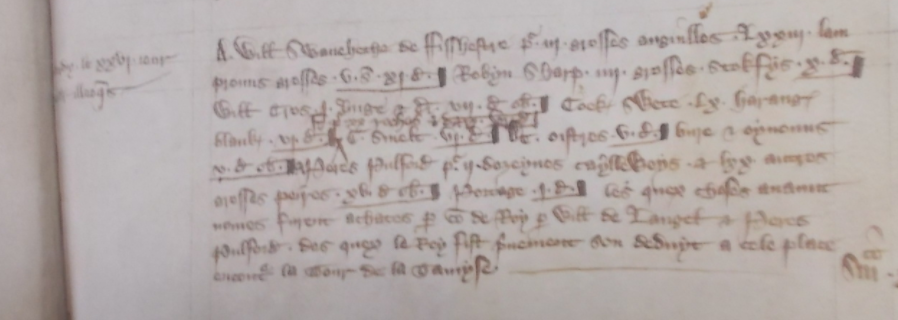
Edward, who was now forty years old, held a parliament in London from 20 October to 10 November 1324. An entry in his chamber account, dated 26 October 1324 during this parliament, states that the king crossed the River Thames from the Tower of London to La Rosere, and fist p[ri]uement son deduyt a cele place encont[re] la Tour, "secretly took his pleasure in that place opposite the Tower" or "privately made love in that place opposite the Tower". Another entry a couple of days later states that a man named Robin Carter was given two shillings because he "came promptly to the Tower with his boat to bring the king across the Thames to the place which the king bought there". [The National Archives E 101/380/4, fos. 19r, 20r] The intriguing statement about lovemaking appears at the end of what I thought at first was a rather tedious entry about buying fish. It turns out that two of Edward's clerks, William Langley and Piers Pulford, who compiled this account which is now held in the National Archives, recorded the purchase of eels, lampreys, stockfish, unsmoked herring, oysters, roach and smelt, plus butter and onions, for the king and the other person to share after they made love. The fishermen who sold the fish and seafood were called, for the record, Wille Swayncherche, Robyn Sharp, Wille Cros and Cock Swete (I kid you not). Oooooh, this was an exciting find.

Pic below: large eels, 10d for four large stockfish, herring, 5d for oysters, smelt, onions, OK, yeah yeah, this isn't very exciting, just a typical purchase of fish and seafood, le Roy fist p'uement son deduyt...wait, WHAT?!

Faire son deduit, or deduyt or dedoit, is translated in the online Anglo-Norman Dictionary - which, incidentally, is a terrific resource for which I'm very grateful - as "to have one's pleasure (of a woman)". Edward's crossing of the Thames to La Rosere was dated several months before Queen Isabella departed for her homeland in early March 1325, but as the king made love 'secretly' or 'privately' or 'discreetly' (priuement), Isabella surely cannot be the person in question. Whether the royal couple had much of a sex life after 1322, when their marriage began to go wrong, is a question we will never be able to answer. Their youngest child, Joan of the Tower, was born in July 1321; that they had no more children after this year, when Edward was thirty-seven and Isabella was twenty-six, might mean that the fertility of one or both of them had declined, or it might mean that their intimate relations had become sporadic or non-existent. As for Hugh Despenser the Younger, as royal chamberlain he was the boss of the two clerks of the royal chamber who wrote this account, and he would have been mentioned if it had been he who crossed the Thames to La Rosere with the king. And, as the Anglo-Norman Dictionary states, the phrasing used almost certainly means that Edward II's lover was a woman.

Edward had a household of something like 500 people; he had a bodyguard of eight or more archers around him all the time; he had numerous valets, pages, clerks, knights, ushers, squires, sergeants-at-arms, marshals and so on; he must have been surrounded by people at just about every moment. There's evidence that six of Edward's chamber valets slept inside his chamber, or at the very least just outside: in 1326, they were paid for waking up at night every time that the king himself awoke. Another six men, four of the king's sergeants-at-arms and two ushers, were meant to sleep just outside the door of his bedchamber, according to Edward's Household Ordinance of December 1318. Many of Edward's servants must, therefore, have known exactly when, where and with whom the king had intimate relations. Privacy was all but impossible for him, and of course for other medieval royals for the same reason.

It's really interesting therefore to note that during the parliament held in the autumn of 1324, Edward II left his entire enormous household behind in the Tower where he stayed from 16 to 28 October, and crossed the river to a house he'd only very recently acquired, in order to make love with someone secretly or privately or discreetly. Evidently, he didn't want anyone, besides his two clerks, to know who he was having sex with. Who the heck was it? Alas, William Langley and Piers Pulford were too discreet to say, or perhaps didn't even know.

In her Sexuality in Medieval Europe: Doing Unto Others (third edition, 2017, pp. 4-5), Ruth Mazo Karras points out the gendered nature of intimate language in the Middle Ages. In modern English, the words 'make love', 'have sex' and 'f*ck' are words we can use about both men and women; we can say 'she f*cked him' or 'she had sex with her' or whatever. The words imply something we do with someone, not to them. In contrast, the Middle English word swive(n), i.e. to have intercourse, meant something a man did to a woman. Karras also gives the example of the modern French word foutre, which means 'to f*ck' and like in English can refer to both men and women, but in medieval French, meant 'to penetrate' and was also only used to talk about what a man did to a woman. This is the reason, Karras says, that the subtitle of her book is Doing Unto Others; medieval people generally understood sexual acts as an active subject, inevitably a man, doing something to a passive object, almost inevitably a woman. The Anglo-Norman Dictionary translates faire lur deduit, literally 'make their pleasure', as 'to make love', i.e. this was something that two people did together, taking their pleasure, together. By contrast, the phrase used in Edward II's account of October 1324 is faire son deduyt, which literally means 'make his (sexual) pleasure' and is an example of a gendered phrase: something that Edward, as a man, is doing to someone, a woman.

The Westminster Abbey chronicle Flores Historiarum thundered in its account of events in 1324 that Edward II enjoyed "illicit intercourse [or copulations], full of sin" (concubitus illicitos peccatis plenos). It goes on to say that for this reason, Edward removed Queen Isabella and her "sweet conjugal embraces" (dulces amplexus conjugales) from his side. [Flores Historiarum, ed. H.R. Luard, vol. 3, p. 229] Although this may simply be a coincidence, Westminster Abbey is only a couple of miles from the Tower of London, from where Edward sneaked off to meet a lover secretly; perhaps the author of the Flores heard rumours.

The nature of Edward II's sexuality is something that can be endlessly debated, and it's impossible ever to know for certain. We have no way of knowing what Edward thought of his own sexuality, and there is no way of proving who he had sex with and when, unless the sexual act was procreative: we know he must have had intercourse with Queen Isabella approximately nine months before the births of their children, and we know he must have had intercourse with the unidentified woman who was the mother of his illegitimate son Adam. That's all that we can ever know for sure, however likely we think it might be that he had sex with Piers Gaveston and Hugh Despenser the Younger, and perhaps with Roger Damory and Hugh Audley. One assumes that Edward, born as the son of a reigning king and heir to his father's throne from the age of four months, was entirely accustomed to the lack of privacy in his life, and accustomed to the reality that many people would have known when he took a person to bed. He was, however, keen to keep the identity of the woman with whom he made love at La Rosere in October 1324 hidden, and we can only speculate as to the reasons for that.

Although Edward II is sometimes depicted in modern writing as a gay man who would have shunned sexual intercourse with women - and who therefore cannot possibly have been the father of Queen Isabella's children - we know that he had a sexual relationship with a woman sometime around 1305/10 which resulted in their son Adam (d. 1322). That Edward acknowledged Adam as his child indicates that this relationship was one of some duration and seriousness: after all, if a man has a one-night stand with a woman he's never met before, and a few weeks later she seeks him out and says "I'm pregnant and it's yours", if he doesn't know her, how can he be sure that the child really is his? And here in October 1324 is an example of the forty-year-old king having sex with another woman, a woman he didn't have to have sex with (i.e. unlike the queen, she was never going to be the mother of his heirs) but did have sex with, because he wanted to. Another fact to slot into the life of this complex man, and a reminder that the simplistic narratives about him created by many modern writers are just that: simplistic narratives that don't come anywhere close to the reality of who Edward II was.

14 February, 2021

The Relationship of Queen Isabella and Roger Mortimer (3)

First part; second part. In the last post, I looked at what chroniclers said about Isabella of France and Roger Mortimer's relationship, and also what lots of them didn't say about it. Evidence that their association was flagrant and scandalous, as so often claimed by later writers, is decidedly lacking, and if the two were lovers, it seems vastly more likely that they were very discreet.

Also on the subject of what people didn't say about their relationship, if Isabella and Roger's adultery was so notorious and blatant while they were in France in 1325/26 and it was widely known that they were involved sexually and romantically by Christmas 1325, as is often stated, it's hard to understand why Isabella's cousin Philip VI never used her adulterous affair as a weapon against her son Edward III. After all, Philip was there while Isabella was at her brother Charles IV's court supposedly flaunting her affair with Roger Mortimer in front of everyone, and Edward III claimed Philip's throne in 1337. The French cooked up some pretty desperate propaganda to discredit Edward III, most notably a claim that he'd raped the countess of Salisbury. [1] Wouldn't his mother's adultery have been a really obvious weapon to use? Wouldn't Philip have tried to embarrass Edward with his mother's scandalous behaviour, and furthermore, suggested that Edward might not be Edward II's son and therefore not even the rightful king of England, never mind king of France? But Philip VI never said a word about Isabella's alleged adultery.

Isabella's uncle Henry of Lancaster, earl of Lancaster and Leicester, led a brief and unsuccessful revolt in late 1328 and early 1329, and cited his points of dissatisfaction with the governance of Isabella and Roger Mortimer during Edward III's minority. Henry's complaints appear in the Plea and Memoranda Rolls of London, and he said a great deal about the bad advice to which the underage Edward III was being subjected, his (Henry's) quarrel with Roger Mortimer, the question of Philippa of Hainault's dower and much else, but not a word about Isabella's reliance on Roger or about their private relationship. [2] No-one ever claimed that Edward III was not Edward II's son until the late twentieth century, and it seems odd, if Isabella was known to have committed adultery, that rumours didn't spread in their own lifetimes. After all, if Isabella was known to have had sexual relations with Roger Mortimer in and after 1325/26, some people might have thought that she slept with him, or with another man, a few years earlier as well. Even the contemporary chroniclers who said they'd heard rumours of Isabella and Roger's 'liaison' never cast the slightest doubt on Edward III's paternity, which perhaps leads one to wonder if they truly believed the rumours. Another question that occurs to me: would Isabella have had as much support from the English bishops in and after 1326 as she did if she'd been parading her adulterous affair with Roger? It's all very well saying they knew about the affair but just ignored it, but would they really have done that? Would chronicler Jean le Bel have said that Roger Mortimer "more than anyone was suspected of being the father" of Isabella's alleged unborn child in 1330 if their sexual relationship was known to everyone? If their affair was so notorious, who else was going to be the father? I don't really think that "Oh, but people didn't dare to talk about the queen's adultery and therefore they kept silent" as an explanation of chroniclers' reticence on the subject is much of an argument. We could argue till the cows come home what chroniclers and others might have said about anything, but the evidence we have is the evidence we have.

Pic below: one writer a few years ago, stating that "Queen Isabella was an acknowledged adulteress." Oh really? Acknowledged by whom? Herself? Nope, never. Or is there some kind of committee that officially acknowledges adulteresses? And Edward II "may have been the father of his supposed offspring." Oh, such generosity. This is really insulting to Isabella too, to suggest that a woman with her profound and even sacred sense of her own royalty might have been willing to foist a child she had conceived with a non-royal man on the throne. This is yet another example of what I talked about in the last post, where the idea that Isabella was an "adulteress" is elevated to the status of a certain fact and treated with the reverence often accorded to Holy Writ. There's a constant assumption that because Isabella was a woman and Roger was a man, their relationship must have been romantic and sexual. The idea that they might have been close political allies and not lovers at all, at least in the early stages of their association, is almost never considered.


Thomas Costain's perenially popular The Three Edwards states that it is all but certain that Isabella and Mortimer first met in the Tower of London in 1321. Hahaha, no. Roger attended Isabella's wedding to Edward II in Boulogne on 25 January 1308, and at their coronation a month later, he played an important role in the ceremonial procession into Westminster Abbey: he and three other men carried the royal robes. Roger spent much of his career in the 1310s in Ireland, so he and the queen probably didn't come face to face that often, but charter witness lists show that he visited court on occasion, and obviously Isabella would have known exactly who the lord of Wigmore was long before 1321. A lot of novels, weirdly, follow Costain's idea and have Isabella and Roger first being introduced in the Tower when he's a prisoner there.

There's also a common idea that Isabella began her affair with Roger Mortimer in the Tower of London, shortly after she supposedly first met him there. This idea comes from a misreading of dates: Isabella gave birth to her youngest child, Joan, later queen of Scotland, in the Tower on 5 July 1321, and Roger and his uncle Roger Mortimer of Chirk were imprisoned in the Tower on 13 February 1322. An earlier generation of historians misdated either the birth or the onset of the imprisonment and thought that Isabella and Roger were in the Tower at the same time, and that somehow this was evidence for the beginning of their passionate sexual relationship. Because as we all know, women who have just given birth are famous for being really keen to begin a passionate sexual relationship with a new lover, and any two people who are in the same place at the same time are bound to have sex together. And you know, the Tower of London is a pretty darn big place, a massive sprawling fortification with lots of towers; I think there were twenty-one in the 1300s, or something like that. The royal apartments were absolutely nowhere near the prison cells, and there were workshops within the Tower grounds, where carpenters, masons, armourers, etc were at work, so there were always lots of people coming and going. One novel, hilariously, has the queen of England sneaking off to have sex with Roger in his prison cell, and no-one ever notices, because - get this - she wears a cloak with a hood. Obviously, she stole Harry Potter's invisibility cloak.

Other than one medieval French chronicle, the playwright Christopher Marlowe (1564-93), in his c. 1592 play about Edward II, was the first person to suggest that Isabella was involved in Roger Mortimer's escape from the Tower on 1 August 1323. [3] There's no evidence whatsoever that she helped him escape or that he was important to her in any way back then, and to my mind the notion that they were plotting against Edward II together as early as 1322/23 is merely hindsight, projecting knowledge of their relationship back several years, coupled with a romantic wish that Isabella had always loved Roger and helped him escape to fight another day. On 17 February 1323, while staying in the Tower, Isabella sent a letter to the treasurer of England, Walter de Norwich, about Roger's wife Joan Geneville. Since Roger's own arrest in early 1322, Joan had been held under house arrest with eight servants, and the queen asked the treasurer to ensure that she received the money allocated for her own and her servants' sustenance as promptly as possible. This has often been taken as proof of Isabella's collusion with Roger Mortimer, but the rather inconvenient fact is that she was staying in the Tower with Eleanor Despenser, niece of Edward II and wife of Hugh the Younger, and Eleanor sent the same letter about Joan's money, almost exactly word for word, also on 17 February 1323. [4] So if we take the queen's letter as evidence of her plotting against her husband with Roger, presumably Eleanor was also plotting with him against her husband and uncle. This doesn't seem terribly likely.

Edward III's arrest of Roger Mortimer in Nottingham Castle on 19 October 1330 is also very often misunderstood. Not long ago, someone snapped at me on social media that it's absurd to think that Roger and Isabella might not have been lovers when the king and his friends caught them together in Isabella's bedchamber. Um. No. They weren't alone in Isabella's bed, being intimate, but were having a meeting with their few remaining allies, including Roger's son Geoffrey Mortimer and the bishop of Lincoln, Henry Burghersh.

I think a lot of people nowadays assume that Edward II and Isabella of France's relationship was nothing but tragically awful and disastrous from start to finish, which is wildly inaccurate anyway. Then they assume that Isabella and Roger's relationship must necessarily have been the exact opposite of that, and write Isabella as though she's a fictional character escaping an unsatisfactory marriage into a wonderfully fulfilling affair. It's become an extremely popular interpretation, but that doesn't make it true. Isabella, Roger and Edward were real people, not fictional characters, and certainly not archetypes marked 'Abusive Gay Husband', 'Adoring Straight Lover' and 'Sad Lonely Heroine In Need Of A Real Man's Love'. Their lives were their own and were messy and complicated, not the plot of a romance novel where Edward makes Isabella endlessly unhappy until Roger emerges stage left to show her what true love and sexual satisfaction are. 

The complex politics of the 1320s, the aftershocks of the Contrariant rebellion, Edward II's incompetence, his complicity in Hugh Despenser the Younger's tyranny and extortion, all the rest of it, are reduced to a fairy-tale about a neglected woman and her adoring lover. Roger here also appears not as a person in his own right, but simply as The Hetero Lover, the anti-Edward II who is claimed to have been "everything that Edward II was not" and who later becomes the unscrupulous villain who makes Isabella do bad things and thus becomes The Scapegoat. Where is Isabella's agency? Where is the powerful, awesome politician who brings down a king? Nowhere; Isabella is treated as little more than the simpering heroine of a 1950s Mills and Boon romance who "succumbs to the strong and lusty adventurer" and "surrenders herself to the embraces" of her strong, manly, virile lover. This panting Victorian nonsense was published in the twenty-first century. Give me strength.


To claim that Edward II of all people, the man who was called "one of the strongest men in his realm" by chroniclers, was not strong makes clear that this narrative has little to do with reality. And now could anyone 700 years later possibly know whether Roger Mortimer was "unequivocally heterosexual" or not? There are people I know really well and talk to a lot, and I wouldn't have the faintest clue if they're "unequivocally heterosexual" or not.  

Another assumption is that Isabella, now madly in love and lust with the wonderful strong manly virile audacious superlatively heterosexual lover who gives her great orgasms or whatever, automatically now despises Edward II ("it is easy to understand that Isabella could feel nothing but profound revulsion for her husband"). This appears to be a classic case of projection, and is a simplistic way of understanding human relationships, as though Isabella was capable of feeling only one emotion for the man who was her husband for almost two decades and was the father of her children. And who was as royal as she herself was. Let's not forget that Isabella of France was a woman with a strong and sacred sense of her own royalty. Although of course she was a human being too, with needs and desires, her profound sense of her royalty is often dismissed or underestimated. And yes, I know perfectly well that a century later Katherine de Valois, daughter of the king of France and widow and mother of kings of England, had a long-term sexual and romantic relationship with Owen Tudor, a squire. I'm not talking about Katherine de Valois; I'm not claiming that no queen who has ever lived on this planet could possibly commit adultery or fall in love with a man well beneath her in rank. I'm talking about Isabella of France, specifically, as an individual. I'm not quite sure that "Oh, you see, this person did something, so a completely different person a century earlier might have done it too" is much of an argument, even though people have often made that argument to me.

For what it's worth, my feeling is that at first, in 1325/26, Isabella and Roger were political allies whose goals coincided; they, Roger's Contrariant allies such as John Maltravers and William Trussell, and untold numbers of people in England, desperately wanted to bring Hugh Despenser the Younger down. This achieved, it became obvious that Edward II's support had collapsed and that he could no longer continue to be king, and Isabella kept Roger as her adviser through the unprecedented times that followed. I  personally doubt that Isabella slept with Roger while Edward II was alive or at least still officially alive, i.e. until September 1327. Once she was a widow, or at least officially a widow, she might have been more open to a sexual or romantic relationship of some kind with Roger. If they did, they must have been reasonably discreet, and maybe their intimacy was only occasional. I have no doubt that Isabella had feelings for Roger, feelings of trust and affection, and perhaps more, though whether she was ever in love with him is impossible to know for certain. Roger's own feelings are also impossible to assess with any degree of certainty. Given how much he got out of his relationship with the queen, e.g. granting himself a grandiose earldom, arranging marriages for his daughters with the most eligible heirs in the kingdom, becoming involved with politics at the highest level, and so on, it would seem a mighty coincidence if he just happened to fall madly in love with Isabella in late 1325, just as one would reasonably doubt that Hugh Despenser just happened to fall madly in love with Edward II in c. late 1318. I'm sure that Isabella of France trusted Roger Mortimer and had genuine feelings for him. Whether those feelings included passionate lust and passionate love, I'm not at all convinced, and the notion that Roger loved Isabella passionately doesn't convince me either. To me, Roger Mortimer's marriage of almost three decades to Joan Geneville, the often forgotten woman who bore him a dozen children and supported him loyally through thick and thin, is a far more appealing love story than fantasies about an "unequivocally heterosexual" baron seducing a cruelly neglected queen.

Sources

1) Antonia Gransden, 'The Alleged Rape by Edward III of the Countess of Salisbury', English Historical Review, 87 (1972), pp. 341, 344.

2) Calendar of Select Plea and Memoranda Rolls of the City of London, ed. A.H. Thomas, vol. 1, pp. 77-83.

3) Seymour Phillips, Edward II, p. 490.

4) The National Archives SC 1/37/45 is Isabella's letter; SC 1/37/4 is Eleanor's.